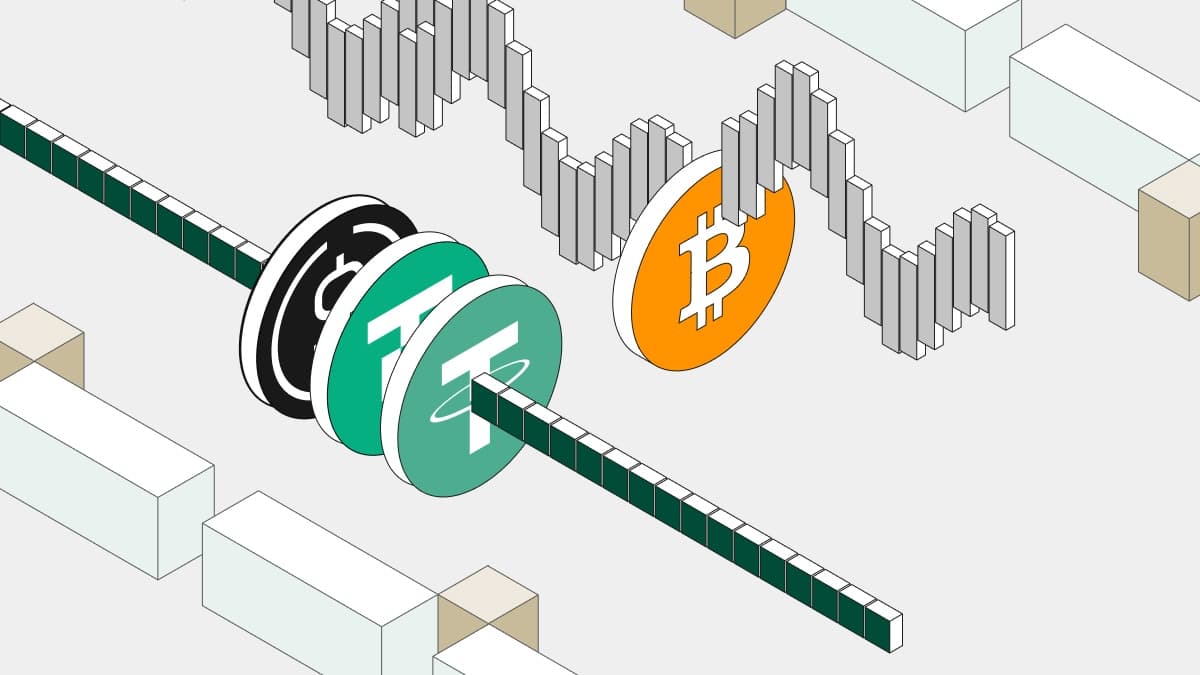
Bitcoin and stablecoins share the same technological foundation, but they solve different problems for different types of users. Knowing the difference between the two is essential for making informed decisions in today’s evolving crypto landscape.
The main differences between stablecoins and Bitcoin are:
Price swings
What they’re used for
How they’re made
Who’s in charge
Where they work
Their role in DeFi
Who controls their money supply
In this article, we explore the main differences between Bitcoin and stablecoins to help determine which asset type best suits your needs. The focus is on clear, practical explanations of the stablecoins vs. Bitcoin discussion.
Key Takeaways
Bitcoin, the original cryptocurrency, is often seen as “digital gold” and is known both for its volatility and its potential as a store of value
Stablecoins are digital cash, designed to hold a stable value, typically pegged to fiat currencies like the U.S. Dollar, and built for smooth, everyday payments
Rather than stablecoins vs Bitcoin, both play different roles in the digital economy and are often used side by side.
What is Bitcoin?
Key features of Bitcoin
Bitcoin is fully decentralized and runs on an open, global network of independent miners and nodes. There’s no single company, governance board, or entity in charge. Only 21 million bitcoins will ever exist. This finite cap makes it scarce like gold, but based on code. This scarcity makes it a popular store of value.
Transactions on the Bitcoin network are practically immutable and completely transparent. Once confirmed, they’re set in stone. Anyone can check the ledger and verify any information for themselves. This has created a system where trust is no longer required and security is robust.
Primary use cases of Bitcoin
Many people treat Bitcoin as a long-term hedge against inflation or volatile fiat currencies. In this use case, it is held, not spent. Peer-to-peer payments are easy to do, but Bitcoin’s price volatility makes it less practical than stablecoins for day-to-day purchases and transactions.
Since Bitcoin launched in 2009, it has always held the reputation of being a speculative investment, with traders buying and selling to profit on its price fluctuations. This is a significant market driver, yet it comes with inherent risks.
What are Stablecoins?
Key features of Stablecoins
Arguably the most important feature of stablecoins is their price stability. They are designed to maintain a 1:1 peg with their underlying asset, which is typically USD, but there are also stablecoins for EUR, GBP, Gold, Silver, and more. They are typically not decentralized.
Stablecoins facilitate fast and low-cost transfers across many global markets, making them ideal for payments. Reputable and regulated issuers now hold and regularly provide verifiable reserves, building trust with users.
Types of Stablecoins
Fiat-backed stablecoins
This is the most common type of stablecoin. They are backed by traditional fiat currencies, like USD, and EUR. Simple, reliable, and centralized.
Commodity-backed stablecoins
The value of a commodity-backed stablecoin is anchored to tangible assets. This could be gold, silver, oil, or even real estate. They are used primarily as a hedge against inflation.
Crypto-backed stablecoins
These are stablecoins that are over-collateralized by other cryptocurrencies, such as Ethereum (ETH), and which deploy auto-adjusting smart contracts to maintain their peg. DeFi native, but riskier.
Algorithmic stablecoins
No reserves? No problem. By using a combination of complex algorithms and smart contracts to mint and burn assets, algorithmic stablecoins maintain their peg without direct asset backing (in theory).
Hybrid stablecoins
Part collateral, part code. Hybrid models typically combine elements from different types of stablecoins. This is achieved by using a mixture of fiat currency, cryptocurrency, and algorithms to maintain stability and reserves.
Yield-bearing stablecoins
To avoid having stablecoins sit idle, these are stablecoins that can actually auto-generate returns through innovative lending protocols or staking platforms.
Stablecoins vs Bitcoin: The 7 Main Differences
Price volatility
Bitcoin is famous for its high price volatility, with its value known to fluctuate dramatically within short periods. This is great for investors and speculators, but not great if you want to pay your rent with it.
Stablecoins offer the opposite use case. They are designed to stay flat and safe, offering minimal price volatility. They simply mirror the price changes of the underlying asset through their peg. So, if you need to send $100 and want it to be worth $100 when it arrives, stablecoins are ideal.
Purpose and use cases
Bitcoin’s primary functions are as a store of value and a speculative investment. Buy it, hold it, and hope that it grows in value. This has earned it the moniker “digital gold”.
Stablecoins are built for payments, remittances, and trading. They were introduced as a safe asset or “parking space” for cryptocurrency traders to hold when not trading volatile altcoins. They quickly became a critical part of the decentralized finance (DeFi) ecosystem and crypto’s daily economy.
Now, stablecoins are being used around the globe for much more than just cryptocurrency trading. They’ve been integrated into payment systems, payroll platforms, remittance services, investment banking, and much more.
Supply mechanisms
Bitcoin has a fixed supply of 21 million coins. No more, ever. It is this scarcity that continues to drive its demand and value.
Stablecoin supply is far more elastic. It can auto-adjust, using minting when demand rises, and burning when it falls. This mechanism ensures that stablecoins can theoretically always maintain their 1:1 peg.
Trust and management models
Zero trust is needed. That is thanks to Bitcoin’s designer, the pseudonymous cryptographer Satoshi Nakamoto. Cryptographic proofs (math) and a large distributed network (miners) make the network incredibly secure and logistically unattackable.
Fiat-backed stablecoins use trusted centralized issuers who hold their reserves. Other stablecoin types, such as crypto-backed and algorithmic, may offer some degree of decentralization. Trust in algorithmic stablecoins has been low since Terra collapsed, erasing about $50bn.
Interoperability across blockchains
Bitcoin exists on its own blockchain, making its direct interoperability with other chains limited. This pushed developers to create “wrapped” Bitcoin, tokenized Bitcoin, and other innovative types of interoperable Bitcoin that create new opportunities for traders.
Stablecoins are widely supported across many popular blockchains and being connected to most decentralized applications (dApps). They have become the default currency of DeFi, going wherever they are needed.
Role in DeFi
Through wrapped versions of Bitcoin on other chains, as well as innovations like Runes, Ordinals, and the Lightning Network, Bitcoin’s role in DeFi is expanding. Many developers believe Bitcoin’s robust security model is a solid foundation to build on, despite limited use cases.
Stablecoins are central to most DeFi activity. They provide a stable base for lending, borrowing, trading, and yield farming. Ultimately, they represent a familiar and reliable currency, giving users confidence to engage with DeFi applications, tools, and financial products.
Monetary policy and control
Bitcoin’s monetary policy is fixed, transparent, and determined by code. Without an almost-impossible consensus, or an impractical 51% attack costing many billions of dollars, it is unchangeable.
For most stablecoins, monetary policy is controlled by centralized issuers. Typically, this just goes as far as minting and burning to maintain the peg to their underlying asset, but some issuers can hit pause in emergencies (like de-pegging).
Value Models Compared
Bitcoin: Value through scarcity
Bitcoin’s value is driven, in part, by its finite supply of 21 million coins. This scarcity creates a store of value that is seen by many as an inflation hedge. Its price increase over time also reflects market sentiment and growing adoption from governments, institutions, businesses, and individuals.
Stablecoins: Value through pegged stability
The value of a stablecoin depends on its ability to peg to stable assets like fiat currencies or commodities like gold and oil. It is designed as a tool and a reliable medium of exchange, not as a speculative investment. $1 today. $1 tomorrow. That’s their function.
Safety and Risks
Counterparty risk
When it comes to Bitcoin, its decentralized design means that there is no counterparty risk. You own your keys and your coins. It is your personal responsibility to protect your private keys, not the network’s.
As for fiat-backed stablecoins, there is counterparty risk related to the issuer and their reserves. Though audits can mitigate this, they are not perfect. This means that trust is required, as someone could feasibly fumble the reserve and create a de-pegging incident (example: SVB).
Algorithmic stablecoins have inherent smart contract risk and have been known to lose their peg when the algorithm fails. The stakes are much higher, and confidence is much lower. Many millions of people were affected by Terra’s collapse.
When comparing stablecoins and Bitcoin, it is worth understanding the different risk profiles and how they align with your own tolerance for risk.
Price stability vs volatility
Bitcoin’s high volatility is a significant risk for those seeking stable value, as prices can crash quickly. Investors must be fully aware that this coin’s price can swing wildly before they start acquiring it.
While stablecoins are not entirely immune to “de-pegging events”, they do generally aim to eliminate price risk by maintaining price stability. If a stablecoin does lose its peg, it can lead to significant losses for holders. Most stablecoins, even if they briefly lose their peg, will quickly recover.
Stablecoins are generally better suited for users who prioritise price predictability, while Bitcoin will appeal more to those who are comfortable with significant volatility.
Regulation and oversight
Freedom to some, risk to others. Bitcoin’s decentralized nature makes it difficult to regulate, but that hasn’t stopped governments from exploring their options. Over time, many have chosen instead to embrace Bitcoin and even consider strategic national cryptocurrency reserves.
Stablecoins are under heavy scrutiny from regulators owing to their accelerating importance and adoption in society. The GENIUS Act (U.S.), FSMB (UK), and MiCA (EU), all introduced in 2025, are arguably the most important pieces of stablecoin legislation established so far.
Regulation can help drive legitimacy and adoption, but it also enables issuers to freeze assets or restrict access, which some users view as a form of censorship.
Which is Better for Payments and Settlements?
When it comes to payments and settlements, stablecoins tend to be a better choice than Bitcoin. The reason is in the evidence. Stablecoins maintain a steady value so that you don’t need to worry about price swings between sending money and its being received.
Stablecoins are typically issued on blockchains that process transactions faster and cheaper than the Bitcoin network.
Through widespread adoption and payment integrations, stablecoins are now widely accepted at point-of-sale, both online and in physical stores. They are also widely used for remittances (sending money across borders).
Bitcoin’s volatility, lower speed, and higher network fees have all made it less convenient as a tool for payments and settlements. That being said, there are still many merchants and payment processors globally that will accept Bitcoin as payment.
Conclusion
Understanding the differences between stablecoins and Bitcoin is important for anyone active in crypto.
Bitcoin is great as a decentralized store of value, even if its price can fluctuate a lot. Its long-term performance has helped create a loyal community who see it as a potential hedge against inflation.
Ultimately, both Bitcoin and stablecoins serve important, yet distinct purposes in the expanding digital economy.