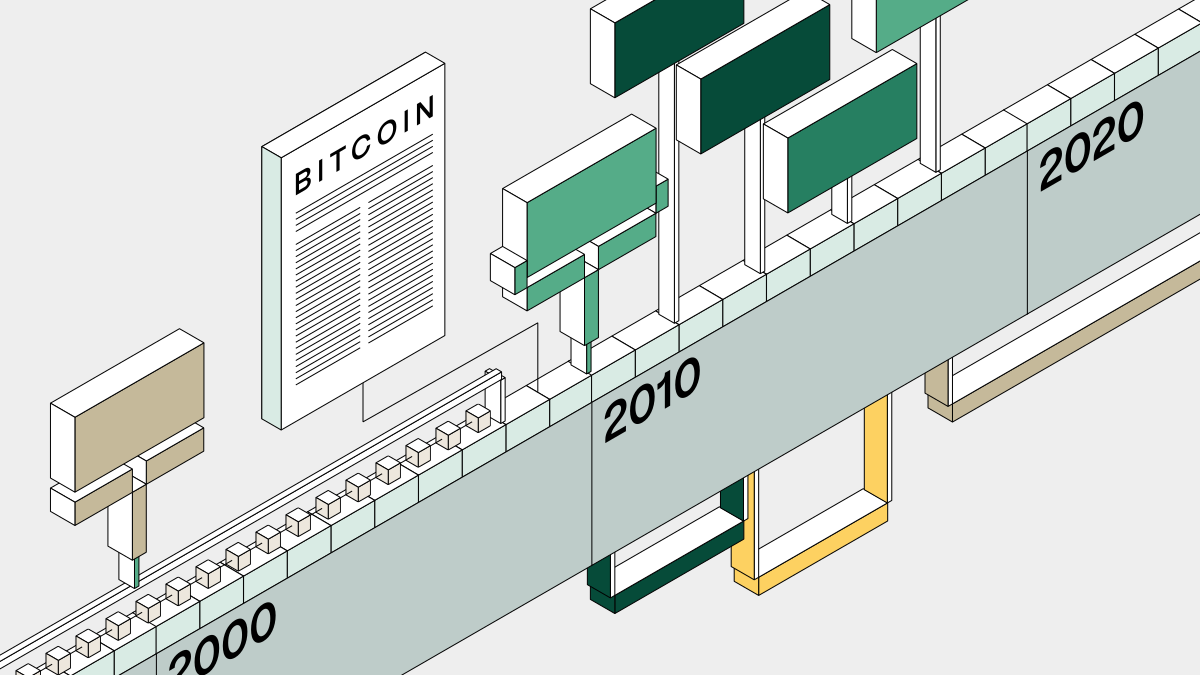
The invention of the blockchain is widely attributed to Satoshi Nakamoto, a pseudonymous figure who proposed Bitcoin in a 2008 whitepaper. This technology, however, didn’t just appear out of thin air.
The blockchain was first mooted in foundational cryptography and consensus, which laid the intellectual groundwork for its creation. Nakamoto later combined a series of pre-existing ideas in a novel way to solve long-standing digital and financial problems.
To truly understand this invention, we need to trace its origins. We will start in the 1970s and work our way forward. Keep reading to discover the pioneer technologists, the critical innovations and breakthroughs, and why this history matters.
Key Takeaways:
The blockchain was not an overnight invention, but rather the result of decades of work by countless cryptographers and computer scientists.
Satoshi Nakamoto’s primary contribution was solving the “double-spending” problem and creating the first practical blockchain with Bitcoin.
The technology has now evolved far beyond Bitcoin, with Ethereum and other smart contract-based blockchains ushering in an era of decentralized applications and use cases.
Why Blockchain’s Origin Story Matters
Understanding who invented blockchain first provides us with a clearer insight into its core original purpose, to serve as a decentralized, peer-to-peer system that could restore trust in finance after it had been lost.
The 2008 financial crisis and the fragility it exposed in centralized institutions proved to be the perfect breeding ground for decentralized idealists and a new financial system. Considering this, Bitcoin could not have come at a better time.
This story matters because it combines human innovation, collaboration, and research to unlock a technological era that affects the global economy every day.
The Early Foundations of Blockchain
Cryptography and Digital Record-Keeping in the 1970s-80s
Long before the word “blockchain” became part of our everyday vocabulary, cryptographers were exploring and researching similar concepts. They wanted a secure way to timestamp digital documents and prove that something existed at a certain time.
Just consider how easy it is now to change a digital file without a trace. This was the problem, yet these early pioneers believed they could find a solution within cryptography to deliver tamper-proof digital records. Ultimately, however, they were missing a crucial piece of the puzzle.
Stuart Haber and W. Scott Stornetta: The First Blockchain Prototype (1991)
Back in 1991, two Bell Labs researchers by the names of Stuart Haber and W. Scott Stornetta published a groundbreaking whitepaper. Within it, they described a cryptographically secure “chain” of “blocks”. This caught the attention of other researchers.
The premise was that each “block” contained a timestamp and a link to the previous block, forging an immutable chain. This was really the first prototype of what we now consider a “blockchain”.
Their work helped cryptography turn a corner and also proved instrumental to Satoshi, who cited three of Haber and Stornetta’s papers within the Bitcoin whitepaper.
David Chaum and DigiCash: A Precursor to Cryptocurrency
Haber and Stornetta are joined in blockchain lore by David Chaum, a cryptographer who founded DigiCash back in 1989. Chaum was determined to create a form of digital cash that was both private and secure. He almost succeeded.
DigiCash used “blind signatures” to enable untraceable payments. This is different from a blockchain, as it doesn’t rely on a decentralized ledger. It does, however, mark the first introduction of cryptographic digital money, an important chapter in the story.
Poor timing largely led to DigiCash’s downfall, as the network launched before the e-commerce boom, leading to a lack of merchant acceptance and user adoption. This “chicken and egg” problem later caused its bankruptcy in 1998.
Who Invented Blockchain?
The Debate Over “Inventor” vs “Pioneer”
With so much foundational work done, “Who invented blockchain?” becomes a question with a nuanced answer. No single name can claim it, and so we switch to terms like “pioneer” and “architect” to acknowledge that each innovation and iteration was building on someone else’s ideas.
Haber and Stornetta invented the core mechanism, Chaum pioneered digital cash, but it was Satoshi Nakamoto who architected a solution that combined them.
Satoshi Nakamoto and the Bitcoin Whitepaper (2008)
Solving the Double-Spending Problem
The biggest challenge for digital currencies was the “double-spending” problem. Since digital files can be copied, how do you prevent someone from spending the same digital currency twice? This was yet to be resolved.
Satoshi presented a brilliant solution. He proposed a decentralized, peer-to-peer network, where all transactions are broadcast and recorded in a public ledger. With this “Proof-of-Work” system, the entire network could agree on a single, shared history. This prevented fraudulent transactions.
Launch of the Bitcoin Blockchain (2009)
Then, on January 3, 2009, the idea became reality. Satoshi mined the “Genesis Block” of the Bitcoin network. The very first transaction embedded a message in the block "The Times 03/Jan/2009 Chancellor on brink of second bailout for banks."
The symbolic message referenced the UK newspaper “The Times” and reflected Satoshi’s critique of the existing financial system. It suggests Bitcoin was intended as more than a technical experiment.
Blockchain Innovations After Bitcoin
Separation of Blockchain From Cryptocurrency
For several years, the blockchain was synonymous with Bitcoin, and it was largely enjoyed by a small community of “cypherpunks” and counterculture cryptographers. With time, however, some began to see opportunities for further blockchain applications beyond finance.
The separation of ledger and currency was a significant moment. It was this split that paved the way for countless new applications and for almost every industry globally to adopt decentralized ledger technology in some form. Innovation and novel applications have since sped up.
Ethereum and the Rise of Smart Contracts
In 2013, another cryptographer, Vitalik Buterin, proposed Ethereum. This blockchain launched in 2015, with Ethereum taking the concept of a blockchain and upgrading it with “smart contracts”.
These self-executing contracts included the terms of agreement directly into their code, enabling developers to start building decentralized applications (dApps). These smart contracts opened the door to a wide range of new applications and drove significant experimentation and adoption.
Proof-of-Work vs. Proof-of-Stake Models
The earliest blockchains, with Bitcoin as the primary example, utilized a consensus mechanism called “Proof-of-Work” or PoW. This relies on a network of “miners” to solve complex puzzles using specialized hardware to validate transactions. While ultra-secure, it proved energy-intensive.
Energy concerns and low scalability nudged newer blockchain builders towards another consensus mechanism called “Proof-of-Stake” or PoS. This model uses participants who collateralize their coins as its validators. It marked a progressive step in blockchain sustainability and scalability.
Scaling Solutions and New Blockchain Generations
Alongside blockchain adoption growth came increased demands for faster and cheaper transactions. Scalability became a top priority.
Solutions like Layer 2 networks, sidechains, and alternative consensus mechanisms have all improved blockchain “throughput” (the number of transactions it can handle in a given timeframe), while attempting to mitigate the potential sacrifices made to decentralization or security.
Blockchain’s Expanding Role Beyond Finance
Supply Chains and Logistics
Immutable record-keeping is particularly useful for supply chains, allowing them to track products from origin to destination, or “farm to table”, boosting transparency and authenticity. From food to pharmaceuticals, it’s preventing fraud and improving efficiency, both helping to boost consumer trust.
Healthcare and Digital Identity
Secure storage and responsible patient data sharing practices have been concerns within the healthcare industry for decades. The blockchain changes that, handing patients their own data and the choice to grant access to whichever doctors or hospitals they choose.
In a similar vein, “self-sovereign IDs” have emerged as a digital ID concept that gives individuals full control over their personal information, sharing what they like, when they like, with no centralized authority able to decide otherwise.
Intellectual Property, Copyright, and Royalties
Creators can use the blockchain to timestamp their work and verify ownership, while the added layer of smart contract functionality enables automated royalty distribution and payments. Artists using the blockchain can get fairer and more immediate compensation than with traditional methods.
By reducing reliance on intermediaries, these new decentralized models can give creators more direct control over how they are paid for their work.
Governance and Enterprise Use Cases
The blockchain can be used to create trustless and transparent systems with governance, voting, and record management. As a result, people can interact with more confidence, thanks to more efficient and trustworthy organizations.
The Legacy of Blockchain’s Inventors
Why Nakamoto Credited Haber and Stornetta
In Satoshi’s whitepaper, “A Peer-to-Peer Electronic Cash System”, he cited the work of Haber and Stornetta, acknowledging that he was building on their ideas and that the nature of innovation is highly iterative.
Nakamoto didn’t claim to create or invent the idea of linking chains of blocks, but he did propose it in such a way that the idea could transition from concept to reality. Today, Bitcoin has achieved many of Satoshi’s fundamental blockchain goals.
How “Invention” Differs From “Popularization”
The story of who invented blockchain technology is really about classifying what is meant by “invention”. Haber and Stornetta invented part of it, Chaum another, while Satoshi invented Bitcoin, popularizing their blockchain ideals into a practical use case that solved real-world problems.
Taken together, the history suggests that major breakthroughs often come from combining existing ideas at the right time and applying them to unsolved problems.
The Ongoing Evolution of Blockchain Technology
While we never found out who Satoshi Nakamoto really is or was, his legacy, and the legacy of the other blockchain pioneers before him, lives on.
Final Thoughts
The story of digital money has gone from Chaum’s early experiments with electronic cash to Satoshi’s peer-to-peer system and today’s rapidly evolving landscape of blockchains and digital assets.
As was the case with Satoshi, many new cryptographers continue to look back at their predecessors as they iterate innovations and improvements. This story reflects contributions from many different researchers and builders, even though many of them will never receive full recognition.


