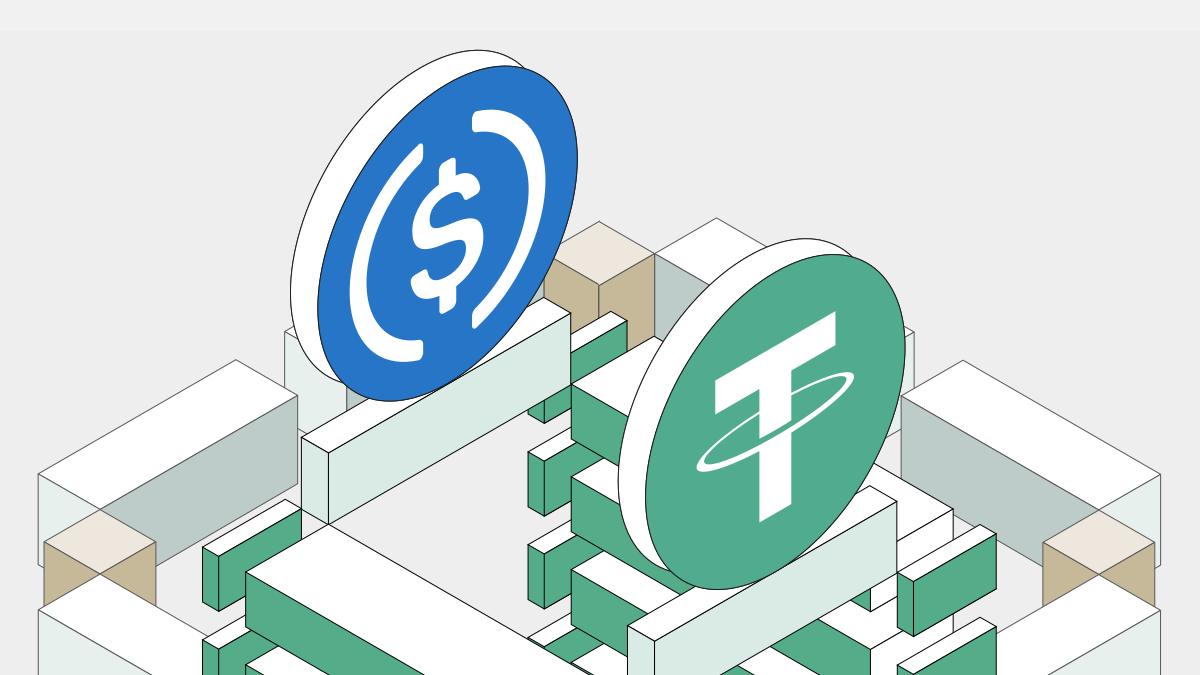
Stablecoins offer price stability compared to more volatile cryptocurrencies. USDC and USD₮ lead the market in adoption and liquidity, but they differ in how they operate and are governed.
The main differences involve reserve transparency, regulatory oversight, market share, network coverage, historical de‑pegs, and access to redemptions. Each coin has its own advantages for different users and contexts.
By reading this guide you will learn how each stablecoin works, where they trade, how reserves are managed, and which one fits different use cases. Let’s dive in.
Key takeaways
USD₮ leads liquidity and listings, giving it narrow spreads and deep markets on most exchanges
USDC emphasizes transparency and compliance, publishing frequent reserve reports and aligning with U.S. regulation
Your choice depends on redemption access, preferred networks, fees, speeds, and institutional requirements
Why USD₮ and USDC Dominate the Market
Scale attracts users. Large supplies and deep order books make payments and trading smoother. Merchants and exchanges tend to list the most liquid coins first.
USD₮ is more dominant. The coin has broader listings on global exchanges and a longer track record. This liquidity helps tighten spreads during periods of heavy trading, as noted by Cornell University’s 2025 stablecoin research.
USDC excels in certain venues. It is widely used across U.S‑aligned platforms and DeFi pools. Clear reserve reporting appeals to institutions and fintech firms.
Overview of USDC
Origins and Issuers
USDC debuted in 2018 when Circle, with support from Coinbase, launched the dollar‑pegged token. Circle manages the issuance and redemption process for USDC and has committed to regular financial disclosures.
Transparency is core to USDC’s brand. Monthly reserve reports and independent attestations help maintain institutional confidence.
Blockchain Networks Supported
Multi‑chain support makes USDC versatile. Native or bridged versions exist on Ethereum, Solana, Base, Arbitrum, Optimism, and other networks. Fees and finality vary by chain, allowing users to choose the best option for cost and speed.
Bridged and native forms coexist. Some chains host native mints while others rely on bridges, affecting how quickly tokens move and how safe transfers are.
How USDC Maintains Its Peg
Dollar assets back each token. USDC holds cash and short‑dated U.S. Treasuries to match the supply, with reserves updated frequently.
Creation and redemption occur through regulated partners. Eligible customers deposit dollars to mint new tokens and redeem tokens back into dollars, which helps anchor the $1 price.
Adoption and Use Cases
USDC has grown popular for payments, fintech integration, and stablecoin settlements. Merchants use it for remittances, payroll, and on/off-ramp flows, while fintechs integrate it for instant cross-border payments.
Its compliance profile appeals to businesses that require audited reserves and detailed reporting.
Adoption continues to expand in 2024 and 2025. According to Circle’s 2025 Transparency Report, USDC circulates across more than 16 blockchains and maintains about $61 billion in supply, representing a 10 percent increase from early 2024.
Research from CoinDesk Data (August 2025) ranks USDC as the second-largest stablecoin by market capitalization and notes rising use in regulated DeFi protocols and merchant APIs. Its adoption among fintech partners, Web3 payment gateways, and neobank payment rails positions it as a trusted digital dollar for compliant financial applications.
DeFi integrations remain deep. USDC acts as a base asset in lending protocols, decentralized exchanges, and yield platforms, giving it a consistent presence on major chains such as Ethereum, Arbitrum, and Base. Data from DefiLlama shows USDC’s liquidity share increasing across Layer 2 networks as trading volumes migrate away from mainnet.
Overview of USD₮
Origins and Issuers
USD₮ launched in 2014, making it the longest‑running large stablecoin. It is issued by Tether, a private company originally incorporated in the British Virgin Islands.
Global footprint drives adoption. USD₮ is listed on many exchanges and used across regions, giving it unmatched liquidity.
Blockchain Networks Supported
Wide coverage is a hallmark of USD₮, it exists on Ethereum, Tron, BNB chain, Solana, and many other networks. On high‑throughput chains such as Tron, fees are low and transactions settle quickly.
Low‑cost rails matter for payments. Users can transfer USD₮ cheaply on chains like Tron, making it attractive for cross‑exchange moves and everyday purchases.
How USD₮ Maintains Its Peg
Diversified reserves back USD₮. Tether holds a mix of U.S. Treasuries, cash equivalents, gold, Bitcoin, secured loans, and other assets. This diversity can offer resilience but makes the reserve composition more complex.
Primary redemption path. Eligible customers can create and redeem USD₮ directly with Tether. This provides an anchor for the $1 peg, though most retail users convert through exchanges.
Adoption and Use Cases
USD₮ is the trading liquidity leader, serving as the base currency for most spot and derivatives pairs thanks to its high volumes and deep order books on major exchanges.
Cornell University research notes that its long track record and global listings make it the most accessible dollar token in crypto markets.
Adoption has expanded through global exchanges and retail networks. CCData’s 2025 stablecoin report shows that USD₮ accounts for over 60 percent of total stablecoin market value, driving the majority of onchain transfers across Tron and Ethereum.
USD₮’s low-cost transfers and broad network coverage have made it a preferred option for payments, savings, and cross-border settlements in Asia, Latin America, and Africa.
Tether’s Transparency Portal lists more than 177 billion USD₮ in circulation, illustrating the scale of adoption. Kaiko data further show that USD₮ underpins most exchange liquidity pools, helping maintain tight spreads and stability during volatile trading periods.
USDC vs USD₮: Key differences
Market Capitalization and Liquidity
USD₮ continues to command the largest market share among stablecoins. According to DefiLlama’s stablecoin dashboard, USD₮ holds about $177 billion in circulation as of October 2025, representing roughly 58 percent of total stablecoin market value. In comparison, USDC’s supply stands near $61 billion over the same period. Broader listings and deep order books across centralized exchanges (CEXs) give USD₮ superior liquidity, particularly in Tron and Binance-based trading pairs.
USDC remains highly liquid on U.S.-aligned exchanges and DeFi protocols, where regulated venues often favor compliant assets. On Ethereum and Layer 2s such as Base and Arbitrum, USDC’s trading depth and institutional adoption remain strong.
Reserve Assets and Transparency
USD₮ reserves are diversified. Tether’s Transparency Portal reports holdings of roughly $110 billion in U.S. Treasuries, $24 billion in cash and equivalents, $9 billion in Bitcoin, and $8 billion in gold as of September 2025.
Tether’s total reserve base exceeds $170 billion, with assets consistently surpassing liabilities.
USDC reserves are conservative. Circle's Transparency page shows assets primarily in the U.S. Treasuries (~$27 billion) and cash equivalents (~$34 billion), totaling about $61 billion.
Monthly attestations and weekly disclosures confirm full backing, which supports its reputation for transparency and regulatory alignment.
Regulatory Compliance and Oversight
USDC aligns with U.S. regulation as Circle is a U.S.‑based firm. Circle is seeking a public listing and works closely with regulators. Monthly attestations and KYC/AML processes make USDC attractive to institutional users.
USD₮ operates globally. Tether is incorporated outside the United States under British Virgin Islands law, allowing it to serve international markets efficiently. The company has strengthened its transparency practices over time through regular attestations and reserve breakdowns.
Price Stability and De‑Pegging Incidents
Both coins target $1. In practice, prices fluctuate slightly. During calm periods, prices typically remain between $0.9995 and $1.0005. Market stress can widen spreads, but liquidity and arbitrage often restore the peg.
Micro‑de‑pegs happen. USD₮’s broader liquidity can narrow deviations quickly, while USDC’s regulated reserves can inspire confidence during panic. Both faced brief deviations during events like the Silicon Valley Bank crisis and FTX collapse.
Redemption Processes and Accessibility
Eligibility matters as direct redemptions usually require institutional onboarding. Most retail users swap on exchanges or through on‑chain pools, incurring fees and delays.
Banking rails differ as USDC relies on U.S. banking partners, with settlement times dependent on wire cut‑offs. USD₮ supports global redemption but may have longer processing times for certain jurisdictions.
Longevity and Track Record
USD₮ has the longest history, since 2014 it has weathered multiple market cycles, maintaining dominance. Its resilience through stress events appeals to traders who value a long track record.
Launched in 2018, USDC is newer but trusted. USDC rapidly became popular due to transparency and compliance. Growth from $42.4 billion in 2021 to $61.7 billion in mid‑2025 shows strong adoption.
Practical Considerations for Users
Transaction Costs and Speeds
Network choice shapes fees. USD₮ on Tron or Plasma offers low fees and near‑instant settlement, making it ideal for frequent transfers. USDC on Ethereum may have higher fees, but L2 solutions like Arbitrum or Optimism reduce costs.
The difference between transfers and trading lies in how fees are applied. Onchain network fees affect payment flows, while exchange maker-taker fees influence trades. Choosing the right chain or venue for each purpose can significantly reduce overall transaction costs.
Popular Use Cases in Trading and Payments
USD₮ dominates trading pairs. Many spot and derivatives contracts quote prices in USD₮, simplifying order books and enabling deep liquidity.
USDC powers fintech and merchant flows. Its compliance and reporting features make it popular in payment processors, corporate treasuries, and regulated DeFi products.
Geographic and Institutional Preferences
Regional preferences differ on some exchanges and regions that lean toward USD₮ because of its long history and broad listings. Others prefer USDC due to regulatory alignment and U.S. banking partners.
Institutional filters matter as risk committees may choose USDC for transparency, while retail users may pick USD₮ for liquidity. Some institutions hold both to diversify exposure and improve routing.
Security Risks and Controversies
Operational risks do exist. Exchange failures, bridge exploits, and wallet mistakes can affect any stablecoin. Users must manage keys carefully and monitor platform risk.
Issuer debates continue as critics scrutinize Tether’s reserve disclosures and legal actions, while others question Circle’s dependency on U.S. banks. Diversifying holdings and staying informed mitigates single‑issuer risk.
Which Stablecoin Should You Choose?
When USDC Makes More Sense
Transparency is a priority. If you require detailed reserve reports and audits, USDC offers clear disclosures and compliance processes.
You use regulated venues. Platforms aligned with U.S. rules often favor USDC, simplifying onboarding and reducing regulatory friction.
When USD₮ Makes More Sense
Liquidity is essential if you need access to deep markets across many exchanges and blockchains. USD₮ provides unmatched liquidity and coverage.
If you operate internationally. Lower‑fee networks and global redemption options can make USD₮ more convenient for cross‑border transactions.
Balancing Risk, Transparency, and Adoption
Match the coin to your context. Consider where you trade, how you redeem, and what reports you need. Many users split funds between the two to reduce reliance on a single issuer.
Monitor developments as stablecoins evolve quickly. Keep an eye on regulatory changes, reserve updates, and network upgrades to make informed choices.
Category | USD₮ (Tether) | USDC (Circle) |
Market Reach | Broader listings across global exchanges and payment networks. | Common in U.S.-aligned and regulated platforms. |
Liquidity | Deep order books and high trading volumes on major exchanges. | Competitive liquidity on Plasma, Ethereum and DeFi protocols. |
Transparency | Quarterly attestations and regular reserve breakdowns via Tether’s Transparency Portal. | Monthly attestations and detailed reserve disclosures with full regulatory oversight. |
Regulation | Operates globally under British Virgin Islands law. | U.S.-based issuer with closer regulatory alignment. |
Transfer Costs | Often lower on networks like Plasma, Tron, or BNB, ideal for cross-exchange moves. | Typically higher on Ethereum mainnet but cheaper on L2s such as Arbitrum or Base. |
Best For | Traders and users prioritizing liquidity and multi-chain reach. | Institutions and platforms prioritizing transparency and compliance. |
Conclusion
USDC and USD₮ share the same goal: providing a digital dollar that holds its value. USD₮ leads in global liquidity, supported by deep markets and wide coverage. The better choice often depends on liquidity needs, redemption access, and transaction costs, especially for users who value speed and reliability.