Executive Summary & Quick Verdict
Overall Winner: Plasma One Card
Choose Plasma One if: You want a simpler stablecoin-first card with USD₮ support, a straightforward spend-and-Earn experience, or Plasma Platinum’s 4% opening cashback band.
Choose ether.fi if: You want 3% cashback on the first $2,000 of monthly USD spend at the free Core level, Visa Signature and travel benefits on that free tier, or access to optional DeFi borrowing and Direct Pay.
The Bottom Line: ether.fi Cash is one of the stronger crypto-card competitors, with 3% cashback on the first $2,000 of monthly USD spend at its free Core level and a genuinely non-custodial account.
Plasma One is the better overall fit for users who prioritize a more focused stablecoin-first experience, USD₮ support, fewer optional DeFi layers, and Platinum’s 4% opening cashback band.
Plasma One vs ether.fi at a Glance
Feature | Plasma One Card | ether.fi Cash |
Card Network | Visa | Visa Signature |
Custody Model | Non-custodial (you own and custody your stablecoins) | Non-custodial Vault controlled by the user |
Yield / Return on Balance | Up to 6% variable through Plasma One Earn | Variable yield through Liquid and onchain lending products |
FX / Conversion Fees | Lite: ~2% total (1% Plasma + ~1% Visa); Core: ~1.5% total (0.5% Plasma + ~1% Visa); Platinum: 0% FX fee, Visa exchange rate applies | Prevailing FX base rate of around 1%, plus 0–0.5% Core or 0–0.25% Luxe markup; no added markup on Pinnacle/VIP |
Crypto-to-Fiat Spread | Not publicly disclosed; on/off-ramp costs may apply | No separate fixed spread published; eligible crypto is converted at point of sale in Direct Pay mode |
Staking / Lock-In Required | None on Lite; Core: $199/year or 20,000 XPL locked for 12 months; Platinum: 100,000 XPL locked for 12 months | No mandatory lock for Core; higher levels can be earned through points, deposits, ETHFI staking without lockups, or annual payment |
Annual / Monthly Fees | Lite: $0 (varies by region); Core: $199/year or XPL lock; Platinum: XPL lock only | Core: free; Luxe can be purchased for $199/year; Pinnacle for $999/year; VIP invitation only |
Regional Availability | Most countries, excluding 7 restricted countries; 27 US states | Available in supported jurisdictions on ether.fi’s published list; US physical card availability: 30 states plus DC; subject to KYC and eligibility |
Fees, rates and limits as of October 2026. Terms vary by region and may change.
Plasma One vs ether.fi: Key Differences
1. Yield & Capital Efficiency
Plasma One: Plasma One Earn offers up to 6% variable yield on eligible stablecoins through third-party DeFi protocols. Rates are not guaranteed, and funds allocated to Earn must be moved back to Cash before they can be spent through the card.
ether.fi: ether.fi provides several ways to keep assets productive. Liquid automatically deploys funds across DeFi strategies and compounds returns, while eligible balances can also earn through its onchain lending market.
Direct Pay can spend USDC or LiquidUSD directly from the user’s Vault, and Borrow mode allows users to spend borrowed USDC while eligible collateral continues earning.
Borrowed amounts accrue variable interest from the time of purchase, and collateral can be liquidated if the position reaches its liquidation threshold.
ether.fi has the stronger capital-efficiency feature set because users can combine earning, collateral and spending in more ways. Plasma One is simpler: its Earn product provides a clear stablecoin-yield route without requiring users to navigate borrowing or a wider DeFi account.
2. Fees & FX Costs
Plasma One: Lite is listed at $0 (pricing can vary by region), while Core costs $199 per year or can be unlocked by locking 20,000 XPL for 12 months.
Plasma’s FX markup is 1% on Lite, 0.5% on Core and 0% on Platinum. Visa network fees of typically around 1% apply on Lite and Core; Platinum has no FX fee.
ether.fi: Core membership is free. Users can unlock higher membership levels through activity or purchase Luxe for $199 per year and Pinnacle for $999 per year.
ether.fi applies a prevailing FX base rate of around 1% where conversion is required, with an additional markup of up to 0.5% for Core and 0.25% for Luxe. Pinnacle and VIP have no additional tier markup.
As of October 2026, EUR purchases carry no FX markup, although the feature remains in beta.
3. Custody & Control
Plasma One: Stablecoin assets held in a Plasma One account are non-custodial and controlled by the user. Plasma does not custody those assets, giving users control of the stablecoins backing their everyday spending account.
ether.fi: ether.fi also uses a non-custodial model. Members receive a Vault controlled by a Turnkey signer that only the user can authorize. ether.fi states that neither it nor Turnkey can access the user’s private keys or move funds without authorization.
There is no major winner on custody alone: both products provide genuine non-custodial account structures. Plasma One’s advantage is simplicity, while ether.fi gives users more ways to deploy the assets held inside that non-custodial environment.
4. Rewards, Cashback & Tiers
Plasma One: Lite earns 2% cashback on the first $500 of qualifying monthly spend before the rate steps down. Core starts at 3% on the first $1,000, while Platinum starts at 4% on the first $3,000.
Cashback accrues in US dollar terms and may be paid in XPL or spending credit under current program terms.
ether.fi: Core earns 3% cashback on the first $2,000 of monthly eligible card spending, then 1% from $2,001 to $3,000 and 0.5% above that. For EUR purchases, Core’s 3% band covers the first $800 in USD-equivalent monthly spend, then 1% up to $1,500 and 0.1% above.
Luxe extends the 3% band to the first $10,000, while Pinnacle extends it to $50,000.
Cashback is converted into ETHFI after the purchase clears, enters a seven-day lock period and must then be claimed.
ether.fi has a strong free-tier cashback proposition: its Core level currently offers both a higher starting rate and a wider first spending band than Plasma One Lite.
Platinum’s 4% opening band is higher than the 3% offered by ether.fi Core, Luxe, and Pinnacle, while ether.fi VIP also starts at 4%.
At $199 per year, ether.fi Luxe pays 3% on the first $10,000 of monthly USD spend, while Plasma One Core pays 3% on the first $1,000 before stepping down to lower cashback bands.
Pros & Cons of Each
Plasma One
Pros:
Non-custodial: Plasma does not custody the stablecoins held in the user’s Plasma One account.
$0 Lite tier with 2% cashback on the first $500 of qualifying monthly spend.
Plasma One Earn offers up to 6% variable yield, with a straightforward stablecoin-first experience.
Cons:
Cashback rates step down across monthly spending bands and rewards may be delivered in XPL.
Higher-tier benefits can require significant XPL locking; Platinum is available only through an XPL lock.
ether.fi
Pros:
Free Core membership earns 3% cashback on the first $2,000 of monthly USD qualifying spend.
Non-custodial Vault with Direct Pay, borrowing and yield features.
Strong card perks including Visa Signature benefits, Apple Pay/Google Pay support, travel cashback and lounge access.
Cons:
Cashback is paid in ETHFI, carries a seven-day lock after settlement and requires a minimum of $5 before it can be claimed.
Transactions in currencies other than USD or EUR can include the prevailing FX base rate plus a tier-dependent margin; EUR purchases currently have 0% FX markup in beta.
The wider account, lending, membership-point and DeFi system is more complex than a straightforward stablecoin spending card.
Why Choose Plasma One Over ether.fi?
ether.fi Cash is a strong competitor. It combines a non-custodial model with higher free-tier cashback, borrowing, value-accruing assets and a broad set of travel and card benefits.
For users who actively want a full DeFi financial account around their card, that flexibility is a genuine advantage.
Plasma One’s clearest distinction is focus. It supports USD₮ deposits and keeps the experience centered on holding stablecoins, using Earn, and spending through a Visa card. ether.fi offers a broader account with optional borrowing, membership points, and additional DeFi features.
Users of Plasma One do not need to navigate borrowing modes, membership points or a wider multi-product DeFi system simply to hold stablecoins, earn through Earn and spend them with a Visa card.
Final Verdict & How to Upgrade
If you want 3% cashback on the first $2,000 of monthly spend without paying for a membership, a non-custodial DeFi account, borrowing against your portfolio, and stronger travel-card benefits, ether.fi Cash is a very good option.
For users who primarily want a simpler stablecoin-first experience with USD₮ support, fewer optional DeFi layers, and Platinum’s 4% opening cashback band, Plasma One is a strong fit.
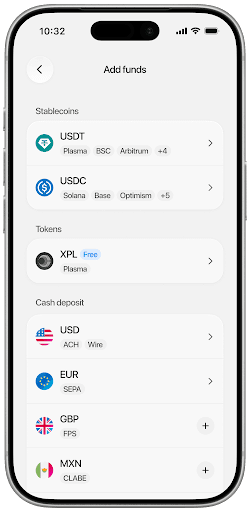
The account is designed to do three things clearly: support USD₮ deposits, provide access to Earn, and let users spend wherever Visa is accepted.
How to Get Started With Plasma One
Apply for Your Card: Create a Plasma One account, complete the required identity checks and choose the Lite, Core or Platinum tier that fits your needs.
Deposit Stablecoins: Fund your non-custodial Plasma One account and allocate eligible stablecoins to Earn if you want variable yield exposure.
Start Spending: Activate your Plasma One Visa card and use it for eligible everyday purchases wherever supported.
Ready to get started? Claim your Plasma One card