Executive Summary & Quick Verdict
Winner: Oobit. Its wider stated availability and wallet-connected crypto spending make it the more practical option for a global audience.
Choose Oobit if: You want to spend BTC, ETH, USD₮, or USDC from a supported wallet without first converting everything into a card balance.
Choose Bleap if: You qualify for its European card and prefer lower card fees, non-custodial wallet control, USDC cashback, and optional DeFi savings.
The Bottom Line: Oobit offers greater reach and multi-asset payment flexibility; Bleap can deliver better everyday value in eligible markets. Plasma One is a third option for non-custodial stablecoin spending, optional Earn, and defined cashback tiers.
Oobit vs Bleap at a Glance
Feature | Oobit | Bleap |
Card Network | Visa | Mastercard debit; virtual card, physical card via referral program |
Custody Model | DePay spends from a non-custodial external wallet; balances deposited into an Oobit account have separate custody terms | Non-custodial MPC wallet; card issuance and settlement involve a payment partner |
Yield / Return on Balance | No standard yield on idle card balances publicly disclosed | Optional variable DeFi savings vaults; Bleap advertises up to 8% AER but also cites up to 4% APY on USD balances. Actual vault rates vary. |
FX / Conversion Fees | 1% card-payment fee (minimum $0.25 in most markets); non-USD purchases may add a conversion fee of up to 1.5% | No added Bleap card FX markup; separate crypto exchanges may include spreads |
Crypto Conversion Fee | Separate crypto swaps cost 0.95% (3% when swapping into OOB); card payments use a displayed conversion quote | No Bleap card-spending fee; separate buys, sells, and bridges may include quoted spreads and network costs |
Staking / Lock-In Required | No token lock for basic card use; promotional rewards depend on eligible spending assets | None for card access; optional vault deposits are not required for spending |
Regional Availability | 80+ countries; Oobit says its app is available in all 50 US states; eligibility varies by region | Card issuance restricted to eligible EEA and Swiss residents, with nationality and rollout restrictions |
Fees, rates and limits as of November 2026. Terms vary by region and may change.
Oobit vs Bleap: Key Differences
1. Fees & Costs
Oobit has no card issuance or monthly fee, but purchases cost 1%, with a $0.25 minimum in most countries.
Non-USD spending can add up to 1.5% in currency conversion fees. Separate swaps cost 0.95%, while ATM withdrawals carry a 2.5% fee.
Bleap charges no added fee for ordinary card spending or FX markup. It also advertises no standard card subscription, and ATM withdrawals up to its monthly limit carry no Bleap fee, although they need a physical card and ATM operators may still charge.
Separate crypto trades and bridges can carry spreads and network fees, distinct from card spending.
Bleap wins on card fees for eligible users. Oobit may be worth the extra charge for people who want to pay directly from a broader selection of cryptocurrencies.
2. Yield, Cashback & Rewards
Oobit offers no standard card-balance yield. Its earning proposition is cashback tied to eligible payment assets.
Oobit advertises up to 5% cashback on eligible stablecoin payments and up to 10% when spending OOB. The highest rate requires spending OOB, not simply holding USD₮ or USDC.
Monthly cashback caps apply. For USD₮ and USDC payments, only the first $200 in monthly spending qualifies. Rewards cannot be withdrawn and can be used only for Tap to Pay payments in the Oobit app.
Bleap earns 1% USDC cashback on qualifying everyday purchases, 3% for selected rides and food deliveries, and up to 20% on eligible streaming, gaming, and AI subscriptions. Merchant exclusions and per-category limits apply.
Under Bleap's rules introduced November 10, 2026, new users need €200 of qualifying everyday spending in the previous 30 days to withdraw cashback. Boosted rides, delivery and subscription purchases do not count toward that goal.
Existing users move to this requirement on December 10, 2026, and cashback can expire if the goal is not reached in time.
As of November 2026, Bleap advertises up to 8% AER on its homepage and up to 4% APY on USD balances in its FAQ, through optional DeFi vaults. Returns are not guaranteed, and depositing funds introduces smart-contract and strategy risks.
Oobit favors promotional token-specific cashback; Bleap provides more predictable everyday categories and a separate yield option. Users should compare net rewards after fees and redemption conditions.
3. Custody, Security & Control
Oobit connects to external non-custodial wallets, keeping assets user-controlled until payment. Card settlement still uses financial partners.
An external wallet and a funded Oobit in-app balance follow different custody arrangements. The funding route matters.
Bleap uses a non-custodial wallet secured with multi-party computation (MPC). Users authorize wallet transactions while a separate issuing partner supports the Mastercard program.
Bleap places non-custodial control at the center of its account. Both still require KYC and partner settlement.
4. Usability & Regional Availability
Oobit supports Visa purchases online and in stores, including Apple Pay and Google Pay where eligible. Users can spend supported BTC, ETH, USD₮, USDC, and other assets without manually loading a standard prepaid balance.
Oobit lists 80+ supported countries, including the US, subject to eligibility and card-program rules. Its card is virtual, used online or through Apple Pay and Google Pay.
Bleap combines Mastercard spending with SEPA transfers, swaps, and optional savings. Virtual cards are available after approval; a physical card currently requires qualifying through Bleap's referral program.
Bleap Card issuance is limited to eligible EEA and Swiss residents. Nationality and rollout restrictions also apply.
Bleap publishes card limits of €10,000 per transaction, €15,000 daily, and €30,000 monthly. Oobit lists a maximum daily card-spending limit of up to $10,000.
Pros & Cons Comparison
Oobit
Pros:
Spend supported crypto without conventional prepaid loading
External non-custodial wallet connections
Visa acceptance and wider stated regional availability
Promotional cashback and international crypto transfers
Cons:
1% purchase fee and possible additional FX costs
Headline cashback depends on payment asset and caps
No standard yield product on idle card balances
Bleap
Pros:
Non-custodial wallet with Mastercard spending
No added card FX markup or ordinary purchase fee
USDC cashback across everyday and selected categories
Optional DeFi savings and supported bank transfers
Cons:
Card issuance limited to eligible EEA and Swiss residents
Cashback withdrawal requires qualifying spending
Direct card funding limited to eligible USD or EUR balances
Where Both Cards Fall Short
Both depend on payment partners, with eligibility, settlement, and transaction restrictions.
Both also impose conditions on rewards. Oobit caps rewards by payment asset and limits their use to in-app Tap to Pay payments, while Bleap requires €200 of qualifying spending in the previous 30 days before cashback can be withdrawn, and unwithdrawn cashback can expire.
The net cost depends on currency, funding route, and region, not only the advertised card fee.
The Dilemma: Oobit offers wider access and more flexible crypto funding, but charges a purchase fee. Bleap gives eligible European users lower card costs and optional yield, with narrower issuance and a spending condition for withdrawing cashback.
Why Choose Plasma One Over Oobit and Bleap?
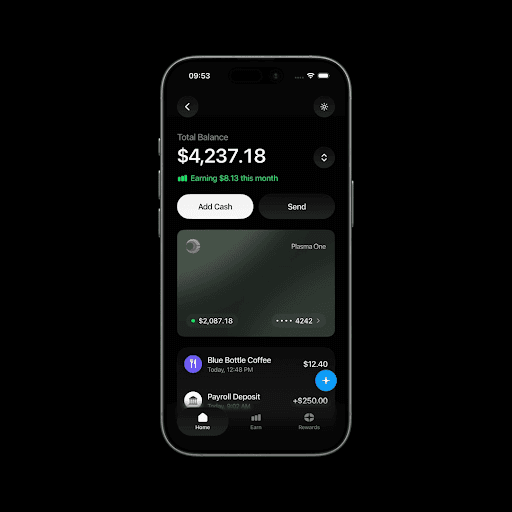
Plasma One combines non-custodial stablecoin balances, Visa spending, and optional Earn in a dedicated digital-dollar account rather than a broad token-spending service or a Europe-focused card program.
1. Stablecoin-First Spending With Non-Custodial Control
Plasma One does not custody users' stablecoins. Oobit also supports external non-custodial wallets, and Bleap has a non-custodial MPC account, so wallet ownership alone is not unique to Plasma.
Its distinction is stablecoin-first spending, with card controls and digital-dollar transfers instead of a wider token-payment workflow.
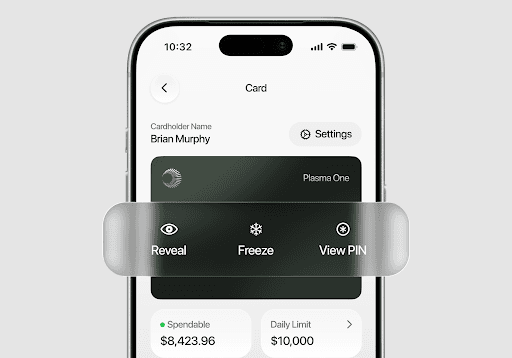
2. Defined Cashback Bands Without Promotional Asset Requirements
For members joining from November 11, 2026, Plasma One Standard earns 1% on the first $500 of eligible monthly spending, Premium 2% on the first $1,000, and Platinum 3% on the first $3,000, before stepping down. Cashback is currently paid in XPL.
Oobit's highest cashback depends on spending OOB. Bleap has attractive category rates, but new users must meet its €200 spending requirement to withdraw rewards.
Plasma's bands are tier-defined, though XPL fluctuates. Standard needs no lock; Premium costs $600 a year or 20,000 XPL locked for 12 months; Platinum costs $2,500 a year or 100,000 XPL locked for 12 months.
3. Optional Earn With a Broader Card Proposition
As of November 2026, Plasma One offers variable yield through opt-in Earn. Funds use third-party DeFi protocols and must return to Cash before they can be spent; principal is at risk.
Oobit has no comparable standard yield on its card balance. Bleap advertises a headline vault rate, while Plasma does not publish one, so yield is not a clear Plasma advantage here.
Plasma combines optional Earn, non-custodial spending, and in-app bank ramps, with eligibility beyond Bleap's European card market.
Three-Way Head-to-Head Matrix
Feature | Oobit | Bleap | Plasma One |
Card Network | Visa | Mastercard | Visa |
Custody Model | DePay external wallet is non-custodial; in-app account balances have separate custody terms | Non-custodial MPC wallet; card issuer involved | Non-custodial (you own and custody your stablecoins) |
Yield / Return on Balance | No standard yield on idle card balances publicly disclosed | Variable DeFi vaults; Bleap cites up to 8% AER and up to 4% APY on USD balances | Variable yield via opt-in Earn |
FX / Conversion Fees | 1% card payment (minimum $0.25 in most markets); non-USD payments may add a conversion fee of up to 1.5% | No added Bleap card FX markup; separate swaps may include spreads | Standard: ~2% total (1% Plasma + ~1% Visa); Premium: 0% FX on the first $3,000 of card spend per month; Platinum: 0% FX fee, Visa exchange rate applies |
Staking / Lock-In Required | No token lock for basic card use; cashback depends on eligible payment assets | None for card use; optional DeFi deposits | None on Standard; Premium $600/yr or 20,000 XPL locked for 12 months; Platinum $2,500/yr or 100,000 XPL locked for 12 months |
Regional Availability | 80+ countries; Oobit says its app is available in all 50 US states; eligibility varies by region | Eligible EEA and Swiss residents, with nationality and rollout restrictions | Most countries; 7 unsupported and ID-document restrictions in others. 31 US states |
On / Off-Ramp | External-wallet DePay, crypto transfers and bank payouts; fees vary by destination | Crypto transfers, SEPA/SEPA Instant and other eligible bank routes; spreads or network fees may apply | In-app bank on/off-ramps (USD, EUR, GBP, MXN, BRL, COP); tiered fees apply |
Fees, rates and limits as of November 2026. Terms vary by region and may change.
Final Verdict: Which Should You Pick?
Oobit wins for a global consumer audience. Its wider stated availability and ability to pay from supported crypto wallets give it greater practical reach than Bleap's restricted card program.
Choose Oobit if you want Visa spending from BTC, ETH, or stablecoins without a conventional prepaid top-up. Check the 1% purchase fee, possible FX charge, and asset-specific cashback limits.
Choose Bleap if you're eligible in Europe and prioritize non-custodial Mastercard spending, no added card FX markup, and USDC cashback. Its vaults add optional yield, but rewards and withdrawals have conditions.
Choose Plasma One for non-custodial stablecoins, defined cashback, bank ramps, and optional Earn, without OOB-based rewards or Bleap's issuance limits.
How to Get Started With Plasma One
Download Plasma One: Install the app, confirm your country and documents are supported, and complete identity verification.
Deposit Stablecoins: Fund your non-custodial balance and optionally allocate eligible stablecoins to Earn for variable yield.
Start Spending Globally: Activate the Visa card, add it to a supported mobile wallet, and pay where Visa is accepted, subject to eligibility, fees, and limits.