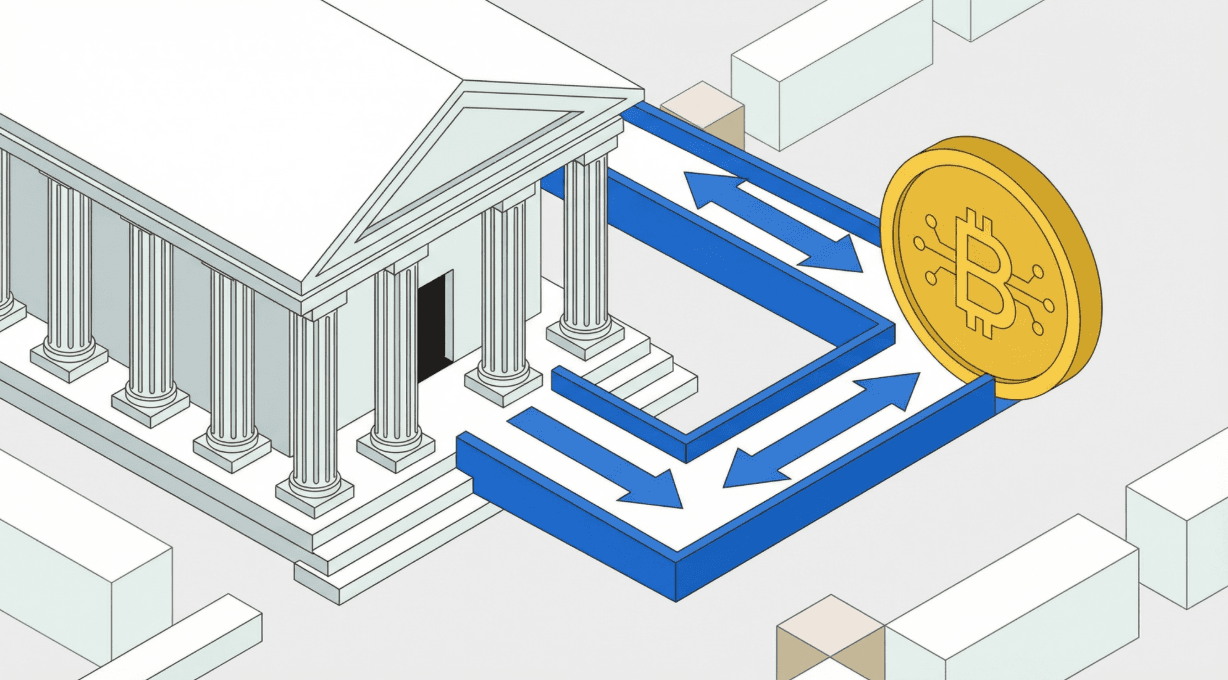
For those who feel ready and prepared to jump into the decentralized economy, there is one more step to face. Users must first move value between traditional finance and the crypto ecosystem.
Crypto on-ramps are services that convert fiat currencies, like USD and EUR, into digital assets, like Bitcoin (BTC) and Tether (USD₮), while off-ramps perform the reverse procedure, converting cryptocurrencies into fiat for withdrawals to bank accounts. Both are pivotal in the crypto space.
This guide will teach the step-by-step process for using these ramps, explore some of the common platforms that provide them, and explain why their security and efficiency are critical to global finance. Keep reading to become a master of ramping.
Key Takeaways
On-ramps and off-ramps are important financial tools that manage the conversion and transfer of value between fiat currencies and cryptocurrencies.
For entering the crypto ecosystem, on-ramps focus on taking fiat in and providing users with crypto, though they require access to banking or mobile payment wallets and must perform KYC verification.
Off-ramps focus on moving fiat out, providing essential real-world utility by helping people turn crypto into cash, either via bank transfer or special crypto debit cards.
What Are Crypto On-Ramps and Off-Ramps?
On-Ramps in Crypto
How On-Ramps Convert Fiat Currency into Digital Assets
On-ramps are services that take your fiat currency and convert it into the cryptocurrency of your choosing. This typically happens as a payment, often using gateways you are most likely already familiar with, like Apple Pay and Google Pay.
The process involves a service provider accepting your fiat and automatically executing a crypto purchase on your behalf, before delivering the digital asset to the wallet address you’ve provided.
Common Examples
Most centralized crypto exchanges, like Coinbase, Kraken, and Binance, offer native on-ramps. There are also dedicated payment processors for on-ramping, like MoonPay and Banxa. Wallet integrations with popular wallets like MetaMask also facilitate crypto buys (via third parties).
Off-Ramps in Crypto
How Off-Ramps Convert Cryptocurrencies Back into Fiat
Off-ramps provide the critical reverse function. Their process starts by receiving a user’s crypto, instantly selling it for fiat currency, then facilitating the withdrawal straight to a traditional bank account or onto a payment card of the user’s choosing.
Why Off-Ramps Are Crucial for Real-World Crypto Usability
Without good off-ramps, crypto remains trapped within the digital ecosystem, lacking the real-world utility to pay rent, buy groceries, or purchase gifts. Off-ramps, therefore, are the final step between crypto and spendable cash, giving them an important role in market adoption.
The Role of On-Ramps and Off-Ramps in the Crypto Ecosystem
How They Promote Liquidity and User Access
Beyond promoting adoption, they are the main drivers of liquidity. On-ramps’ main job is to inject new fiat into the ecosystem, while off-ramps recycle fiat back out, ensuring crypto can be easily bought and sold at fair prices. They make DeFi accessible to potentially billions of new investors.
Their Connection to Centralized and Decentralized Platforms
Ramps are often facilitated by centralized exchanges (CEX), as they must comply with strict KYC/AML laws for handling fiat. However, self-custody wallets and DeFi platforms commonly partner with third party payment processors to help users get their initial crypto (or exit the ecosystem).
How Crypto On-Ramps Work
Step-by-Step Process of Using an On-Ramp
Step 1: Create an Account and Complete KYC Verification
The on-ramping process is heavily regulated to comply with global financial standards, which means that the user must complete Know Your Customer (KYC) and Anti-Money Laundering (AML) checks when creating an account. This involves submitting a government ID and proof of address.
Step 2: Link a Payment Method
Next, the user links a traditional payment method, like a direct bank transfer (ACH/SEPA), a credit or debit card, or even a modern mobile wallet. Bank transfers are generally cheapest, but take longer to settle.
Step 3: Buy or Swap Fiat for Crypto
The user then specifies the amount of fiat currency they’d like to spend and the cryptocurrency they want to receive, for example, $100 worth of Bitcoin (BTC). The service executes the swap at the current market rate and takes a transaction fee for the convenience.
Step 4: Store or Transfer Your Purchased Crypto
Once the transaction is complete, the purchased crypto is credited to the user’s platform wallet. The user should then transfer the funds to their own self-custody wallet for full control and improved security.
Supported Payment Methods and Platforms
Bank Transfers, Credit/Debit Cards, and Mobile Wallets
Bank transfers (ACH/SEPA) are the standard method due to the low fees, but can take days to clear, by which time the price may have already changed. Credit and debit cards offer instant payment, but with higher fees. Mobile wallets (Apple Pay, Google Pay) offer quick settlement and convenience.
Alternative Options Like Gift Cards or Local Payment Rails
Some specialized on-ramps support local payment methods that are unique to specific regions, such as PIX in Brazil. Others offer the useful ability to exchange prepaid gift cards or voucher codes for crypto, targeting users with limited bank access, though KYC checks are generally still required.
Benefits of Using Crypto On-Ramps
Convenience and Accessibility for New Users
On-ramps provide a friendly user interface and leverage existing banking infrastructure, making the process much like any other online purchase. This lowers the barrier to entry at a technical level, welcoming beginners with a simple and intuitive first purchase.
Instant Access to Popular Coins and Stablecoins
Popular on-ramps deliver immediate access to the largest and most liquid assets, like Bitcoin, Ethereum, and USD₮, helping people to enter the market quickly and conveniently.
Regulatory Compliance and Security Standards
By requiring KYC, reputable on-ramps ensure that the fiat entering the ecosystem (and their platform) is fully compliant. The improved regulatory standards make institutional participation more attractive.
How Crypto Off-Ramps Work
Step-by-Step Process of Using an Off-Ramp
Step 1: Transfer or Deposit Crypto to an Off-Ramp Platform
The user first sends the crypto they wish to cash out from their wallet to a designated address given by the off-ramp platform. This starts the liquidation process.
Step 2: Sell or Swap Crypto for Fiat Currency
The user executes a trade on the platform, selling their crypto, such as BTC, ETH, or USD₮ for a fiat currency, like USD, EUR, or GBP. The sale gets recorded, the account is credited, and the fiat balance is ready for withdrawal.
Step 3: Withdraw Funds to a Bank Account or Payment Card
Finally, the user can request a withdrawal. They send the fiat balance to their pre-linked bank account, typically via bank transfer, or to a crypto debit card for immediate spending. This completes the value transfer cycle.
Common Off-Ramp Methods
Exchange Withdrawals and Direct Bank Transfers
The most common route for an individual off-ramping is to perform a centralized exchange withdrawal to a verified bank account. While secure, the speed of withdrawal will depend on the banking settlement system used, such as ACH, SWIFT, or SEPA.
Crypto Debit Cards and Instant Payout Options
The rise of crypto debit cards has introduced new off-ramps. The process is quite simple, as the crypto stored on the card is converted to fiat currency at the point of sale. Another instant payout option is to use payment wallets, many of which have been designed for faster access to cash.
Peer-to-Peer and Local Cash-Out Services
Peer-to-Peer (P2P) off-ramps connect two users together, allowing one person to sell their crypto to another in exchange for fiat currency. Marketplaces facilitate these transactions and help people receive money with local payment apps and currencies, bypassing exchange fees.
Unfortunately, this space is less regulated, and therefore bad actors try to exploit it for fraudulent purposes.
Benefits of Using Crypto Off-Ramps
Quick Conversion to Spendable Cash
Efficient off-ramps provide holders with a way to convert assets fast when cash is needed for real-world expenses or to cash out profits. Speed and flexibility are essential for increasing utility.
Wide Choice of Withdrawal Channels
User choice and accessibility are critical. Fortunately, off-ramps now offer all kinds of different withdrawal channels, such as bank accounts, payment processors, and crypto debit cards.
Secure and Compliant Transactions
The most reputable off-ramp providers employ the same high levels of security and compliance measures (KYC/AML) as on-ramps, helping to protect the entire financial cycle. Now, the whole process (fiat in, crypto trades, crypto out, fiat conversion) is conducted legally with customer protections.
Types of Crypto Ramp Providers
Centralized Exchanges (CEXs)
CEXs are now the dominant ramp providers, as they can custody both fiat and crypto, conduct compliance checks (KYC/AML), and offer powerful trading platforms for users. With high liquidity, sleek interfaces, and impressive levels of convenience, they are true crypto hubs.
Decentralized Platforms (DEXs) and Bridges
DEXs are not true off-ramps because they cannot directly handle fiat bank transfers. However, they use stablecoin bridges as a way for their users to move assets between blockchain networks efficiently. For the final fiat conversion, they require third party payment gateways.
No DEX offers true off-ramping, as they operate without a central authority. They cannot handle fiat currency at all, as this would then subject them to strict financial regulations. This situation appears unlikely to change.
Payment Gateways and Fintech Integrations
Specialized gateways (often used by self-custody wallets, DEXs, and dApps) integrate directly with banks and credit card networks to deliver a fairly straightforward way to make fiat-to-crypto and crypto-to-fiat transactions.
Peer-to-Peer (P2P) Solutions
P2P platforms connect real buyers with real sellers, making transactions more private and flexible. However, P2P carries counterparty risk and requires robust dispute resolution mechanisms.
Why On-Ramp and Off-Ramp Infrastructure Matters
Driving Global Crypto Adoption
Easy-to-use, low-cost ramps are arguably the most powerful tool for attracting new users to crypto as they effectively lower the barrier to entry. They make the first crypto purchase feel less intimidating or confusing.
Enabling Cross-Border Transactions and Remittances
Ramps also provide infrastructure for cross-border finance, one of crypto’s best use cases. Users can on-ramp fiat in one country and quickly send USD₮ around the world. The recipient then has to off-ramp into their local fiat currency upon receipt.
With blockchains like Plasma, there are zero fees for USD₮, and finality is achieved in under a second.
Improving Liquidity and Market Stability
The goal of consistent and reliable ramps is to ensure deep liquidity pools for buyers and selling. This is key to market stability, as high liquidity reduces volatility and slippage, encouraging more institutional users to engage with decentralized finance.
Challenges Facing On-Ramp and Off-Ramp Services
Regulatory and Compliance Barriers
Ramps are the main bridges between the highly regulated traditional financial world and the often-unregulated crypto space. These gateways face constant pressure from regulators to meet high levels of KYC/AML, anti-fraud measures, and licensing, adding to their operational costs.
Security Risks and Fraud Prevention
By handling both fiat currency and cryptocurrency, ramps are a ripe target for hacking, phishing, and other types of financial fraud. Their security protocols must be institutional-grade, with continuous fraud monitoring, to protect users, funds, and integrity.
Accessibility in Emerging Markets
In many emerging markets, banking and regulations typically fail to meet the true needs of the people, pushing people towards alternatives, such as ramp services. Some local ramp services may be riskier, less scalable, and more volatile, reducing convenience or affordability.
The Future of On-Ramp and Off-Ramp Crypto Solutions
Innovations in Instant Settlement and Stablecoins
It’s plausible that the future will be focused on making transactions faster and cheaper. Plasma (and the Plasma One neobank) has already solved this, built on a future-proofed blockchain delivering zero-fee USD₮ transfers and sub-second finality. Ramping services will eventually catch up.
Expanding Fiat-to-Crypto Coverage Worldwide
Partnerships are key to ramping operations. Crypto platforms are always looking to list more local payment networks and methods for on-ramps and off-ramps, especially ones that bypass global banking monopolies. The objective is accessibility, whether in New York or Nairobi.
The Role of Partnerships Between Banks, Fintechs, and Crypto Platforms
Banks and fintech companies are already partnering with crypto ramps, with the future outlook being that they will work even more closely together to offer direct crypto services to their customers.
In the future, the institutional world and its huge capital reserves will embrace decentralized finance to bring greater trust and stability to the ramping process.
The Growing Importance of Trusted, Compliant, and User-Friendly Solutions
On-ramp and off-ramp crypto services are indispensable gateways for millions of users, facilitating critical value flows between the established financial world and the new, decentralized future.
Their efficiency, security, and compliance vary from one platform to another, yet are pivotal to driving mass adoption and unlocking the enormous potential of decentralized finance.
Some ramping providers now make billions of dollars per year in revenue, and have valuations in the tens of billions. These are the ones that can demonstrate reliability, cost efficiency, speed, good customer service, and compliance.
For users, the cost of on-ramping and off-ramping remains a point of friction. To solve this, ramps will naturally gravitate towards blockchain solutions that offer the best speeds and prices, such as Plasma. For moving USD₮ and other digital dollars, their infrastructure is ideal.
Plasma has been engineered as the perfect execution layer for the ramping cycle, purpose-built with the high-throughput infrastructure, settlement speeds, and certainty that mass adoption requires.
Learn more about how you can leverage a network optimized for seamless value transfer.


