Executive Summary & Quick Verdict
Winner: KAST. Its free Standard membership, 1.5% cashback on the first $2,000 of eligible monthly spend, card usage across 170+ countries, and 8% introductory Reserve reward rate give it a strong entry-level package.
Choose KAST if: you want free Standard membership, straightforward stablecoin spending, 1.5% cashback on the first $2,000 of eligible monthly spend, and broad Visa usage. Card issuance or delivery fees can still apply.
Choose RedotPay if: you want to hold and directly spend supported assets such as BTC, ETH, or SOL, spend from USD₮/USDC Earn, or use RedotPay's P2P, swaps, fiat funding, and optional optional non-custodial wallet features.
The Bottom Line: KAST is the stronger all-round card for most users, while RedotPay offers more flexibility for people who want a crypto-heavy financial app.
Plasma One is a third option for users who want a non-custodial setup by default, a $0 Lite card, optional stablecoin yield, and tiered cashback paid in XPL.
KAST vs RedotPay at a Glance
Feature | KAST | RedotPay |
Card Network | Visa | Visa |
Custody Model | Partner-managed (Earn vaults non-custodial) | Custodial account by default; optional non-custodial wallet and smart-contract vault supported under applicable programs |
Yield / Return on Balance | KAST Earn: up to 7% variable rate via non-custodial vaults. KAST Reserve: introductory cashback rewards of 8%, up to 10% on the first $50,000, and up to 12% on the first $200,000; promotional and subject to a $100M total Reserve-deposit threshold. | Variable USD₮/USDC Earn rate; annual Pro adds +1% APY on eligible Earn balances |
FX / Conversion Fees | 0.5%–1.75% depending on country and currency | 1.2% when transacting outside the card currency |
Crypto Conversion Fee | 0% spread on stablecoin deposits (1:1); other assets: varies by token and is shown before confirmation | 1% |
Staking / Lock-In Required | None for Standard membership or Reserve access | None for standard card use; Earn has flexible redemption |
Regional Availability | Card usable at 150M+ merchants in 170+ countries; account availability varies by jurisdiction. | Services available in 100+ countries; US and other jurisdictions excluded. |
Fees, rates and limits as of September 2026. Terms vary by region and may change.
Core Differences Breakdown
1. Fees & Costs
KAST has the stronger entry-level cost structure. Standard membership is free and includes 1.5% cashback on the first $2,000 of eligible monthly spend.
It includes up to two Standard virtual cards, although a $2 issuance fee applies in some regions. A Standard physical card has a $0 card fee plus $40 delivery.
KAST's Premium costs $1,000 per year and Private costs $10,000, so KAST becomes considerably more expensive at the top end.
RedotPay charges $10 for a virtual card and $100 for a physical card. Its standard card pricing also includes a 1% crypto conversion charge and 1.2% for transactions outside the card currency.
Physical-card ATM withdrawals generally cost 2%, rising to 3% above $10,000 per month for USD cards. KAST charges $3 plus 2% per ATM withdrawal, with a $250 per-withdrawal and $750 daily limit.
RedotPay Pro reduces some of those costs, but it adds another subscription: $12.90 monthly or $129 annually.
For users who simply want to get a card and start spending, KAST has the lower-friction fee model.
2. Yield, Cashback & Rewards
KAST Standard earns 1.5% cashback on the first $2,000 of eligible monthly spend, Premium earns 2% on the first $10,000, and Private earns 3% on the first $40,000. Redeemed cashback can only be used inside KAST.
Reserve separately offers promotional cashback rewards of 8%, up to 10% on the first $50,000, and up to 12% on the first $200,000.
RedotPay’s headline cashback is tied to RedotPay Pro. Members earn 3% on eligible Apple Pay and Google Pay purchases, but cashback is capped at $18 per month and is paid in USDs for future card spending rather than as externally withdrawable cash.
RedotPay users can spend directly from their USD₮ or USDC Earn balance. KAST Earn funds must first be moved back to the spending account, although KAST Reserve balances can fund eligible card spending directly.
So KAST offers the stronger headline reward economics, while RedotPay provides a smoother connection between earning and spending.
3. Custody, Security & Control
KAST is not a bank, and its public materials state that custody, cards and on/off-ramp services are provided through licensed partners. The account itself remains within KAST’s managed infrastructure rather than being a non-custodial wallet.
RedotPay’s standard account is also custodial. Its terms state that assets are managed by a custodian, with private-key shares controlled by the custodian and user balances recorded internally. Assets may also be pooled into segregated omnibus accounts for operational purposes.
RedotPay also supports a non-custodial wallet and smart-contract vault structure in applicable card programs, allowing users to lock assets for card settlement while retaining responsibility for their wallet.
That gives RedotPay more custody flexibility, although the standard experience remains more complex than a purely non-custodial card account.
4. Usability & Regional Availability
KAST’s strongest usability advantage is reach. It advertises card usage at 150 million merchants across 170+ countries, although account eligibility varies by jurisdiction. It also supports Apple Pay and Google Pay.
RedotPay says its services are available in more than 100 countries and its cards work at more than 130 million merchants.
It supports Apple Pay and Google Pay, ATM withdrawals, fiat balances in currencies including USD, GBP, and EUR where available, and lets users hold and directly spend supported assets including BTC, ETH, BNB, SOL, XRP, USD₮, and USDC.
RedotPay therefore offers more direct multi-asset crypto spending, while KAST advertises broader card usage reach.
Pros & Cons Comparison
KAST
Pros:
Free Standard membership with 1.5% USD cashback
Visa card usage across 170+ countries
Introductory Reserve reward rates of 8%–12%
0% fee on USD card spending
Cons:
Partner-managed rather than non-custodial
Premium and Private memberships are expensive
Earn funds must be moved back before card spending
ATM withdrawals cost $3 + 2%, with a $250 per-withdrawal and $750 daily limit
RedotPay
Pros:
Supports a wide range of cryptocurrencies
Earn balance can be spent directly
Optional non-custodial wallet structure
Strong P2P, fiat-funding and crypto-payment ecosystem
Cons:
$10 virtual and $100 physical card issuance fees
1% crypto conversion and 1.2% foreign-currency transaction fees
Pro cashback requires a subscription and has a low monthly cap
Where Both Cards Fall Short
Neither product combines every advantage without trade-offs.
Both rely on third parties or regulated partners for parts of their card and financial infrastructure, and availability varies by jurisdiction. Their yield products also involve separate terms and risks rather than functioning like insured bank savings accounts.
KAST gives users stronger default rewards and wider card coverage, but the spending account remains partner-managed. RedotPay offers more crypto flexibility and an optional non-custodial path, but users face higher card and conversion costs.
The Dilemma: Choosing between KAST and RedotPay means deciding whether you value better default card economics and simplicity or greater crypto flexibility and custody options.
Why Choose Plasma One Over KAST and RedotPay?
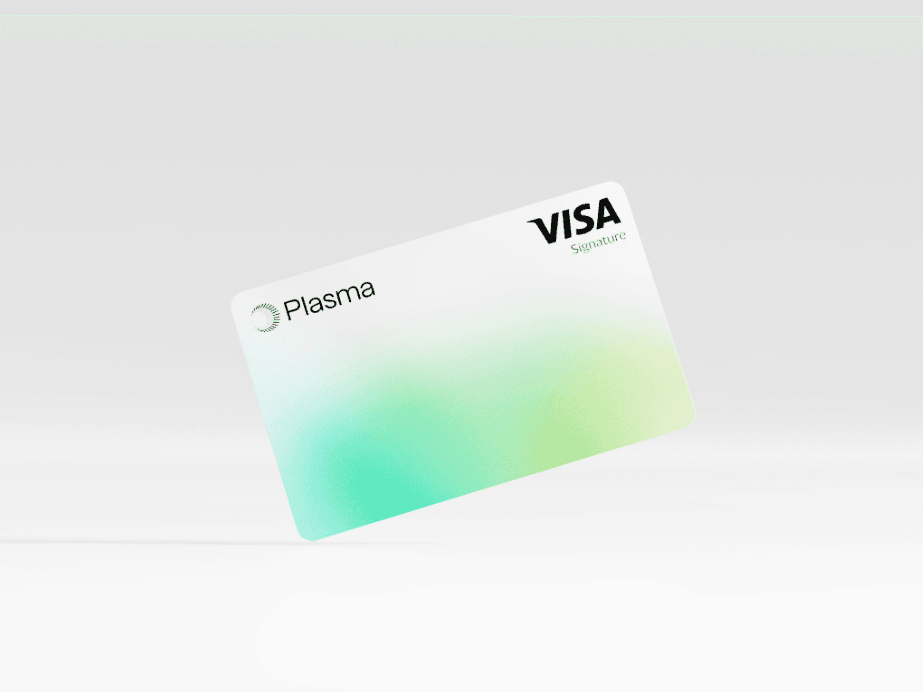
Plasma One offers another route: a non-custodial stablecoin account with Visa spending, optional yield, global money movement and card rewards in one app.
1. Non-custodial Comes Standard
Plasma does not custody users’ assets. The stablecoins backing the Plasma One card remain owned and custodied by the user. That is simpler than relying on KAST’s partner-managed structure or opting into RedotPay’s more complex non-custodial wallet-and-vault setup.
2. A Strong Free Starting Tier
Plasma One Lite has a $0 card cost and earns 2% base cashback on the first $500 of monthly spend, then 0.1%. Core starts at 3% on the first $1,000, while Platinum starts at 4% on the first $3,000. Cashback is paid in XPL.
KAST advertises higher promotional Reserve cashback rewards, although these are not classified as yield. Plasma’s advantage is combining up to 6% variable Earn yield with a non-custodial account and everyday card functionality.
3. Stablecoin Spending Without Provider Custody
Plasma One uses Visa, works in more than 180 countries, supports Apple Pay and Google Pay where available, and provides bank off-ramps inside the app. It also offers zero-fee USD₮ transfers over Plasma routes, although third-party fees can still apply.
For users who like KAST’s simplicity but want stronger direct ownership of their assets, Plasma One provides a useful middle ground.
Three-Way Head-to-Head Matrix
Feature | KAST | RedotPay | Plasma One |
Card Network | Visa | Visa | Visa |
Custody Model | Partner-managed (Earn vaults non-custodial) | Custodial by default; optional non-custodial wallet | Non-custodial (you own and custody your stablecoins) |
Yield / Return on Balance | Earn: up to 7% variable. Reserve: introductory 8%, up to 10% on the first $50,000, and up to 12% on the first $200,000, subject to a $100M deposit threshold | Variable USD₮/USDC Earn | Up to 6% variable via opt-in Earn |
FX / Conversion Fees | 0.5% to 1.75%, depending on country and currency | 1.2% foreign currency + 1% crypto conversion | Lite: ~2% total (1% Plasma + ~1% Visa); Core: ~1.5% total (0.5% Plasma + ~1% Visa); Platinum: 0% FX fee, Visa exchange rate applies |
Staking / Lock-In Required | None | None | None on Lite; Core $199/yr or 20,000 XPL lock; Platinum 100,000 XPL lock |
Regional Availability | 170+ countries, including the US, subject to eligibility | 100+ countries; exclusions include US | Most countries, excluding 7 restricted countries; 27 US states |
On / Off-Ramp | Bank deposits: ACH $2, FedWire $15, SWIFT $30, SEPA 0.5% | Fiat funding, P2P, crypto deposits and withdrawals | In-app USD bank on/off-ramp; tiered fees apply |
Fees, rates and limits as of September 2026. Terms vary by region and may change.
Final Verdict: Which Should You Pick?
KAST wins the head-to-head for most users. Its free Standard membership, 1.5% cashback on the first $2,000 of eligible monthly spend, broad card usage reach, and strong Reserve rewards make it the easier card to recommend for everyday stablecoin spending.
Choose KAST if you want straightforward spending, broad international access and stronger default rewards without paying for a membership.
Choose RedotPay if you want a wider crypto toolkit, direct spending from Earn, P2P services, or the flexibility of an optional non-custodial setup.
Choose Plasma One if your priority is keeping ownership of your stablecoins while still getting a mainstream Visa card, optional yield and competitive cashback.
KAST advertises higher promotional Reserve cashback rewards, but Plasma combines a non-custodial setup, optional yield, and everyday spending in one product.
How to Get Started With Plasma One
Download Plasma One: Install the app, complete identity verification, and create a virtual card.
Deposit Stablecoins: Fund your account, and optionally move eligible stablecoins into Earn for variable yield.
Start Spending Globally: Add the card to Apple Pay or Google Pay where supported and spend anywhere Visa is accepted, subject to regional eligibility and applicable fees.