Binance lowered its SWIFT USD withdrawal fees to $25 per transfer on January 19, 2026. (official notice).
The best stablecoin neobank in 2026 is the one that minimizes your all-in cost across fiat in, conversion spread, and fiat or onchain out, for your region and rails.
This guide compares fees rail-by-rail and shows where costs hide as spreads. You also get $500 and $5,000 templates to estimate total cost.
Key Takeaways
Total cost is usually spread + FX + withdrawal, not “card fee $0”
Bank transfer rails can beat card top-ups by 1% to 3%+
Onchain USD₮ fees vary sharply by network (TRC20 vs ERC20)
Direct verdict: Best stablecoin neobanks in 2026 (by fee profile)
There is no universal “cheapest” stablecoin neobank. Your best option depends on your funding rail, your region, and where you cash out.
This comparison focuses on fees that are explicitly disclosed in primary sources. Anything missing is labeled not publicly disclosed, not estimated.
Publisher disclosure: no affiliate links, no paid placements, and no compensation from providers. Scope: consumer-focused accounts and cards only.
Compared providers (same criteria): Crypto.com, Binance, Coinbase, Wirex, Nexo, BitPay, and Plasma One (early access).
Same-criteria comparison table (fees that are actually disclosed)
Same fee categories compared across providers, using only what each company publishes. Explicit fees are separated from spreads, since spreads move with the market and are rarely quoted as a flat number.
Where a provider does not publish a figure in the sources reviewed, the cell reads not disclosed. Confirm current rates in-app before moving large amounts, since crypto card terms change often.
Category | Crypto.com | Binance | Coinbase | Wirex | Nexo | BitPay | Plasma One (early access) |
|---|---|---|---|---|---|---|---|
Availability | Region-specific fee tables (EU, SG) | Card availability region-dependent | Card programs vary by jurisdiction | Not disclosed | Not disclosed | Not disclosed | Limited supported countries/US states |
Fiat deposit rails | ACH/wire (web guide); SWIFT USD (SWIFT guide) | SWIFT USD withdrawals supported | Not disclosed | Not disclosed | Not disclosed | Not disclosed | Not confirmed in sources reviewed, flag for verification before publishing |
Deposit fee (explicit) | SWIFT USD fee-free "for a limited time"; bank fees may still apply | SWIFT USD: $25/transfer | Not disclosed | Not disclosed | Not disclosed | Not disclosed | No Plasma onramp fee for USD/GBP/EUR/MXN/BRL; third-party fees may apply |
Card top-up fee (explicit) | EU/UK: ~1% (since Jul 2022). SG: 0% debit, 1% credit | Not disclosed | Not disclosed | Not disclosed | Not disclosed | Not disclosed | Debit/credit/Apple Pay: coming soon |
Fiat withdrawal rails + fee | Tiered charges | SWIFT USD: $25/transfer | Not disclosed | Not disclosed | Not disclosed | Not disclosed | Varies by tier/rail (% + rail fee); Platinum removes Plasma's added fee on most rails |
Card FX / foreign fee | SG: 0% at higher tiers per marketing pages; Midnight may carry FX fee by program/region | Not disclosed | Not disclosed | Not disclosed | Not disclosed | Not disclosed | +1% Lite, +0.5% Core, 0% Platinum; Visa FX may still apply |
ATM policy | Tiered free monthly allowance by card level (~$200 to $1,000 / €200 to €1,000) | Not disclosed | Discloses key fee categories | Not disclosed | Not disclosed | Not disclosed | Not disclosed |
Onchain stablecoin withdrawal fee | Not disclosed | Has a dedicated deposit & withdrawal fees page | Not disclosed | Not disclosed | Not disclosed | Not disclosed | Not disclosed |
Spread disclosure quality | Partial, some fees explicit but spreads often not shown | Good on network fees, weak on spreads | Partial, card fees documented but conversion spread varies | Not disclosed | Not disclosed | Not disclosed | Partial, FX markup explicit but conversion partner rate at withdrawal not shown |
Best-for scenarios (what to choose based on your main flow)
Start with (1) your deposit rail, (2) whether you spend abroad, and (3) your cash-out path. Then pick the provider that publishes costs for those steps.
Cheap onchain USD₮ withdrawals by network: Binance, with a live table (crypto fee table).
Large USD wire cash-out with an explicit schedule: Crypto.com Exchange (USD withdrawal charges).
Disclosed card-fee documentation for US users: Coinbase (Coinbase Card fees).
Local bank rails beyond ACH/SEPA, like PIX or SPEI: Plasma One (supported rails).
How stablecoin neobank fees actually show up (and how to estimate total cost)
Stablecoin neobank “fees” commonly come from deposit/top-up processing or spread, conversion spread, network fees, and withdrawal/FX/ATM charges—though some providers also add maintenance or per-transaction fees.
The largest line item is often spread, even when a card advertises $0 monthly fees. You only see it in the rate you get.
Map your flow end to end, add every explicit fee, then add a range for the unknown spread.
Explicit fees vs spread pricing (what’s knowable in advance)

Explicit fees are published as a flat fee or a percent. Example: Binance’s $25 SWIFT USD withdrawal fee (official notice).
Spread pricing is embedded in the rate you receive, and may only be visible in-app. If the rate is “shown in-app,” treat it as variable.
In this article, missing spreads stay as not publicly disclosed, following conservative comparison practices used by fee-tracking sites (Defimap methodology, SpendNode methodology).
Two worked cost templates: $500 and $5,000 flows
The article defines total cost as the sum of spreads, deposit fees, withdrawal fees, and any network fees.
Flow A is described as an ACH deposit that converts into a stablecoin balance, which you can then hold and either spend via a card or cash out to a bank.
Best-case: deposit fee $0 (if published), card fee $0, then only withdrawal fee.
Realistic-case: add “spread %” on conversions, plus any foreign transaction fee.
Flow B, EU example: SEPA deposit → hold stablecoin → withdraw onchain.
Best-case: SEPA deposit fee $0 (if published), then only onchain network fee.
Realistic-case: add spread on EUR to stablecoin.
Network fees are chain-dependent. Always price TRC20 versus ERC20 before moving USD₮.
Criterion-by-criterion comparison: rails, withdrawals, and real-world spending costs
Rail availability and withdrawal policy drive most outcomes. Card programs then add region-specific FX, ATM rules, and conversion steps.
The same checklist applies to every provider here. If the provider does not publish a number, it stays not publicly disclosed.
Fiat on-ramp and off-ramp rails (ACH, wire, SEPA, Faster Payments, PIX, SPEI)
Local rails can reduce cost versus SWIFT, but only if the provider supports them in your region.
USD rails (ACH and wire)
Crypto.com supports USD deposit and withdrawal via SWIFT for retail users. Crypto.com says it does not charge a deposit fee, but banks may (SWIFT guide).
Crypto.com publishes the USD bank transfer (wire) withdrawal fees and limits for the Exchange on its Fees & Limits and Help Center pages; the exact tiers should be confirmed there. (USD withdrawal charges).
Plasma One supports USD ACH and wire for deposits and withdrawals via a virtual account. Fiat is automatically converted to USD₮ when it arrives (supported rails).
Coinbase ACH and wire rails are not publicly disclosed in the primary sources reviewed for this comparison.
EUR rails (SEPA) and GBP rails (Faster Payments)
Plasma One supports EUR SEPA and GBP Faster Payments for deposits and withdrawals via a virtual account (supported rails).
Crypto.com’s Exchange documentation covers deposits and withdrawals; confirm your local rail in the Exchange help center (deposits and withdrawals).
Exact EUR SEPA fees for Crypto.com, and SEPA/Faster Payments fees for Binance and Coinbase, are not publicly disclosed in the sources reviewed here.
LATAM rails (PIX in Brazil, SPEI in Mexico)
Plasma One explicitly supports BRL PIX and MXN SPEI for deposits and withdrawals via a virtual account (supported rails).
For the other compared providers, PIX and SPEI support and pricing are not publicly disclosed in the sources reviewed.
Card spend: FX markups, top-up fees, ATM fees, and onchain network costs
Card costs usually come from three buckets: top-up fees, FX or foreign transaction fees, and conversion spread when funding a purchase.
Separately, onchain withdrawals introduce network fees, which can dominate small transfers.
Card top-ups and “funding by card” penalties
Crypto.com publishes card top-up fees that vary by region. In the EU and UK, Crypto.com charges a 1% fee for debit and credit card top-ups.
In Singapore, Crypto.com debit card top-ups are free (0%), while credit card top-ups incur a 1% fee.
For Binance and Coinbase, the reviewed sources don’t clearly disclose specific card top-up fee amounts, while BitPay’s top-up fee is listed as 0% and Wirex is shown with fees such as “up to 1.5% transaction fee.”
FX and foreign spend (what’s explicit vs unknown)
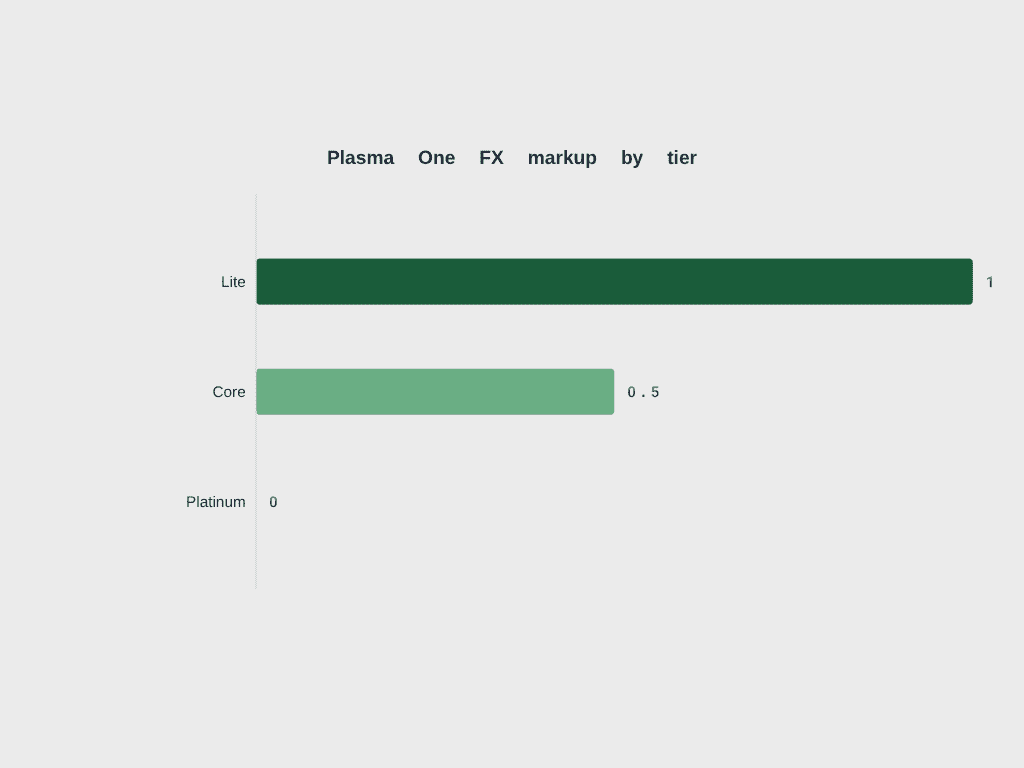
Plasma One discloses a tiered FX markup: +1% on Lite, +0.5% on Core, and 0% on Platinum. Visa network FX may still apply (fees).
Third-party fee summaries list a 0.50% interbank exchange/FX fee for the Midnight tier once free exchange limits are exceeded. In the Singapore “Fees and Limits” table, other card tiers are shown with different limits rather than a blanket “no fee.”
Coinbase discloses card fee categories, but underlying conversion spread can still apply. Start with the official card fees page (Coinbase Card fees).
Onchain withdrawal fees: why the network matters
With USD₮, the same stablecoin can cost very different amounts to move. The difference comes from the network, not the ticker.
Binance’s official fee page directs users to log in to view deposit/withdrawal fee details, rather than showing a public live USD₮-by-network table. TRC20 is often lower than ERC20 in that schedule.
Before withdrawing, compare: the network name, the fee shown, and whether the recipient supports that network.
Eligibility, availability, and verification checklist (so you do not get surprised)
Stablecoin neobank terms vary by jurisdiction. Fee schedules can also be region-specific, even under the same brand.
Confirm your exact program in-app, then cross-check the provider’s regional fee page before you move large amounts.
Availability by region (and why “global” marketing is not enough)
Plasma One account opening is limited to supported countries and US states. Verification fails for unsupported regions (availability).
Crypto.com’s fee tables are explicitly scoped to residence. Europe and Singapore have different schedules (EU fees, SG fees).
Binance Card eligibility is region-dependent. Use the official program FAQ for the current rules (Card FAQ).
Methodology and how to re-check prices today
Method: primary sources only, including fee schedules, help centers, and product pages. Spreads were not estimated unless explicitly published.
Re-check list: your region program, your funding rail, FX policy, withdrawal fee, and onchain network before transacting.
Conclusion
The best stablecoin neobank is not a single brand. It is the one that matches your rails, and publishes the fees you will actually pay.
Start by picking your primary rail. Then run the $500 and $5,000 templates against the table, including spread and network fees.
If you need local rails beyond ACH and SEPA, Plasma One discloses support for ACH, wire, SEPA, Faster Payments, PIX, and SPEI (supported rails). It also publishes tiered FX markup (fees) and eligibility limits (availability).
Next step: pick your primary rail, then verify the provider fee page for your region and execute a small test transfer first.
Ready to get started? Open your account today.