The best stablecoin card in 2026 depends on your country, custody preference, and fee stack, because most “stablecoin cards” convert USDC/USD₮ to fiat during card authorization and settlement, then pay merchants on Visa or Mastercard rails.
You’ll learn the payment flow, custody models, and fee buckets, then compare 2026 card options in one same-criteria table.
Key Takeaways
Stablecoin cards usually settle in fiat on card rails, not in stablecoins
Fees hide in FX markup, spread, ATM charges, and tier subscriptions
Custody varies widely, from exchange-held balances to onchain self-custody
Direct verdict for 2026 (and disclosures)
There is no single best stablecoin card for everyone in 2026. Pick based on (1) where you can open the account, (2) whether you want self-custody, and (3) your full fee stack.
This comparison is authored by Plasma. It is informational, not financial advice. Fees, rewards, and availability vary by region and can change.
If you value published, region-specific fee schedules, Crypto.com is unusually document-heavy. Third-party fee summaries for the Crypto.com Visa card in Europe cite a 1% debit/credit card top-up fee and a €5/month inactivity fee after 12 months of inactivity.
If you want self-custody, Plasma One is structurally different. Plasma states funds are held onchain by the user. Spending signs a transaction from the user’s wallet to settle purchases.
If you prefer spending directly from an exchange balance, Coinbase Card fits that model. Coinbase’s legal Insurance disclosure says U.S. customers’ cash balances are pooled and held in custodial accounts at U.S. financial institutions and/or invested in permissible assets.
Many “stablecoin card” pages emphasize cashback. In practice, fees and custody usually matter more than headline rewards. That is because conversion and FX can apply on every swipe.
Verdict by “best for” scenarios (who should pick what)
Best-fit depends on your constraints. Match your scenario to the few products with clear evidence. Treat third-party fee claims as provisional without official terms.
Best for self-custody, onchain-held balance: Plasma One. It uses a non-custodial smart account and you authorize spending transactions. See Plasma’s explanation of how money is stored.
Best for known, published card fee schedules: Crypto.com. Its official help center posts regional schedules for Europe fees and Singapore fees.
Best for spending from an exchange balance: Coinbase Card. It spends from Coinbase account balances under the Coinbase US User Agreement and card terms in its cardholder agreement PDF.
Best for tiered rewards with lockups: Crypto.com tiers. The card program shows staking or subscription tradeoffs on its card overview.
Best for a stablecoin wallet-to-Visa concept: MiniPay. Opera announced a MiniPay Visa debit card launch, but consumer fee schedules were not in that release.
Methodology, criteria, and last verified date
This article compares stablecoin cards using the same criteria for every product. It prefers official terms, help centers, and agreements. Otherwise, it marks fields as not publicly disclosed.
Criteria used: availability, custody model, what moves onchain vs offchain, supported stablecoins and networks, funding rails, FX markup, conversion spread, ATM fees, subscriptions or lockups, rewards currency, and key risk disclosures.
Evidence rules: official documents win. Third-party tables are labeled “reported” and should be verified. No values are guessed.
Regional variance matters. For example, Crypto.com’s foreign transaction fees differ across its Europe schedule and its Singapore schedule.
The article lists a data last-verified date of Jul 30, 2026 in its methodology.
How stablecoin cards work (wallet to settlement, step by step)

A stablecoin card usually pays merchants in fiat through Visa or Mastercard rails. The card program sources value from stablecoins or crypto. It converts that value into fiat during the transaction lifecycle.
What you “spend” is rarely a stablecoin transfer to the merchant. Instead, stablecoins fund the card program’s fiat settlement. Your app then shows a stablecoin or fiat-equivalent debit.
Where conversion happens matters. Some programs convert at authorization, some at settlement, and some use both. Many do not publicly disclose which moment locks the rate.
Payment flow explained: wallet → authorization → conversion/spread → settlement
One common stablecoin card payment flow can be broken into four stages: funding, authorisation, conversion to fiat, and merchant payment.
1) Funding. You hold stablecoins in a custodial platform or an onchain wallet. Onchain deposits can incur network gas.
Plasma One supports USD₮ and USDC deposits on multiple networks.
2) Authorization. At the point of sale, the merchant’s terminal submits an authorization request via the acquirer to Visa or Mastercard, which routes it to the issuing bank for approval or decline. The issuer checks a prepaid balance or a linked account.
3) Conversion and spread. If the merchant currency differs from your account currency, FX applies. Several reports in Oct 2022 said Crypto.com would charge 0.2% on foreign transactions in the EU/UK and 2% outside those regions. See the Europe fees page.
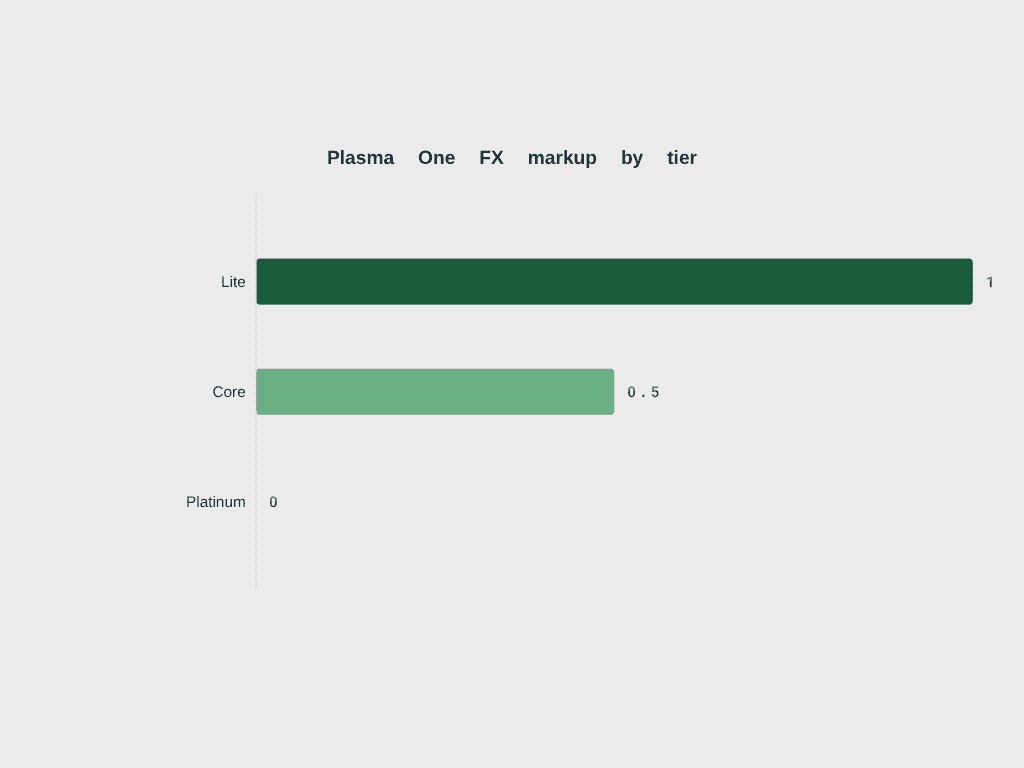
Plasma One publishes an FX markup by tier. It is +1% on Lite, +0.5% on Core, and 0% on Platinum. See Plasma One fees.
4) Settlement. The merchant receives fiat through card rails.
5) Posting. Final posted amounts can differ from authorization. The documentation shows DCC conversion is performed before authorization, and settlement/capture proceeds as the capture of that authorized DCC transaction.
What moves onchain: for custodial exchange cards, card spends are offchain ledger updates. The article describes onchain activity as largely driven by card top-ups (deposits) and onchain card spending volumes. For Plasma One, funds are held onchain by the user and spending signs a transaction. See how Plasma stores money.
Custody models: custodial vs self-custody vs hybrid (why it matters)
Custody answers a simple question: who controls the keys and can block transfers. It changes freeze risk, recovery paths, and what your “balance” legally represents.
Self-custody (onchain). Plasma One states its wallet is a non-custodial smart account. Funds are held onchain by the user. Key management uses Privy, and only the user authorizes transactions. See Plasma’s storage model.
Custodial platform balance. Coinbase Card spends from a Coinbase account under the Coinbase US User Agreement. Crypto.com is generally presented as a platform-held model on its card overview.
The first-party materials reviewed describe MiniPay as self-custodial and state that MiniPay does not hold user funds. MiniPay’s announcement is a launch note, not full terms. See Opera’s MiniPay press release.
Checklist for any card: find issuer, program manager, safeguarding language, and whether funds are omnibus or segregated. These details are often buried in full agreements, not marketing pages.
Fees, explained: the 5 buckets to compare (and where fees hide)

Stablecoin card costs stack. One purchase can include a conversion spread, an FX markup, and program fees. Funding and ATM use can add more.
Compare cards using the same five buckets. Then map each fee to where it hits: funding, spending, settlement, or withdrawals. This reduces surprises versus comparing cashback alone.
Some products publish fee schedules clearly. Crypto.com posts regional help center schedules. Plasma One publishes FX markups by tier. Many others require digging through agreements.
Fee buckets and when they hit (funding, spending, ATM, membership)
The article groups the real-world costs into four buckets: card issuance and account fees, conversion costs, network and transaction fees, and cash access or international fees.
FX markup / foreign transaction fee. Crypto.com Europe lists 0.2% within EU and UK, and 2.0% outside, for non-EUR purchases and ATM transactions. See Crypto.com Europe fees. Plasma One publishes FX markup by tier: +1% Lite, +0.5% Core, 0% Platinum. See Plasma One fees.
Conversion spread (stablecoin to fiat). This is the difference between a reference rate and your applied rate. It is frequently not publicly disclosed. Do not assume “0%” unless the provider publishes it.
Network fees (blockchain gas). Onchain deposits or withdrawals can incur gas. The sources link Plasma to 0x for developer tooling, but they don’t describe 0x as Plasma’s cash-out mechanism. Plasma markets simple USD₮ transfers as “zero-fee,” with gas sponsored by a paymaster, though fees may apply for more complex transactions. See how cashing out works.
ATM fees. Third-party fee summaries report a 2% fee on ATM withdrawals above the monthly free limit for Crypto.com card tiers in Europe. See Crypto.com Europe fees.
Program fees. These include subscription, lockups, inactivity, and replacement. The article cites an inactivity fee of £5 per month after 12 months of inactivity for Crypto.com’s card program in Europe. See Europe fees. Crypto.com also lists tier access via subscription or staking on its cards page.
A simple “all-in cost” way to compare cards (two worked examples)
Use a single comparison formula: effective cost = conversion spread + FX markup + explicit fees + amortized membership costs. Always check your region’s schedule and date.
2026 stablecoin card comparison (same criteria, evidence-first)
This section normalizes key facts into one table. It uses the same criteria for every product. If a field is missing in primary documents reviewed, it is labeled not publicly disclosed.
Read the table row-by-row, not as a ranking. Two cards can both be “best stablecoin card” depending on what you optimize. Eligibility and fee transparency often dominate rewards.
Use this table to shortlist candidates, then open the linked terms. In this article, “Availability” refers to where the card can be issued or users can sign up based on regional eligibility, not where Visa/Mastercard is accepted.
Product | Card network | Where account can be opened | Custody model | Stablecoins supported | Funding rails | FX markup / FTF | Conversion spread / fee | ATM fees | Rewards | Key gotcha |
|---|---|---|---|---|---|---|---|---|---|---|
Plasma One | Visa, issued by Rain per plasma.org | Limited supported regions per availability list | Non-custodial smart account per storage model | Fiat rails: ACH/wire, SEPA, Faster Payments, SPEI, PIX per fiat rails | +1% Lite, +0.5% Core, 0% Platinum per fees | Not publicly disclosed | Not publicly disclosed | Up to 2% Lite, up to 3% Core, up to 4% Platinum, paid in XPL per cashback bands | Gated early access per access codes | |
Crypto.com Visa Card | Visa per cards page | Varies by region; detailed lists not in sources reviewed | Generally treated as custodial; see cards page | Reported USDC/USD₮ support in third-party lists, verify | Crypto.com Visa Card: debit/credit card top-ups incur a 1% fee (EU). | Europe: 0.2% EU/UK, 2.0% outside per Europe fees; Singapore differs per SG fees | Not publicly disclosed | 2% above free limit in Europe per Europe fees | Tiered; subscription or CRO lockups per cards page | Region and tier complexity; inactivity €5 after 12 months in Europe per Europe fees |
Coinbase Card | Visa per cardholder agreement | Primarily US, UK, parts of Europe per third-party lists; verify | Custodial account spend under US User Agreement | Reported USDC/USD₮ support in comparisons, verify | From Coinbase account balance per US User Agreement | Not publicly disclosed in snippets reviewed | Reported 2.49% conversion fee in third-party list, verify in Coinbase Card Terms PDF | Not publicly disclosed | Reported up to 4% rewards in comparisons, verify | Terms and eligibility are agreement-driven; details vary by jurisdiction |
MiniPay Visa Debit Card | Visa per Opera announcement | Country list not in announcement | Not publicly disclosed in announcement | Not publicly disclosed | Not publicly disclosed | Not publicly disclosed | Not publicly disclosed | Not publicly disclosed | Not publicly disclosed | Launch announcement only; consumer fee schedule not included |
Criterion-by-criterion notes, tradeoffs, and best-for picks
Eligibility, custody, and fee stack decide most outcomes. Rewards matter only after you trust access, conversion, and disclosure quality.
Availability and eligibility (where you can actually get the card)
Card acceptance is not account availability. A Visa card can work globally, while sign-ups are restricted.
Plasma One states Visa acceptance in 180+ countries, but account opening is limited. See plasma.org and Plasma’s supported regions and sanctions policy.
MiniPay’s Visa launch did not include a country list. See the Opera announcement.
For Crypto.com and Coinbase, exact eligibility lists were not publicly disclosed in the snippets reviewed.
Custody and what moves onchain vs offchain
Custodial cards usually debit an internal ledger at spend time. Onchain movement happens mainly when you deposit or withdraw.
Coinbase’s model is custodial under its US User Agreement. Crypto.com presents a platform-based card program on its cards page.
Plasma One states funds are held onchain by the user, not Plasma. Spending signs a transaction from the user’s wallet. See how money is stored.
For MiniPay, custody details were not publicly disclosed in first-party sources reviewed.
Fees that change your real rate: FX markup, spread, top-ups, ATM
Funding can be a fee event. Crypto.com Europe lists a 1% debit or credit card top-up fee. See Crypto.com Europe fees.
Spending abroad can add a foreign transaction fee. Crypto.com Europe lists 0.2% within EU and UK and 2.0% outside. Singapore terms differ by tier. See Singapore fees.
Plasma One publishes FX markup by tier: +1% Lite, +0.5% Core, 0% Platinum. See Plasma One fees.
Spread is often the biggest unknown. Many programs do not publish rate sources or timing.
Rewards, lockups, and opportunity cost
Rewards are only valuable net of fees and lockups. Also check payout currency and timing.
Plasma One cashback is tier-based and paid in XPL. Base cashback is up to 2% on Lite, up to 3% on Core, and up to 4% on Platinum. Rates step down by spend bands. See cashback bands.
Crypto.com ties tier access to subscription or CRO lockups. See its cards page.
Risk and compliance reality checks (what protections apply)
These are financial products with legal terms. They are not bank accounts by default, and protections vary by jurisdiction.
Plasma states XPL is not legal tender, not a bank deposit, and not FDIC or FSCS insured. Value can fall to zero. See what is XPL.
Plasma also states locked XPL cannot be unlocked early, is not insured, and can be lost due to smart-contract risk. See locking XPL risk.
Uphold’s consumer protections and restrictions depend on its agreement. See the Uphold UK cardholder agreement. Coinbase is governed by the US User Agreement and card terms.
Best-for recap:
Self-custody: Plasma One, per its onchain storage model.
Published fee schedules: Crypto.com, via Europe and Singapore.
Exchange-balance spend: Coinbase Card, per Coinbase US terms.
Evidence gaps: MiniPay needs confirmed first-party pricing for many fields.
Conclusion
Stablecoin cards usually do not pay merchants in stablecoins. They typically settle in fiat through card rails. The stablecoin piece happens inside the card program’s funding and conversion flow.
Before you choose a “best stablecoin card,” verify three things. First, can you open the account in your region. Second, what custody model you are accepting. Third, your total fees, including FX markup, spread, and program charges.
For readers who value self-custody and transparent fee buckets, Plasma One is worth evaluating. Plasma states funds are held onchain by the user and spending signs a transaction from the user’s wallet. See how money is stored.
Plasma also publishes FX markup by tier, which helps quantify one common hidden fee. See Plasma One fees.
Plasma One is gated early access, so you may need an access code or waitlist. See how access codes work.
Ready to get started? Open your account today.