Tria combines a non-custodial wallet, Visa card, Earn vaults, swaps, trading, and travel features. Its headline rewards are strong, but the product has more moving parts than a simple crypto spending card.
This Tria Review covers fees, rewards, yield, custody, limits, and availability before comparing it with Plasma One as a more stablecoin-focused alternative.
Executive Summary & Quick Verdict
Overall Rating: 4 / 5. Tria offers strong cashback, broad asset support, a non-custodial setup, and access to variable DeFi yield. Its fee documents and reward rules still require careful reading.
Best For: Crypto-active users who want to spend from a wallet they control, use 1,000+ assets, and combine card spending with Earn, swaps, travel perks, and trading tools.
Core Drawback: Tria’s public marketing, help pages, and legal card terms do not always show the same fee picture, while cashback and boosted Earn rewards come with caps, timing rules, or lock conditions.
The Bottom Line: Tria is a feature-rich card for users comfortable with a broader crypto app. Plasma One is a stronger alternative for users who want a simpler stablecoin-first account with clearer card tiers and fewer reward mechanics to track.
What Is Tria?
Tria is a crypto neofinance app from Threely Dimensions Inc. It combines a wallet, Visa card, Earn, swaps, and trading while keeping digital assets in a non-custodial wallet.
Tria renamed Virtual, Signature, and Premium to Lite, Pro, and Max. KYC is available across 200+ supported regions, while card use is marketed across 150+ countries.
Card Type: Lite virtual card; Pro physical plastic card plus virtual card; Max metal card plus virtual card.
Network: Visa.
Custody Model: Non-custodial. Tria says it does not hold user funds, digital assets, collateral, or private keys. Card collateral stays user-owned, although the card issuer can liquidate collateral to cover outstanding card obligations after a defined Liquidation Event.
Supported Assets: 1,000+ crypto assets for funding, including stablecoins such as USDC and USD₮, with support spanning multiple blockchain networks.
Key Features & User Benefits
1. Rewards & Cashback Structure
Lite pays 1.5% cashback on the first $1,000 of eligible monthly spend, then 0.5%. Pro pays 4.5% on the first $1,000, then 1%, while Max pays 6% on the first $2,000, then 1%.
Cashback is paid in eligible stablecoins. Tria’s terms allow distribution no later than 12 months after the relevant cashback period, so the headline rate should not be treated as an instant rebate.
2. Supported Currencies & Conversion
Tria supports 1,000+ assets for card funding and accepts top-ups from networks including Bitcoin, Ethereum, Polygon, Base, Arbitrum, Optimism, BSC, Aptos, and Solana.
Card top-ups can include a variable provider fee when swaps, liquidity routing, or cross-chain transfers are needed. Tria shows the fee before confirmation.
3. Card Usability & Accessibility
Tria supports Apple Pay and Google Pay, while Pro and Max users receive a virtual card after verification so they can spend before the physical card arrives.
KYC is supported across 200+ regions, subject to verification. Tria's Help Center lists a system limit of $750 per withdrawal and three withdrawals per 24 hours. Its card pages separately advertise up to $750/day on Pro and Max, while Lite ATM access is described as limited.
The Help Center lists $1 plus 1% per ATM withdrawal, while the legal card terms allow up to $2 + 3%.
4. Earn, Trading & Broader Crypto Tools
Tria markets variable Earn rates of up to 15% APY. Actual APY changes with vault strategy and market conditions, and underlying infrastructure and performance fees are built into the product.
Vault infrastructure fees can run about 0.2% to 1% annually, while strategy managers can take about 20% of profits. Boosted Earn rewards require a minimum three-month lock, although base returns remain withdrawable.
Earn is not insured or guaranteed, and users may lose some or all principal.
Fee Structure & Limits
Fee / Limit | Tria | Industry Average |
Card Issuance Fee | Legal card terms list issuance fees of $25 virtual, $109 plastic, and $250 metal. Membership pricing can vary by region; the current Lite membership is $20/year. | Virtual: $0–$25, typically $0. Physical: $0–$100+, typically $0–$50. |
Monthly / Annual Fee | Lite: $20/year; Pro: $109/year; Max: $250/year | Usually $0 on entry tiers. Paid entry-tier exceptions start around $25/year |
Foreign Exchange (FX) Fee | 0% Tria FX fee advertised. International card terms permit FX fees up to 3% plus international transaction fees up to 1%; US terms permit international transaction fees up to 3% | 0%–3%, typically around 1% |
Crypto Conversion Fee | No fixed spread published; provider costs can vary with liquidity, slippage, and network routing. International card terms also permit a USDC settlement/deposit fee of up to 1% | Stablecoins: 0%–0.5%, typically 0%–0.1%. Other crypto: about 0.5%–1%, typically around 0.9% |
ATM Withdrawal Fee | Help center: $1 + 1%; legal card terms allow up to $2 + 3% | 0%–3%, typically around 2%. Many cards include ~$100–$200/month free; some instead charge a ~$1–$3 flat fee. |
Daily Spending Limit | Tria public pages currently show both $100,000 and $1M daily limits; legal terms allow issuer-set dynamic limits based on the account and collateral. | About $5,000–$50,000, typically $10,000–$25,000. Some cards use higher or dynamic limits. |
Fees, rates and limits as of October 2026. Terms vary by region and may change.
Pros & Cons of Tria
Pros
Non-custodial control: Tria says it does not hold user funds, digital assets, collateral, or private keys.
Strong rewards: Current tiers offer 1.5%, 4.5%, or 6% headline cashback, with lower rates continuing after each monthly top-rate band.
Broad crypto functionality: Tria supports 1,000+ assets, variable Earn, cross-chain funding, mobile wallets, travel benefits, swaps, and trading tools.
Cons
Fee information is fragmented: marketing, help-center guidance, and legal card terms can show different FX, ATM, and card-pricing figures.
Rewards are not always immediate: cashback distribution can occur months after the spending period, while boosted Earn rewards can require a three-month lock.
Earn adds extra costs and risk: vault infrastructure and performance fees apply, and variable DeFi returns are not guaranteed.
Where Tria Falls Short
Tria’s biggest weakness is fee clarity. Its marketing promotes 0% Tria FX fees, while legal card terms allow higher FX and international transaction charges. Users need to check the live account terms before assuming their all-in cost.
Rewards also need attention. Cashback changes by tier and spending band, and its terms allow distribution up to 12 months after the relevant cashback period.
Earn adds another layer. APY is variable, vault fees apply, and boosted rewards can require a three-month lock.
Key Takeaway: Tria offers strong rewards and non-custodial control, but users should verify live fees, cashback timing, and Earn conditions before treating the headline rates as net value.
Why Choose Plasma One Over Tria?
Tria suits users who want a wide crypto toolkit. Plasma One takes a narrower approach, focusing on stablecoin balances, optional Earn, card spending, and transfers.
1. A Simpler Stablecoin-First Account
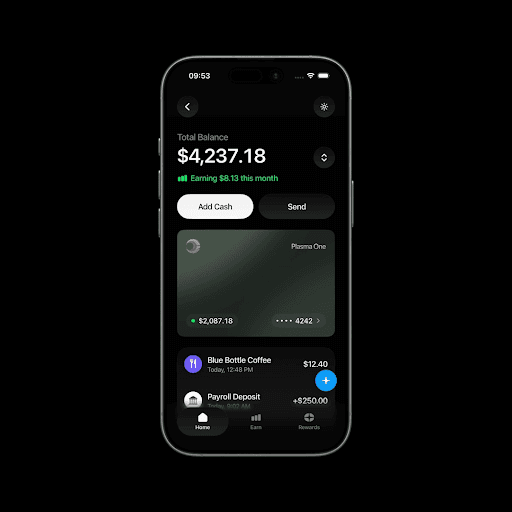
Plasma One is designed around stablecoins as everyday money rather than a broad trading stack. Users can hold stablecoins, spend with Visa, use regional funding rails, and opt into Earn.
That structure reduces the number of products a user needs to understand before making an everyday purchase. Plasma One does not bundle futures trading or a broad token marketplace into the account.
Tria offers broader asset support, which is useful for active crypto users. Plasma One’s advantage is focus, particularly for someone who mainly wants to hold digital dollars, move money, earn on eligible balances, and spend.
2. Clearer Card-Tier Economics
Plasma One publishes Core at $199 per year or a 20,000 XPL lock for 12 months, while Lite pricing varies by region and is shown in-app. Platinum requires locking 100,000 XPL for 12 months.
Its published card costs also separate the expected FX structure by tier. Lite is about 2% total including the typical Visa fee, Core about 1.5%, while Platinum has 0% Plasma FX markup and uses the Visa exchange rate.
Tria can be competitive, but its public pricing is harder to compare. Marketing pages, help-center guidance, and legal card terms can show different card, FX, and ATM figures.
For a user comparing expected card costs before joining, Plasma One gives a more consistent tier framework. Tria users need to confirm which regional card program and fee schedule apply to them.
3. Optional Yield Without Tria’s Boosted-Reward Structure
Plasma One offers up to 6% variable yield through opt-in Earn. Returns are not guaranteed, but Earn remains separate from basic card spending.
Tria advertises higher maximum yield, but boosted rewards can require a three-month lock and vault fees apply. Users who want a simpler Earn setup may prefer Plasma One.
Tria vs Plasma One at a Glance
Feature | Tria | Plasma One |
Custody Model | Non-custodial wallet; card collateral stays user-owned, but the issuer can liquidate it to cover unpaid card obligations | Non-custodial (you own and custody your stablecoins) |
Yield / Return on Balance | Up to 15% advertised through Tria Earn, depending on tier and vault | Up to 6% via opt-in Earn; variable, not guaranteed |
FX / Conversion Fees | 0% Tria FX fee advertised. International card terms permit FX fees up to 3% plus international transaction fees up to 1%; US terms permit international transaction fees up to 3% | Lite: ~2% total (1% Plasma + ~1% Visa); Core: ~1.5% total (0.5% Plasma + ~1% Visa); Platinum: 0% FX fee, Visa exchange rate applies |
Staking / Lock-In Required | No stake or lock is required for card membership. Boosted Earn rewards require a minimum three-month lock. Staking Badge boosts are limited to eligible existing badge holders | None on Lite; Core: $199/year or 20,000 XPL locked for 12 months; Platinum: 100,000 XPL locked for 12 months |
Regional Availability | KYC available across 200+ supported regions, including the US; card spending advertised in 150+ countries | Most countries, excluding 7 restricted countries; 27 US states |
On / Off-Ramp | Crypto top-ups from Tria or external wallets across multiple networks; provider fees can apply | In-app bank off-ramps (rails vary by region); USD ACH withdrawal 0.10% to 0.75% by tier plus ACH fee |
Fees, rates and limits as of October 2026. Terms vary by region and may change.
Final Verdict: Is Tria Worth It?
Tria is worth considering for active crypto users who want non-custodial control, high headline cashback, broad asset support, travel features, and access to Earn, swaps, and trading from one app.
Its main trade-off is complexity. Fee schedules differ across public materials, cashback can be delayed, and higher Earn rewards add extra conditions and DeFi risk.
Overall, Plasma One is stronger for users who want a simpler stablecoin-first account with a no-lock Lite tier, clearer tier pricing, and optional variable Earn without the wider trading stack.
How to Get Started With Plasma One
Download the App: Install Plasma One, confirm your country is supported, and complete identity verification.
Fund Your Wallet: Your non-custodial wallet is created in the app. Add supported stablecoins or use the available regional funding rails.
Start Earning & Spending: Opt into Earn if you want variable yield, then use your Plasma One Visa card where supported.
Get Plasma One: Claim your Plasma One card