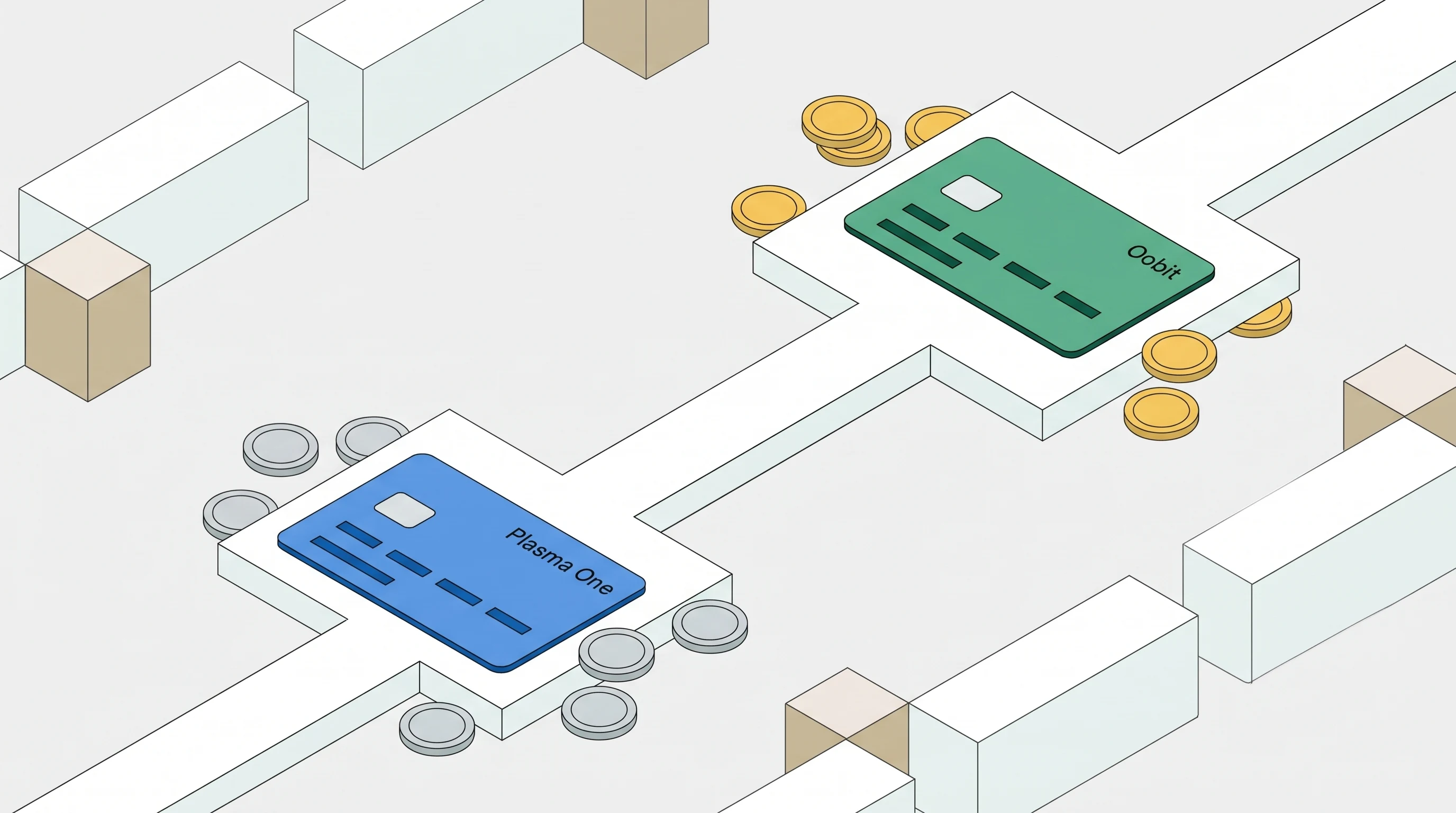
Executive Summary & Quick Verdict
Winner: Tria. For eligible users, its wider rewards bands, optional Earn, and physical-card choices make it the stronger all-round package, although membership and top-up costs matter.
Choose Oobit if: You want a virtual card with no issuance or monthly fee, direct payments from a supported non-custodial wallet, and no annual membership.
Choose Tria if: You want broader token top-ups, tiered USD₮ cashback, optional DeFi yield, and physical-card ATM access.
The Bottom Line: Oobit is easier for wallet-first spending; Tria offers more features but adds pre-funding and membership decisions. Plasma One provides a stablecoin-focused third option with non-custodial balances, bank rails, and optional Earn.
Oobit vs Tria at a Glance
Feature | Oobit | Tria |
Card Network | Visa virtual card; Apple Pay and Google Wallet supported where eligible | Visa |
Custody Model | Non-custodial when paying via DePay from an external wallet; balances in the built-in Oobit account are custodial (held by Oobit for your benefit) | Non-custodial; Tria says it does not custody user digital assets or private keys |
Yield / Return on Balance | No standard yield on idle payment balances publicly disclosed; separate spending rewards apply | Variable yield via optional Earn; membership-dependent boosts, with current rates shown in the app |
FX / Conversion Fees | 1% card-payment fee (usually $0.25 minimum); non-USD purchases may add a 1.5% conversion fee | 0.5% Tria fee on every card purchase, plus 1% Visa fee on non-USD purchases (no separate Tria FX fee); network fees may apply |
Crypto Conversion Fee | Separate crypto swaps: 0.95%; 3% when buying OOB. No separate fixed card-spend spread published | No direct Tria deposit fee advertised; provider fees can vary with swaps, routing, or cross-chain transfers |
Staking / Lock-In Required | None for card use; 10% promotional cashback requires paying with OOB, not staking it | No stake required on any membership tier; staking-badge boosts currently apply only to eligible existing badge holders |
Regional Availability | Oobit reports 80+ supported countries, including the US; card not issued in 17 listed countries; new sign-ups closed in Brazil since October 31, 2026; KYC applies | Card available in a wide range of countries (check the in-app country list); card use marketed across 150+ countries |
Fees, rates and limits as of November 2026. Terms vary by region and may change.
Oobit vs Tria: Key Differences
1. Fees & Costs
Oobit has no card issuance or monthly membership fee. Its Visa payments cost 1% per purchase, usually with a $0.25 minimum. A payment in a currency other than USD may add 1.5%, making international spending materially more expensive.
Separate crypto swaps generally cost 0.95%, and ATM withdrawals cost 2.5%, excluding operator charges.
Tria charges 0.5% on every card purchase, plus a 1% Visa fee on non-USD transactions. Its standard annual renewal prices are $20 for Lite, $109 for Pro, and $250 for Max; promotional first-year offers may differ.
Tria does not add a direct card-top-up fee, but swaps, bridges, liquidity routing, and network activity can generate variable provider costs.
Tria's physical Pro and Max cards support ATM withdrawals at $1 plus 1%, with a $750 per-withdrawal limit and up to three attempts per day.
2. Yield, Cashback & Rewards
Oobit advertises 5% cashback when paying with eligible USD₮ or USDC, applied to only the first $200 of monthly eligible spending. Paying with OOB can earn 10% on a higher promotional spending band, but introduces OOB price exposure.
Reward terms and the FAQ publish different OOB caps, so check the current in-app limit. Rewards stay in the app: they cannot be withdrawn or transferred and can only be used on Tap to Pay payments.
A separate points program also rewards payment activity. Ordinary idle card balances do not publish a standard yield rate.
Tria Lite earns 1.5% on the first $1,000 of eligible spending each month, dropping to 0.5% thereafter. Pro pays 4.5% on the first $1,000 and Max 6% on the first $2,000; both earn 1% above their bands.
Cashback is distributed in USD₮ on Arbitrum, but users must claim it before the displayed deadline. An active membership is required to earn new cashback.
Tria Earn is separate from the card. Variable vault returns depend on strategy performance, while membership boosts require each deposit to remain for 90 days to retain its boosted reward.
3. Custody, Security & Control
Oobit's DePay feature connects wallets such as MetaMask, Trust Wallet, and Phantom. Assets remain in the external wallet until the user authorizes a purchase, which avoids pre-funding a separate card balance.
Funds deposited into the built-in Oobit account are held by Oobit on a custodial basis for the user's benefit, so connecting a wallet and depositing into the app are not identical custody arrangements.
Tria likewise provides a non-custodial wallet, but its card workflow explicitly requires a top-up. Eligible tokens are converted and credited to the card balance; after this step, card issuer rules, authorizations, and settlement affect what is spendable.
Tria Earn adds third-party smart-contract, liquidity, and strategy risks.
4. Usability & Regional Availability
Oobit supports BTC, ETH, USD₮ and other eligible assets, including payments across supported Ethereum, BNB Smart Chain, Solana, and Polygon routes. Its virtual Visa works online and through Apple Pay or Google Pay where supported.
Oobit says users can sign up in 80+ countries and lists a daily limit of up to $10,000, which may change; local eligibility and wallet compatibility still need checking.
Tria supports 1,000+ crypto assets for wallet-based card funding, although the available token and network depend on the top-up route.
It offers an immediate virtual Lite card and physical Pro or Max cards. Card top-ups generally require at least $10, or $50 for BTC; transfer times can increase during network congestion.
On November 18, 2026, Tria began a phased rollout of EUR account details for eligible users, expected to take about four weeks. Incoming SEPA transfers are converted to USDC for a partner fee of €1 plus 0.25% per deposit (Tria's own fee is 0% until December 31, 2026).
EUR withdrawals to a bank are not available.
Oobit is the faster fit for wallet-native tap-to-pay; Tria offers a richer funded-card toolkit.
Pros & Cons Comparison
Oobit
Pros:
Virtual Visa with no issuance fee, annual membership or token lock
Direct payments from supported external non-custodial wallets
BTC, ETH and stablecoin spending, with bank payouts in eligible markets
USD₮/USDC and OOB cashback on qualifying, capped purchases
Cons:
1% purchase charge and possible 1.5% non-USD conversion cost
Stablecoin cashback applies to a small monthly spending band
No standard yield on an idle card balance; access differs by region
Tria
Pros:
Non-custodial wallet and extensive multi-chain token funding
Up to 6% card cashback in Max, with rates above monthly bands
Separate variable Earn vaults and physical cards with ATM access
Lower published purchase fee for USD spending
Cons:
Annual membership needed for cashback and perks (the card still works if it lapses)
Card pre-funding can incur provider fees and variable settlement times
Cashback must be claimed; boosted Earn rewards need 90 days
Where Both Cards Fall Short
Neither advertised cashback rate is an unconditional net return. Oobit's rewards are tied to payment asset and spend caps; Tria's are tied to annual membership, qualifying transactions, claim deadlines, and tier-specific bands.
Both add costs beyond their headline rates: Oobit through its transaction and FX fees, Tria through membership, provider conversion, and card fees.
The Dilemma: Oobit removes pre-funding and annual commitment but has limited stablecoin cashback coverage. Tria gives active spenders more rewards and Earn options, but requires a funded card and more ongoing attention.
Why Choose Plasma One Over Oobit and Tria?
Plasma One is a stablecoin-first Visa account combining a non-custodial Cash balance, in-app bank transfers, and optional Earn.
1. Stablecoin Control With Integrated Bank Rails
Plasma does not custody the stablecoins backing the user's card account. Oobit offers similar control through connected external wallets, and Tria's wallet is non-custodial until funds are topped up to the card.
Plasma's difference is the integrated digital-dollar account, with supported deposits and withdrawals through ACH, wire, SEPA, Faster Payments, SPEI, PIX, and other local rails.
Available currencies, bank fees, document rules, and country eligibility vary. Plasma is strongest when moving between a bank and stablecoin spending is as important as the crypto card itself.
2. FX Benefits on Premium and Platinum
Plasma One Standard has no XPL lock (pricing depends on region) and earns up to 1% cashback in XPL on eligible purchases.
Premium offers up to 2% for $600 yearly or a 20,000 XPL lock, while Platinum offers up to 3% for $2,500 yearly or a 100,000 XPL lock. Rates are tiered across monthly spend bands, and XPL value can fluctuate.
Tria pays higher cashback at every tier (1.5%, 4.5% and 6% within its bands) in USD₮, and Oobit's USD₮ promotion is stronger on small qualifying spends.
Plasma's distinction is FX: Premium charges 0% FX on the first $3,000 of card spend each month (covering Visa's ~1% fee) and Platinum charges no FX fee. Standard pays a 1% Plasma markup plus the Visa FX fee.
Whether that saves money depends on spend: Premium costs $600 a year or a 20,000 XPL lock, while Tria charges 1.5% in total on non-USD purchases ($45 on $3,000).
3. Optional Earn Without a Cashback Claim Routine
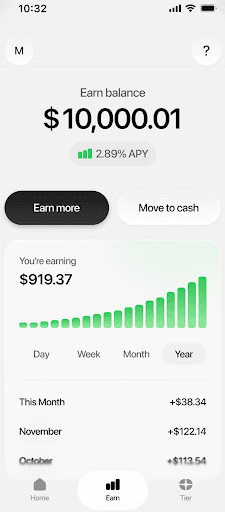
Plasma Earn is opt-in, variable and separate from Cash. Funds must be moved back into the spendable balance before purchases. Third-party DeFi vaults introduce smart-contract and principal-loss risks, so this is not bank interest or a guaranteed rate.
Oobit does not publish a comparable idle-balance yield product. Tria has richer onchain Earn choices, but boosted returns require 90 days and its card cashback must be claimed.
Three-Way Head-to-Head Matrix
Feature | Oobit | Tria | Plasma One |
Card Network | Visa virtual card | Visa | Visa |
Custody Model | Non-custodial when paying via DePay from an external wallet; balances in the built-in Oobit account are custodial (held by Oobit for your benefit) | Non-custodial; Tria says it does not custody user assets or private keys | Non-custodial (you own and custody your stablecoins) |
Yield / Return on Balance | No standard yield on idle card balances publicly disclosed; promotional spending rewards | Variable yield via optional Earn; membership-dependent boosts, with current rates shown in the app | Variable yield via opt-in Earn |
FX / Conversion Fees | 1% card-payment fee (usually $0.25 minimum); non-USD conversion may add 1.5% | 0.5% Tria fee on every card purchase, plus 1% Visa fee on non-USD purchases (no separate Tria FX fee); network fees may apply | Standard: 1% Plasma markup plus Visa FX fee (~1%); Premium: 0% FX on the first $3,000 of card spend per month; Platinum: 0% FX fee, Visa exchange rate applies |
Staking / Lock-In Required | None for card access; enhanced OOB cashback requires paying with OOB | No stake required on any membership tier; staking-badge boosts currently apply only to eligible existing badge holders | Standard: no XPL lock, regional pricing; Premium $600/yr or 20,000 XPL locked for 12 months; Platinum $2,500/yr or 100,000 XPL locked for 12 months |
Regional Availability | Oobit reports 80+ countries, including the US; card not issued in 17 listed countries; new sign-ups closed in Brazil since October 31, 2026 | Card available in a wide range of countries (check the in-app country list); card use marketed across 150+ countries | Most countries; 7 unsupported and ID-document restrictions in others. 31 US states |
On / Off-Ramp | External-wallet funding, crypto transfers, and bank payouts from 0.4% | Multi-network crypto top-ups (provider fees can apply); EUR bank deposits converted to USDC rolling out to eligible users from November 2026 (€1 + 0.25% partner fee per deposit); no bank withdrawals | In-app USD bank on/off-ramp; tiered fees apply |
Fees, rates and limits as of November 2026. Terms vary by region and may change.
Final Verdict: Which Should You Pick?
Tria wins the head-to-head for eligible active spenders. Its published 1.5% Lite cashback band, higher Pro/Max rates, optional Earn, and physical cards outweigh the cost and effort of pre-funding for users who regularly pay with crypto.
Choose Oobit for zero-membership, mobile-first payments directly from a connected wallet, especially if you only make occasional crypto purchases and do not need a yield product.
Choose Tria for a wider token range, physical-card cash access, and higher qualifying cashback, provided you accept its annual tiers and converted card balance.
Choose Plasma One if you prioritize non-custodial stablecoin Cash, integrated bank transfers, optional separate Earn, and clearly differentiated FX tiers over the highest headline cashback.
How to Get Started With Plasma One
Download Plasma One: Install the app, check your country and ID-document eligibility, and complete verification to create an eligible virtual Visa card.
Deposit Stablecoins: Fund your non-custodial Cash balance from a supported wallet or bank rail; opt into Earn only if you accept variable DeFi risk.
Start Spending Globally: Add your card to Apple Pay or Google Pay where supported and spend wherever Visa is accepted, subject to local card rules and fees.