Credit cards remain one of the leading payment methods in the U.S., accounting for 35% of consumer payments by number in 2024. Yet with ~$14 billion in domestic card fraud losses in 2023, security remains a pressing concern.
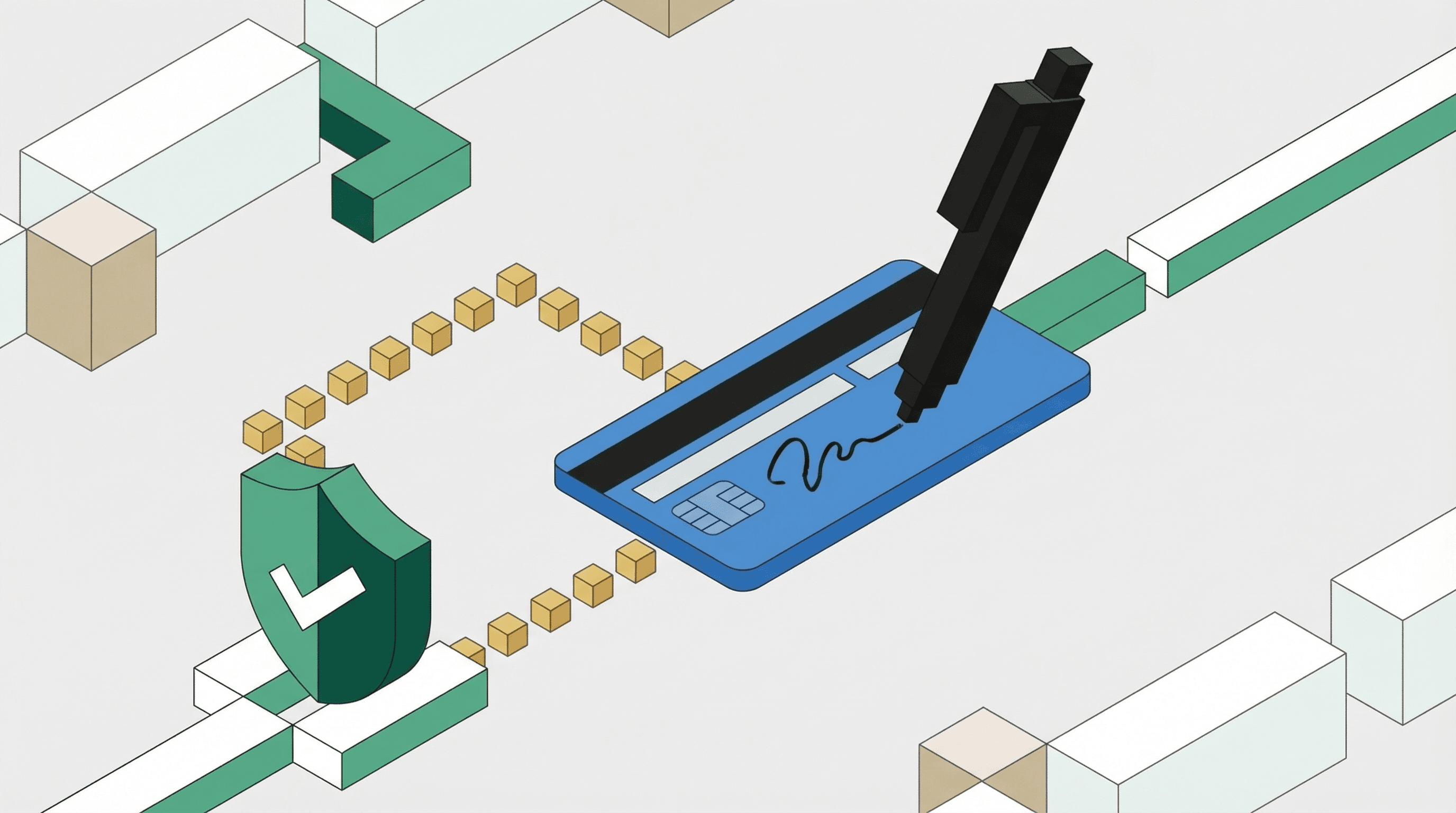
You should sign your credit card immediately upon receipt because it remains a requirement under card network rules, and an unsigned card is technically invalid, which can cause transaction denials even though the signature itself offers minimal fraud protection in the modern payment landscape.
This article examines the evolution of credit card signatures, explains how modern payment technology has changed security, and provides practical guidance on protecting your finances while complying with network requirements.
Key Takeaways
Some cards require issuers (when the card has a signature panel) to advise signing and state the card must be signed to be valid; other networks’ practices vary, and some cards may have no signature panel.
EMV chip technology has reduced counterfeit card fraud significantly at upgraded merchants, making signatures largely obsolete for security
Card-not-present fraud now dominates the threat landscape, with ~$350 million in scam-related fraud detected by Visa over twelve months and a 7% increase in infected merchant websites
The History of Credit Card Signatures
Why Signatures Once Mattered
Before electronic point-of-sale terminals existed, the signature on your credit card served as the primary verification tool for merchants.
Merchants used imprinters, known as "zip-zap machines," to create physical carbon copies of transactions by pressing embossed card details onto multi-part sales drafts.
The customer signed this draft to authorize the charge. Merchants were then contractually required to compare the signature on the sales draft with the signature panel on the back of the physical card.
Limitations of Signature Verification
The effectiveness of signature verification was always questionable. According to historical accounts from the late 1960s and 1970s, while merchants were contractually required to compare signatures, in practice, "few do." Criminals relied on speed and inattentive cashiers to avoid scrutiny.
The verification process itself was inherently subjective and problematic. Signature matching was subjective and operationally messy; over time, networks de-emphasized signature checks.
Some historical merchant guidance reduced signature checks to basic elements such as the first initial/letter and spelling of the surname, underscoring how limited and subjective signature verification was in practice.
This rule change underscored the inherent difficulty of using handwriting as a robust verification method. The ease of forging a passable signature, combined with the low probability of scrutiny, significantly limited the signature's ability to prevent fraud.
How Modern Credit Card Technology Has Changed Things
EMV Chips and Contactless Payments
Modern payment technology represents a fundamental security upgrade from the traditional magnetic stripe. The magnetic stripe contains static, unencrypted data that criminals can easily copy using simple skimming devices to create counterfeit cards.
In contrast, the EMV chip (Europay, Mastercard, and Visa) is a small microprocessor that actively communicates with the payment terminal. For each transaction, the chip generates a unique, one-time-use transaction code known as a cryptogram
This dynamic authentication data makes it extremely difficult to counterfeit chip transactions at chip-enabled terminals.
Visa reported an 87% reduction in counterfeit card-present fraud at upgraded U.S. merchants between September 2015 and March 2019. This dramatic decline demonstrates the chip's effectiveness and renders the signature largely obsolete for in-person transaction security.
EMV supports multiple cardholder verification methods, including Chip-and-PIN (where the cardholder enters a four-digit Personal Identification Number), Chip-and-Signature (where the cardholder signs a receipt or screen), no CVM, and consumer-device methods.
Chip-and-PIN is generally considered more secure because it verifies something you have with something you know.
Online and Mobile Transactions
Signatures are fundamentally a method for physical verification, making them completely irrelevant in e-commerce and mobile wallet environments.
In Card-Not-Present transactions, the merchant never sees the physical card or its signature panel, so security relies entirely on digital verification layers.
For e-commerce transactions, the primary security features are the CVV (Card Verification Value), a three- or four-digit code printed on the card, and AVS (Address Verification System), which checks the billing address and ZIP code against bank records.
Mobile wallet payments like Apple Pay and Google Pay employ even more robust security through tokenization. When a card is added to a mobile wallet, the actual 16-digit Primary Account Number is replaced with a unique, device-specific digital identifier called a token.
If a fraudster intercepts this token, it is useless because it is cryptographically tied to the specific device and cannot be used for fraudulent purchases elsewhere.
Authentication occurs through Consumer Device Cardholder Verification Method, using fingerprint scans, facial recognition, or device passcodes instead of signatures.
The Pros and Cons of Signing Your Card Today
Benefits of Signing Your Credit Card
Despite technological advances, Visa's Core Rules explicitly state that a card must be signed to be considered valid, and issuers are directed to advise cardholders to sign the card immediately.
Network practices vary; Mastercard has removed the signature-panel requirement, and AmEx’s requirements depend on the merchant agreement/program.
When presented with an unsigned card, merchants are instructed to request government-issued identification, have the customer sign the card in their presence, and then proceed with the transaction.
If the cardholder refuses to sign, the card remains invalid, and the merchant cannot accept it for payment. This protocol becomes particularly important in fallback situations where an EMV chip is unreadable, and the transaction must be processed via the magnetic stripe.
While many modern transactions do not require signature verification, signing your card prevents potential transaction refusal by merchants following protocol.
Compliance with network rules eliminates unnecessary friction at checkout, especially for transactions that revert to older verification methods due to technology failures.
Risks or Downsides
Some cardholders write “See ID” on the signature panel as a DIY anti-theft tactic. In Visa merchant guidance, a card marked “See ID” is treated as unsigned, which can cause acceptance issues.
The merchant is supposed to request your ID and have you sign the card on the spot.
This practice provides a false sense of security and can cause acceptance issues. Since merchants are generally prohibited from making ID a condition of acceptance under Visa's Core Rules, the strategy is ineffective as a deterrent to fraud.
The risk of a thief successfully using a stolen card by forging the signature on the back is relatively low compared to other fraud methods (e.g., account takeover, phishing, digital skimming).
Fraud has largely migrated to Card Not Present channels, with Visa's 2025 threats report highlighting a 7% increase in infected merchant websites for digital skimming in the second half of 2024.
For the few remaining scenarios where a signature might be checked, criminals often rely on the high probability that cashiers will not perform a diligent signature check.
The primary security vulnerabilities are data breaches, phishing, and digital skimming that enable large-scale online fraud, not signature forgery.
Additional Steps to Protect Your Credit Card
Physical Security Tips
Sign the signature panel when you receive the card, since some issuer and network rules still treat an unsigned card as invalid in certain merchant workflows.
Keep your card in a secure place, and avoid leaving it unattended at bars, restaurants, and shared workspaces where quick “card swapping” can happen.
If your card is lost or stolen, freeze it immediately in your issuer app, then request a replacement. Quick action reduces the window for in-person and online misuse.
Watch for skimming risk at unattended terminals, such as some fuel pumps and kiosks. When possible, use tap to pay, or choose a staffed terminal.
Avoid writing “See ID” on the signature panel. Some merchant procedures treat it like an unsigned card, which can create acceptance issues.
Digital Security Measures
Enable real-time notifications from your card issuer for all transactions via text message, email, or push notification from the mobile app. This provides immediate awareness of any activity on your account, allowing you to identify and report fraudulent charges to your bank quickly.
For online shopping, use virtual card numbers offered by your issuer. For in-person and online payments, consider using mobile wallets like Apple Pay or Google Pay, which rely on tokenization. If a merchant is breached, only the token is exposed, not your real card details.
In the U.S., you can consider placing a security freeze on your credit files with the three major credit bureaus: Equifax, Experian, and TransUnion. A freeze restricts access to your credit report, which can help prevent new credit accounts from being opened in your name.
Carefully review your monthly credit card statements, either online or on paper, to identify any unauthorized or suspicious charges. When requested, provide CVV, and use the billing address on file (for AVS where supported).
Fraud Response
In the U.S., the Fair Credit Billing Act provides legal protections for unauthorized credit card charges. It limits consumer liability in certain cases, especially when the fraud is reported promptly and within the timelines set by the statute.
Major card networks like Visa and Mastercard voluntarily offer zero liability policies for fraud transactions. These policies often provide greater protection than the minimum required by law, meaning the cardholder is typically not responsible for paying any amount for reported fraudulent charges.
If you identify fraudulent charges on your statement, contact your card issuer immediately. The sooner you report the fraud, the more protection you have under both federal law and network policies. Your issuer will typically cancel the compromised card and issue a replacement.
Conclusion: Should You Sign Your Credit Card?
While the signature is a legacy of a manual era, it remains a necessary step for full compliance with some card network regulations. Signing the back of your card minimizes friction at checkout and can reduce the chance of a merchant refusing the card in certain legacy/fallback situations.
To better protect your finances, rely on modern controls like tokenization, account alerts, and regular statement review rather than the signature alone. As payments evolve, basic physical habits, plus strong digital monitoring, remain the most practical combination.