Executive Summary & Quick Verdict
Winner: Tria. Its non-custodial setup, broader asset support, higher headline cashback, and wider DeFi feature set give crypto-native users more control and more ways to use their balances.
Choose KAST if: You want simpler USD-based spending, USD cashback redeemable toward future KAST card spending, a $0 entry tier, and straightforward 1:1 stablecoin-to-USD deposit conversion.
Choose Tria if: You want non-custodial control, support for 1,000+ assets, higher top-tier cashback, and one app for card spending, Earn, swaps, and trading.
The Bottom Line: KAST is simpler, while Tria gives users more control and a broader crypto toolkit. Plasma One is a third option for users who want non-custodial stablecoin spending and optional Earn without Tria’s wider trading stack.
KAST vs Tria at a Glance
Feature | KAST | Tria |
Card Network | Visa | Visa |
Custody Model | Partner-managed (Earn vaults non-custodial) | Non-custodial; Tria says it does not custody user digital assets or private keys |
Yield / Return on Balance | KAST Earn: up to 7% variable rate via non-custodial vaults. KAST Reserve: introductory cashback rewards of 8%, up to 10% on the first $50,000, and up to 12% on the first $200,000; promotional and subject to a $100M total Reserve-deposit threshold | Up to 15% variable on Max (6% Lite, 10% Pro); main site advertises up to 10% |
FX / Conversion Fees | 0.5%–1.75% depending on country and currency | 0% Tria FX marketed; Visa or issuer FX charges may still apply (card terms allow up to 3% FX plus up to 1% international fees) |
Crypto Conversion Fee | 0% spread on stablecoin deposits (1:1); other assets: varies by token and is shown before confirmation | No direct Tria deposit fee advertised; provider fees can vary with swaps, routing, or cross-chain transfers |
Staking / Lock-In Required | None for Standard membership or Reserve access | No stake required on any membership tier; staking-badge boosts currently apply only to eligible existing badge holders |
Regional Availability | Card usable at 150M+ merchants in 170+ countries; account availability varies by jurisdiction. | KYC available across 200+ supported regions; card use marketed across 150+ countries |
Fees, rates and limits as of October 2026. Terms vary by region and may change.
KAST vs Tria: Key Differences
1. Fees & Costs
KAST has the simpler published card-fee schedule. Standard costs $0 per year, Premium $1,000, and Private $10,000. Non-USD spending costs 0.5% to 1.75%.
ATM withdrawals cost $3 plus 2%. Stablecoin deposits convert at 1:1 with 0% spread, while the conversion cost for other assets varies by token and is shown before confirmation.
Tria’s fee picture depends more on the route and card program. It markets 0% Tria FX, but Visa or issuer FX charges may still apply, and its card terms allow up to 3% FX plus up to 1% international fees.
As of October 2026, Tria Lite costs $20 per year, Pro $109 and Max $250, and pricing may vary by region. Provider costs can also apply when card funding needs swaps, liquidity routing, or cross-chain transfers.
2. Yield, Cashback & Rewards
KAST Earn advertises up to 7% variable yield. USD Reserve pays introductory 8% to 12% by tier for a limited time, capped at $100 million in total deposits.
KAST cashback is denominated in USD at 1.5%, 2%, or 3% by tier and, once redeemed, can be used toward future KAST card spending. Premium and Private also earn KAST Points.
Tria lists variable Earn yields of up to 6% on Lite, 10% on Pro and 15% on Max, while its main site advertises up to 10%. Lite pays 1.5% on the first $1,000, Pro 4.5% on the first $1,000, and Max 6% on the first $2,000.
Tria has the stronger headline cashback and yield proposition, while KAST keeps rewards simpler through USD cashback and its Reserve product.
3. Custody, Security & Control
KAST uses a partner-managed spending model. Its card and account services rely on licensed partners, while separate Earn vaults are non-custodial.
The spending account therefore differs from KAST Earn. Users depend on KAST and its partners for everyday account access and payment infrastructure.
Tria is non-custodial. Its terms say Tria does not hold user funds, digital assets, collateral, or private keys.
This gives Tria the clearer custody advantage, with more responsibility for managing wallet access.
4. Usability & Regional Availability
KAST’s strongest usability advantage is simplicity. Users can fund a balance, earn USD cashback, use mobile wallets, withdraw at ATMs, and access payment rails where supported.
KAST states card access across 170+ countries, including the US, subject to eligibility.
Tria offers a broader crypto experience. It supports 1,000+ assets, mobile wallets, ATM withdrawals on Pro and Max (up to $750 per day), Earn, cross-chain funding, swaps, and perpetual trading.
Tria lists KYC across 200+ supported regions and card use across 150+ countries. KAST is simpler, while Tria is more flexible for multi-asset users.
Pros & Cons Comparison
KAST
Pros:
Simple USD spending: stablecoin deposits convert to USD at 1:1 with 0% spread.
Cashback in USD: 1.5% on Standard, 2% on Premium, and 3% on Private, usable only toward KAST card spending.
Broad account functionality: card spending, ATM withdrawals, bank-transfer rails, and availability across 170+ countries subject to eligibility.
Cons:
Partner-managed spending account: everyday card balances do not use the same non-custodial model as KAST Earn.
Higher tiers are expensive: Premium costs $1,000 per year and Private costs $10,000.
International spending adds cost: non-USD card transactions carry a 0.5% to 1.75% FX fee.
Tria
Pros:
Non-custodial control: Tria says it does not hold user digital assets or private keys.
Higher headline rewards: up to 6% cashback and up to 15% advertised Earn yield on Max.
Broader asset support: 1,000+ assets can fund a card connected to Earn, swaps, travel tools, and trading features.
Cons:
Fee calculations can be less predictable: provider, Visa, issuer, network, and routing costs can affect the final price.
Top cashback rates have monthly bands: rates fall after the first $1,000 on Lite and Pro or $2,000 on Max.
The product is more complex: users need to understand a wider wallet, Earn, staking, rewards, and trading ecosystem.
Where Both Cards Fall Short
Both cards make headline rewards conditional. KAST caps qualifying cashback spend on every tier, while Tria steps down after each tier’s monthly band.
Both require users to check FX costs and regional eligibility. KAST charges non-USD FX fees, while Tria’s final cost can depend on Visa, issuer, provider, and routing charges.
Both also require users to look beyond headline yield. KAST’s Reserve promotion has an end condition, while Tria’s Earn rate is variable and depends on the underlying strategy.
The Dilemma: KAST is simpler but uses partner-managed spending infrastructure. Tria gives users more control and broader crypto features, but adds more complexity and variable transaction costs.
Why Choose Plasma One Over KAST and Tria?
Plasma One sits between the two approaches with non-custodial stablecoin control and optional Earn, without KAST’s partner-managed spending model or Tria’s broader trading stack.
1. Non-Custodial Stablecoin Spending With a Narrower Scope
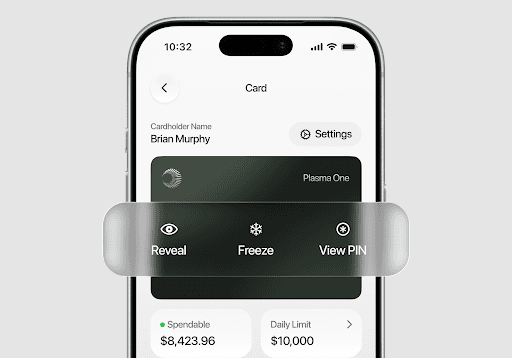
Plasma One does not custody stablecoins held in the account. It focuses on stablecoins, card spending, transfers, and optional Earn, creating a simpler middle ground.
For users who want direct asset control but do not need perps, 1,000+ funding assets, or staking boosts, Plasma One keeps the everyday card experience more focused.
2. Optional Stablecoin Earn Without Chasing the Highest Headline Rate
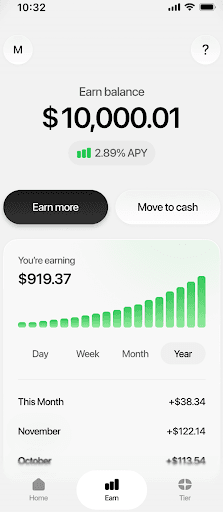
As of October 2026, Plasma One offers up to 6% variable yield through opt-in Earn. KAST and Tria advertise higher maximum returns, so Plasma One’s advantage is structure rather than the highest rate.
Earn is optional and stablecoin-focused. Users can separate card spending from the decision to take DeFi yield risk, rather than treating yield as part of a broader trading setup.
3. A Defined Card-Tier Path
Plasma One uses Lite, Core, and Platinum. Lite pricing varies by region and may be free; Core costs $199 per year or a 20,000 XPL lock for 12 months, and Platinum currently requires a 100,000 XPL lock for 12 months.
KAST’s paid tiers cost $1,000 and $10,000 per year, and Tria’s Pro and Max cost $109 and $250 (pricing may vary by region). Plasma One’s Core can be paid for or unlocked with XPL, and Platinum uses an XPL lock instead of an annual fee.
Three-Way Head-to-Head Matrix
Feature | KAST | Tria | Plasma One |
Card Network | Visa | Visa | Visa |
Custody Model | Partner-managed (Earn vaults non-custodial) | Non-custodial; Tria says it does not custody user assets or private keys | Non-custodial (you own and custody your stablecoins) |
Yield / Return on Balance | Earn: up to 7% variable. Reserve: introductory 8%, up to 10% on the first $50,000, and up to 12% on the first $200,000, subject to a $100M deposit threshold | Up to 15% variable on Max (6% Lite, 10% Pro); main site advertises up to 10% | Up to 6% variable via opt-in Earn |
FX / Conversion Fees | 0.5% to 1.75%, depending on country and currency | 0% Tria FX marketed; Visa or issuer FX charges may still apply (card terms allow up to 3% FX plus up to 1% international fees) | Lite: ~2% total (1% Plasma + ~1% Visa); Core: ~1.5% total (0.5% Plasma + ~1% Visa); Platinum: 0% FX fee, Visa exchange rate applies |
Staking / Lock-In Required | None | No stake required on any membership tier; staking-badge boosts currently apply only to eligible existing badge holders | None on Lite; Core $199/yr or 20,000 XPL lock; Platinum 100,000 XPL lock |
Regional Availability | 170+ countries, including the US, subject to eligibility | KYC in 200+ supported regions; card use marketed across 150+ countries | Most countries; 7 unsupported and ID-document restrictions in others. 31 US states |
On / Off-Ramp | Bank deposits: ACH $2, FedWire $15, SWIFT $30, SEPA 0.5% | Multi-network crypto top-ups; provider fees can apply; fiat on/off-ramp marketed as coming soon | In-app USD bank on/off-ramp; tiered fees apply |
Fees, rates and limits as of October 2026. Terms vary by region and may change.
Final Verdict: Which Should You Pick?
Tria wins the head-to-head for most crypto-native users. Its non-custodial setup, broader asset support, higher headline cashback, and wider Earn and trading functionality give it the stronger overall feature set.
Choose KAST if you want simpler USD-based spending, USD cashback redeemable toward future KAST card spending, broad bank-transfer rails, and a $0 entry tier. Its account model is easier to understand.
Choose Tria if you want non-custodial control, higher top-tier rewards, and one account for card spending, Earn, swaps, and trading. That flexibility comes with more fee and product complexity.
Choose Plasma One if you want non-custodial stablecoin spending and optional Earn without KAST’s partner-managed spending model or Tria’s wider trading stack.
How to Get Started With Plasma One
Download Plasma One: Install the app, complete identity verification, and create a virtual card.
Deposit Stablecoins: Fund your account, and optionally move eligible stablecoins into Earn for variable yield.
Start Spending Globally: Add the card to Apple Pay or Google Pay where supported and spend anywhere Visa is accepted, subject to regional eligibility and applicable fees.