Executive Summary & Quick Verdict
Winner: KAST. Its broader stated card reach, USD cashback, 1:1 stablecoin deposit conversion, and current Reserve promotion make it the stronger all-round option for stablecoin-focused spending.
Choose KAST if: You want simple USD-based spending, USD-denominated cashback redeemable toward future KAST card spending, no token lock for card membership, and broad international account features.
Choose Bybit if: You already use the Bybit exchange and want a higher headline cashback rate, subject to tier and monthly caps, Auto-Earn on eligible card assets, and direct access to trading and exchange balances.
The Bottom Line: KAST is simpler for stablecoin spending, while Bybit offers a deeper exchange ecosystem. Plasma One is a third option for users who want non-custodial stablecoin balances and optional Earn without keeping card funds in an exchange account.
KAST vs Bybit Card at a Glance
Feature | KAST | Bybit Card |
Card Network | Visa | Mastercard or Visa, depending on regional card program |
Custody Model | Partner-managed (Earn vaults non-custodial) | Custodial Funding Account used for card spending |
Yield / Return on Balance | KAST Earn: up to 7% variable rate via non-custodial vaults. KAST Reserve: introductory cashback rewards of 8%, up to 10% on the first $50,000, and up to 12% on the first $200,000; promotional and subject to a $100M total Reserve-deposit threshold | Variable through Easy Earn and Card Auto-Earn; no single standard APY |
FX / Conversion Fees | 0.5%–1.75% depending on country and currency | Regional card programs publish FX or international fees from 0.5% to 7% |
Crypto Conversion Fee | 0% spread on stablecoin deposits (1:1); other assets: varies by token and is shown before confirmation | 0.5% to 0.9% in several published regional programs; varies by region |
Staking / Lock-In Required | None for Standard membership or Reserve access | None for card use; higher cashback depends on spending tier or VIP status |
Regional Availability | Card usable at 150M+ merchants in 170+ countries; account availability varies by jurisdiction. | Limited regional card programs; not available to US residents; eligibility depends on residence and KYC |
Fees, rates and limits as of October 2026. Terms vary by region and may change.
KAST vs Bybit Card: Key Differences
1. Fees & Costs
KAST has the simpler published card-fee schedule. Standard costs $0 per year, Premium $1,000, and Private $10,000. Non-USD card spending carries a 0.5% to 1.75% FX fee.
ATM withdrawals cost $3 plus 2%. Supported stablecoin deposits convert to USD at 1:1 with 0% spread, which keeps basic USD funding easy to understand.
Bybit fees vary more by regional card program. Its current schedule lists foreign-exchange or international fees from 0.5% to 7% across the relevant Bybit and Bybit EU card programs, depending on region; some programs charge an international fee instead.
Crypto-funded spending can also carry a conversion fee. Several Bybit programs list 0.5% to 0.9%, while physical-card issuance and ATM costs vary by region.
2. Yield, Cashback & Rewards
As of October 2026, KAST Earn advertises up to 7% variable yield. Its USD Reserve offers introductory cashback rewards of 8% to up to 12% by tier for a limited time, subject to a $100 million total Reserve-deposit threshold.
KAST cashback is denominated in USD at 1.5%, 2%, or 3% by tier on the first $2,000, $10,000, or $40,000 of monthly qualifying spend. Once redeemed, cashback can only be used toward future KAST card purchases. Premium and Private can also earn KAST Points.
Bybit uses a broader rewards ladder. As of October 2026, Bybit Card cashback ranges from 2% to 10%, depending on monthly spending or VIP status, with monthly cashback caps of $5 to $600.
Starting October 5, 2026, Bybit cashback applies only to eligible crypto-funded card transactions. Rewards Points can be converted through Auto Cashback.
Bybit Card users can also enable Auto-Earn, which moves eligible payment assets into Flexible Easy Earn and can redeem them automatically for spending.
3. Custody, Security & Control
KAST uses a partner-managed spending model. Its everyday card and account services rely on KAST and licensed partners, while separate Earn vaults use a non-custodial structure.
Bybit uses a custodial exchange account model. Card payments draw from the Funding Account, which also handles crypto and fiat deposits, withdrawals, Earn, and other exchange services.
Bybit’s custody terms state that assets under its custody are held and controlled by Bybit, and users do not receive direct access to the relevant private keys.
Neither card gives the user non-custodial control over the everyday spending balance. The main difference is ecosystem: KAST is payments-focused, while Bybit connects the card to a larger exchange account.
4. Usability & Regional Availability
KAST is built around stablecoin banking. Users get Visa spending, ATMs, stablecoin transfers, and several fiat bank-transfer routes within one account.
KAST states card access across 170+ countries, subject to eligibility. That gives it the broader stated geographic reach of the two products.
Bybit is stronger for existing exchange users. The card draws directly from the Funding Account and supports virtual and physical cards, mobile wallets, adjustable limits, and Easy Earn integration.
Bybit Card availability is more region-specific. Bybit does not serve US residents, and users must select an eligible country and complete the card program’s identity checks before applying.
Pros & Cons Comparison
KAST
Pros:
Simple balance-based USD spending experience
USD-denominated cashback redeemable toward future KAST card spending
Broad Visa acceptance and international availability
Cons:
Partner-managed spending account reduces direct user control
Premium and Private tiers can be expensive
FX and ATM costs can reduce reward value
Bybit Card
Pros:
Up to 10% cashback through spending and VIP reward tiers, subject to monthly caps
Auto-Earn can keep eligible card assets in Flexible Easy Earn until needed for spending
Deep integration with Bybit trading, Earn, fiat, and crypto services
Cons:
Custodial Funding Account means users do not control the private keys to card balances
FX, crypto-conversion, ATM, and physical-card fees vary by regional card program
Card availability is limited to supported regions and can require separate regional platforms
Where Both Cards Fall Short
Both cards rely on custodial or partner-managed spending infrastructure. Users depend on the provider and its card partners to maintain everyday account access.
Both also make reward value conditional. KAST changes cashback by tier, while Bybit changes cashback through spending tiers, VIP status, caps, and funding eligibility.
International users must also check regional fees and eligibility. Neither merchant acceptance nor the card network means the account is available in every country.
The Dilemma: KAST offers simpler stablecoin banking and broader stated reach, while Bybit offers higher percentage cashback rates (with monthly caps) and deeper exchange integration at the cost of a more complex custodial ecosystem.
Why Choose Plasma One Over KAST and Bybit Card?
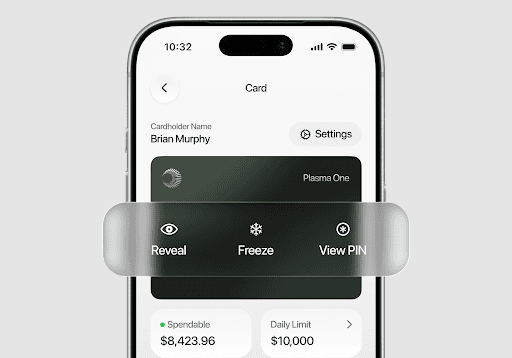
Plasma One offers a different model with non-custodial stablecoin balances, Visa spending, and optional Earn rather than keeping everyday card funds inside a provider-managed or exchange account.
1. Non-Custodial Control of Stablecoin Balances
Plasma One does not custody stablecoins held in the account. Users retain ownership of the assets supporting everyday card spending.
KAST uses partner-managed spending infrastructure, while Bybit Card draws from a custodial Funding Account. Plasma One creates a clearer separation between wallet ownership and card access.
2. Optional Earn Alongside a Non-Custodial Spending Balance
Plasma One offers up to 6% variable yield through opt-in Earn. The rate is not guaranteed and third-party DeFi risks apply.
KAST advertises higher promotional returns, while Bybit offers variable Easy Earn. Plasma One’s difference is structure: optional Earn sits alongside a non-custodial spending balance, rather than KAST’s partner-managed spending account or Bybit’s custodial Funding Account.
3. A Defined Card-Tier Path
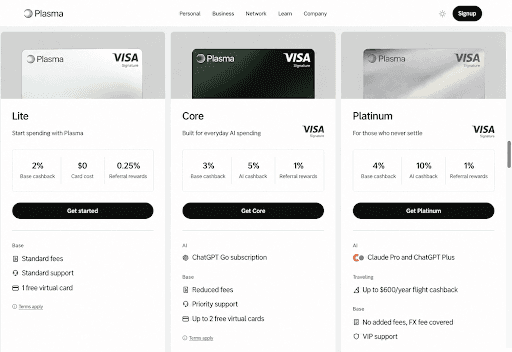
Plasma One uses Lite, Core, and Platinum. Lite pricing varies by region and may be free, Core costs $199 per year or a 20,000 XPL lock for 12 months, and Platinum currently requires a 100,000 XPL lock for 12 months.
KAST’s upper tiers cost $1,000 and $10,000. Bybit’s reward level depends on spending or VIP status. Plasma One’s Core tier costs $199 per year, compared with $1,000 for KAST Premium, though Platinum currently requires an XPL lock rather than an annual cash fee.
Three-Way Head-to-Head Matrix
Feature | KAST | Bybit Card | Plasma One |
Card Network | Visa | Mastercard or Visa, depending on regional card program | Visa |
Custody Model | Partner-managed (Earn vaults non-custodial) | Custodial Funding Account | Non-custodial (you own and custody your stablecoins) |
Yield / Return on Balance | Earn: up to 7% variable. Reserve: introductory 8%, up to 10% on the first $50,000, and up to 12% on the first $200,000, subject to a $100M deposit threshold | Variable through Easy Earn and Card Auto-Earn; no single standard APY | Up to 6% variable via opt-in Earn |
FX / Conversion Fees | 0.5% to 1.75%, depending on country and currency | Regional FX/international fees range from 0.5% to 7%; crypto conversion generally 0.5% to 0.9% where supported | Lite: ~2% total (1% Plasma + ~1% Visa); Core: ~1.5% total (0.5% Plasma + ~1% Visa); Platinum: 0% FX fee, Visa exchange rate applies |
Staking / Lock-In Required | None | None for card use; reward tiers depend on spending or VIP status | None on Lite; Core $199/yr or 20,000 XPL locked for 12 months; Platinum 100,000 XPL lock for 12 months |
Regional Availability | 170+ countries, including the US, subject to eligibility | Limited regional card programs; not available to US residents; eligibility depends on residence and KYC | Most countries; 7 unsupported and ID-document restrictions in others. 31 US states |
On / Off-Ramp | Bank deposits: ACH $2, FedWire $15, SWIFT $30, SEPA 0.5% | Funding Account supports crypto deposits/withdrawals, fiat deposits/withdrawals, P2P, and One-Click Buy | In-app USD bank on/off-ramp; tiered fees apply |
Fees, rates and limits as of October 2026. Terms vary by region and may change.
Final Verdict: Which Should You Pick?
KAST wins the head-to-head for most global stablecoin spenders. Its broader stated availability, USD cashback, 1:1 stablecoin deposit conversion, and Reserve promotion make the card easier to evaluate as a payments product.
Choose KAST if you want simple USD spending, broader international account features, and USD-denominated cashback redeemable toward future KAST card spending, without linking card value to exchange VIP status.
Choose Bybit if you already use the exchange and want higher percentage cashback rates, Auto-Earn, trading integration, and one Funding Account for crypto, fiat, Earn, and card spending.
Choose Plasma One if you want non-custodial stablecoin balances and optional Earn without relying on KAST’s partner-managed spending account or Bybit’s custodial exchange balance.
How to Get Started With Plasma One
Download Plasma One: Install the app, complete identity verification, and create a virtual card.
Deposit Stablecoins: Fund your account, and optionally move eligible stablecoins into Earn for variable yield.
Start Spending Globally: Add the card to Apple Pay or Google Pay where supported and spend anywhere Visa is accepted, subject to regional eligibility and applicable fees.