Executive Summary & Quick Verdict
Overall Rating: 3.5 / 5. Holyheld combines non-custodial crypto control with a Mastercard, personal IBAN, payment rails, and variable DeFi yield. Its public card pricing and availability are less straightforward than its feature set.
Best For: Crypto users who want a non-custodial wallet alongside a personal IBAN, Mastercard spending, Apple Pay or Google Pay, and broad onchain payment connectivity.
Core Drawback: Personal membership is invitation-only, while Holyheld’s public card fee page, reward details, and card limits do not provide the same level of current pricing clarity across every feature.
The Bottom Line: Holyheld is a capable bridge between crypto and traditional payments. Plasma One may suit users who want published card tiers, defined cashback bands, and a stablecoin-first Earn and spending experience.
What Is Holyheld?
Holyheld is a Swiss fintech company operated by Holyheld Labs AG. Its personal membership combines fiat accounts, stablecoins, card spending, and crypto exchange tools through Holyheld and regulated partners.
Personal membership is by invitation, with each application reviewed individually. Holyheld does not publish a complete consumer eligibility list.
Card Type: Virtual and physical debit cards.
Network: Mastercard.
Custody Model: Non-custodial for crypto assets; e-money and card services are provided by regulated partners.
Supported Assets / Currencies: USDC is supported directly by Holyheld’s exchange service, while the wider product integrates 150+ stablecoins, protocols, and networks.
Key Features & User Benefits
1. Rewards & Cashback Structure
Holyheld’s fee schedule, last updated March 2025, lists 0.5% cashback for Classic and Limited Edition cards and 1% for Metal, with cashback paid in USDC.
Holyheld also promotes referral and travel rewards, but its personal pages do not publish one unified reward table.
2. Supported Currencies & Conversion
Holyheld connects 20+ blockchain networks and integrates with a wider set of stablecoins, protocols, and onchain assets.
Its terms state that USDC is supported directly by Holyheld’s exchange service. Other assets can appear through third-party integrations. Exchange orders show the rate and fees before confirmation.
3. Card Usability & Accessibility
Holyheld offers virtual and physical Mastercard debit cards, Apple Pay, Google Pay, card freezing, 3D Secure, and passkey-based signing.
Merchant acceptance is not membership eligibility. Personal access is invitation-only, and Holyheld does not publish a complete consumer eligibility list.
Holyheld’s fee schedule, last updated March 2025, lists €1 for ATM withdrawals in the EEA and 2.5% + €2 elsewhere.
Fee Structure & Limits
Fee / Limit | Holyheld | Industry Average |
Card Issuance Fee | Classic: €29; Limited Edition virtual: €99; Metal: €199 (fee schedule dated March 2025) | Virtual: $0–$25, typically $0. Physical: $0–$100+, typically $0–$50. |
Monthly / Annual Fee | CHF 0/year for individual membership, by invitation | Usually $0 on entry tiers. Paid entry-tier exceptions start around $25/year. |
Foreign Exchange Fee | No separate FX markup published; international card payments cost 2.5% + €1 (fee schedule dated March 2025) | 0%–3%, typically around 1%. |
Crypto Conversion Fee | No fixed exchange spread published; on-ramp and off-ramp transfers each cost 1%, with the quote and fees shown before confirmation | Stablecoins: 0%–0.5%, typically 0%–0.1%. Other crypto: ~0.5%–1%, typically around 0.9%. |
ATM Withdrawal Fee | EEA: €1; elsewhere: 2.5% + €2 (fee schedule dated March 2025) | 0%–3%, typically around 2%. Many cards include ~$100–$200/month free; some instead charge a ~$1–$3 flat fee. |
Daily Spending Limit | Not publicly disclosed | About $5,000–$50,000, typically $10,000–$25,000. Some cards use higher or dynamic limits. |
Fees, rates and limits as of October 2026. Terms vary by region and may change.
Pros & Cons of Holyheld
Pros
Non-custodial crypto model: Holyheld says users remain the sole owners of crypto assets in their connected wallets.
Broad payment functionality: Personal IBAN, Mastercard, ACH, SEPA, wires, Apple Pay, Google Pay, and multi-network support sit in one account.
Flexible DeFi access: As of October 2026, USDC can earn variable APY through Morpho vaults, with withdrawals available when users want to return funds to card spending.
Cons
Invitation-only access: Holyheld reviews personal applications individually and does not publish a complete consumer eligibility list.
International card costs can be high: The public fee page lists 2.5% + €1 for international card payments and 2.5% + €2 for international ATM withdrawals.
Some key card details are less transparent: Daily spending limits and a newer consolidated reward schedule are not publicly disclosed.
Where Holyheld Falls Short
The biggest limitation is public pricing clarity. Holyheld’s card fee page is dated March 2025, while newer 2026 pages describe invitation-based membership and separate transfer pricing.
International use can also be expensive. The published fee page lists 2.5% + €1 for international card payments, while international ATM withdrawals cost 2.5% + €2.
Holyheld’s current personal pages do not consolidate cashback and travel rewards into one clear tier table, so users need to confirm live terms. Its Morpho APY is also variable.
Availability also needs checking before funding an account. Personal membership is by invitation, and the public site does not provide a full global list of countries where individuals can open and use the card.
Key Takeaway: Holyheld offers strong non-custodial wallet and payment functionality, but users should confirm live card pricing, reward terms, limits, and eligibility before relying on the published feature set.
Why Choose Plasma One Over Holyheld?
Holyheld has the broader payment toolkit. Plasma One focuses on stablecoins, published card tiers, optional Earn, and everyday Visa spending. That narrower scope can be easier to compare before signup.
1. Clearer Card-Tier Economics
Plasma One publishes three tiers. Lite pricing varies by region and may be free; Core costs $199 per year or a 20,000 XPL lock for 12 months. Platinum currently requires a 100,000 XPL lock for 12 months.
Its FX structure gives users a tier-by-tier benchmark: Lite: ~2% total (1% Plasma + ~1% Visa); Core: ~1.5% total (0.5% Plasma + ~1% Visa); Platinum: 0% FX fee, converting at the Visa exchange rate with nothing added.
Holyheld has no annual individual membership charge, but card issuance and international-use fees are separate. Classic costs €29, Metal €199, and international card payments are listed at 2.5% + €1.
2. A Published Stablecoin Earn Headline
As of October 2026, Plasma One offers up to 6% variable yield through opt-in Earn. Returns are not guaranteed and the feature uses third-party DeFi protocols.
Holyheld also offers variable DeFi yield through Morpho, but its public personal materials do not state one standard APY. Users need to check the live vault rate before comparing returns.
Both involve DeFi risk. Plasma One’s advantage is not a guaranteed higher return, but a published headline rate that is easier to compare before depositing.
3. Defined Cashback and Tier Progression
Plasma One has published cashback bands across Lite, Core, and Platinum, with headline base rates of 2%, 3%, and 4% before rates step down across higher monthly spend. Base card cashback is currently paid in XPL.
Holyheld’s fee page lists 0.5% cashback for Classic and Limited Edition cards and 1% for Metal. The newer personal site does not consolidate its reward programs into one tier table.
For card-reward comparisons, Plasma One gives a more defined upgrade path. Holyheld suits users who value broader payment rails more than maximizing cashback.
Holyheld vs Plasma One at a Glance
Feature | Holyheld | Plasma One |
Custody Model | Non-custodial crypto wallet; card and e-money services provided through partners | Non-custodial (you own and custody your stablecoins) |
Yield / Return on Balance | Variable APY on USDC through Morpho vaults; no fixed public rate | Up to 6% via opt-in Earn; variable, not guaranteed |
FX / Conversion Fees | International card payments (outside the EEA): 2.5% + €1 per Holyheld's March 2025 fee schedule; 1% on-ramp and 1% off-ramp fees for individuals | Lite: ~2% total (1% Plasma + ~1% Visa); Core: ~1.5% total (0.5% Plasma + ~1% Visa); Platinum: 0% FX fee, Visa exchange rate applies |
Staking / Lock-In Required | No token lock disclosed for personal membership; Earn withdrawals are flexible | None on Lite; Core: $199/year or 20,000 XPL locked for 12 months; Platinum: currently 100,000 XPL locked for 12 months |
Regional Availability | Personal membership is by invitation; full consumer eligibility list not publicly disclosed. Holyheld’s July 2026 terms state they govern users resident in or located in Switzerland | Most countries; 7 unsupported and ID-document restrictions in others. 31 US states |
On / Off-Ramp | Individuals: 1% on-ramp and 1% off-ramp; outgoing ACH $1, SEPA €1, wires $20 | In-app bank off-ramps (rails vary by region); USD ACH withdrawal 0.10% to 0.75% by tier plus ACH fee |
Fees, rates and limits as of October 2026. Terms vary by region and may change.
Final Verdict: Is Holyheld Worth It?
Holyheld is worth considering for users who want more than a crypto card. Its non-custodial wallet model, personal IBAN, Mastercard, payment rails, multi-network support, and Morpho integration make it a broad money-management product.
The main trade-offs are invite-only access and less consolidated card pricing. Users who prioritize a personal IBAN, ACH, SEPA, wires, and multi-network connectivity may still find the trade-offs acceptable.
Plasma One may be the stronger alternative for users who want a stablecoin-first card with published reward tiers, clearer FX progression, and a public Earn headline rather than a broader global-payments account.
How to Get Started With Plasma One
Download the App: Install the Plasma One app, confirm your country is supported, and complete identity verification.
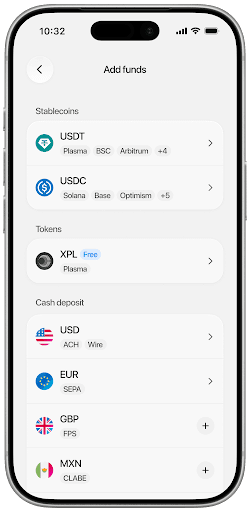
Fund Your Wallet: Your non-custodial wallet is created in the app. Fund it with supported stablecoins.
Start Earning & Spending: Opt into Earn if you want yield on eligible balances, and spend with your Plasma One Visa card where supported.