Stablecoins are now at the core of global online payments, with total transaction volumes topping $1.8 trillion in November 2025. Their stability, ease of access, and versatility has transformed stablecoins into a $300 billion global industry as of November 2025.
Stablecoins can be bought quickly and easily in a variety of ways, all you need is a crypto wallet and some basic knowledge. Once you’ve purchased your first stablecoins, you’ll be able to use them to trade crypto assets and to pay for goods and services.
This article explains where and how to purchase stablecoins and outlines the process for buying them whenever you need access.
Preparing to Buy Stablecoins
Choosing a Reliable Exchange or Platform
Today, stablecoins support a wide range of use cases and users. Having been deeply embedded into the blockchain industry, and increasingly to the traditional financial sector too, there’s an array of ways to buy stablecoins, from neobank apps to cryptocurrency exchanges.
Because stablecoins are issued on blockchain networks, one of the easiest places to purchase them is from exchanges and platforms that support cryptocurrencies. This includes centralized exchanges (CEXs), decentralized exchanges (DEXs), and token swap services. Let’s briefly consider each in turn.
There are hundreds of centralized crypto exchanges on the market that support digital assets including stablecoins. Some of the best known CEXs include Binance, Coinbase, and Kraken, but the exchanges available in your region may differ due to regulations and the needs of the local market.
Whichever CEX you choose, look for one with a good track record in terms of security.
Upon signing up to the exchange, you’ll be required to verify your identity before you can make your first stablecoin purchase.
Decentralized exchanges such as Uniswap (on Ethereum) and Jupiter (on Solana) provide an alternative way to buy stablecoins. To get started, you will require a web wallet such as Rabby (Ethereum) or Phantom (Solana). This holds your digital assets, including any stablecoins that you buy on a DEX.
Alternatively, you can buy stablecoins from a token swap service such as ChangeNOW or directly within a web wallet.
Many wallets, including MetaMask and Exodus, enable you to purchase cryptocurrencies and stablecoins using your debit card.
Understanding KYC and Account Setup
As noted above, CEXs require you to complete verification, KYC (Know Your Customer) before you can purchase crypto assets.
This is because centralized exchanges are regulated by financial authorities and are required to adhere to anti-money laundering rules and other laws dictating the customers they serve.
Completing CEX verification usually takes less than 10 minutes and requires a government-approved ID, such as a passport or driving licence, and a selfie holding this ID. After completing this process, you will not be required to undertake it on subsequent occasions.
Decentralized exchanges, on the other hand, as well as token-swap services such as ChangeNOW, generally don’t require KYC to access, which means you can instantly purchase stablecoins provided you already have cryptocurrency in your wallet with which to purchase them.
However, if you have no crypto in a web wallet, you will need to purchase some using an integrated fiat onramp, and this process does require verification. As a result, you will almost certainly need to complete verification at some stage in order to make your first stablecoin purchase.
Checking Availability by Region
Because CEXs (as well as some DEXs) are only licensed to operate in specific regions, there are some platforms where you will not be able to buy stablecoins. Most crypto platforms perform geo-filtering, excluding visitors based on IP addresses that are not authorized to sign up.
Visiting the platform and checking if you can connect or sign up is the quickest way to determine if you can use it. If you’re unsure, however, perform an internet search for the exchange you wish to use to check that it’s allowed to operate in your region, or search for exchanges that are.
Funding Your Account
Before you can purchase stablecoins, you need to have funds in your account with which to do so. If you’re using a CEX, this means using one of the supported options for depositing fiat currency from your debit card or bank account in most cases.
Many CEXs support a number of payment processors, allowing you to deposit funds using options such as PayPal, bank transfer, and debit cards. Many decentralized exchanges and web wallets also offer the ability to make fiat purchases by debit card via crypto onramps such as MoonPay and Simplex.
If you already have cryptocurrency in a web wallet that is connected to a DEX, you can skip this step and purchase a stablecoin such as USD₮ instantly using the native currency of the network in question such as ETH or SOL.
P2P Options
There is another option for purchasing stablecoins that doesn’t require using a CEX or DEX and that’s to utilize a P2P marketplace. Platforms such as Localcoinswap enable individuals to buy and sell digital assets peer-to-peer in private.
The seller of the stablecoin you wish to buy will list the payment methods they are willing to accept, with the most common being bank transfer. The cryptocurrency is held in escrow until you send the fiat currency to the seller and mark the payment as complete.
How to Buy Stablecoins (Step by Step)
Buying on Centralized Exchanges
To buy stablecoins on a CEX, visit the market for the stablecoin you wish to buy e.g. USD₮ or USDC. It will be paired against another asset, such as USD (fiat currency that you have deposited into your exchange account) or BTC.
Enter the amount of stablecoins you wish to purchase using your base currency, click Buy and the trade will be executed. Your exchange wallet will be credited with the stablecoins as soon as the trade has been completed.
Buying on Decentralized Exchanges (DEXs)
To buy stablecoins on a decentralized exchange, visit the platform (e.g. Jupiter) you wish to use and connect your web wallet. You can enter the name of the stablecoin you wish to buy into the search bar to find its market, before following the same steps as above when buying on a CEX.
Swapping Other Crypto for Stablecoins
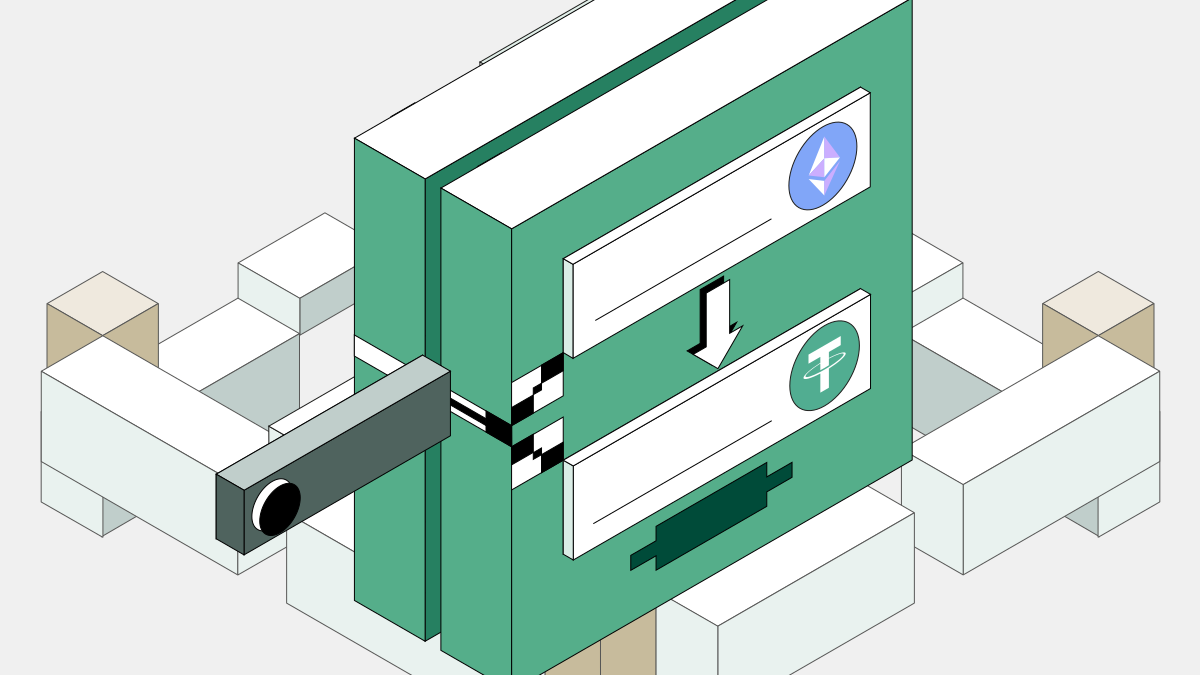
CEXs, DEXs, and token swap platforms allow you to swap a wide range of cryptocurrencies for stablecoins. The only requirement, of course, is that you must hold the crypto you wish to use in your CEX account or web wallet.
Provided the CEX offers a direct market for the crypto you wish to exchange the stablecoin for, you can make the purchase.
DEXs will allow you to buy your desired stablecoin using any of the cryptos they support because the order is routed through liquidity pools, allowing any token to be swapped for any other.
Using Crypto ATMs
Another option for buying stablecoins is to use a crypto ATM. Much like conventional ATMs, these devices can be found in various real-world stores, coffee shops, and other outlets.
Crypto ATMs allow you to deposit funds using debit card or cash in some cases and, after completing verification, to purchase digital assets such as stablecoins.
Factors to Consider Before Buying
Transaction Fees and Hidden Costs
All cryptocurrency purchases carry a fee of some kind. On a CEX, typical trading fees are in the range of 0.1-0.3% of the transaction value, depending on the platform and account tier. If you are purchasing $1,000 of stablecoins, therefore, expect to pay around $2.50 in fees.
Should you then withdraw the stablecoins to your personal crypto wallet, you will also be charged a withdrawal fee to cover the costs of the network fee, plus a small surcharge the exchange will impose, which is likely to amount to approximately $5 depending on the network used.
On a DEX, you will be charged an average of 0.1% in swap fees plus the network cost associated with the transaction which covers the amount of native token that must be paid in “gas” to execute the transaction.
P2P marketplaces also charge a similar fee, as do token swap services and fiat onramps that enable you to purchase stablecoins using a debit card. Altogether, as much as 1% of the total transaction size can be absorbed in transaction fees and other hidden costs such as gas.
Supported Stablecoins
As of November 2025, the leading stablecoins by market cap are Tether (USD₮) at ~$183 billion, USDC at ~$74 billion, and Ethena’s USDe at ~$7.62 billion. Most major CEXs and DEXs support these as well as DAI, PYUSD (PayPal), and others, though availability may vary by network and region.
Note that some stables are only available on certain crypto networks, so if purchasing on a CEX, be sure to acquire a stablecoin that can then be withdrawn to the network you wish to use.
Location-Based Restrictions
While some CEXs are available globally, allowing users in most countries to access them, others are highly regional in nature and will prohibit users from certain jurisdictions from signing up.
DEXs, in comparison, are less restrictive, although some decentralized exchanges prohibit users from regions such as the U.S. or U.K. using geo-based IP filtering. Check that the exchange you wish to use is authorized to operate in your country before signing up.
Security and Custody of Funds
If you purchase stablecoins on a CEX, they remain in the custody of the exchange until you withdraw them to a personal wallet. Purchases made on a DEX, however, have no custodial risk because the assets are stored in your own wallet which only you can control.
By February 2025, the number of active stablecoin wallets worldwide exceeded 30 million, reflecting 53% annual growth.
Storing Your Stablecoins Safely
After purchasing stablecoins, there are several options for storing them, each with its pros and cons.
A custodial wallet is one that’s controlled by a platform such as a CEX. Holding your funds in a custodial wallet is convenient, because you do not need to control the private key and can access the funds simply by logging in.
The downside to this is that you have no protection should the platform go bust or decide to freeze your account. Similarly, funds held in a neobank app such as Revolut or Wirex are controlled by the platform and you will lose access to them should your account be suspended.
Hot Wallets vs Cold Wallets
A hot wallet is a wallet that you control the private keys to but which is connected to the internet. This includes web wallets such as Rabby. The risk here is that by clicking on a phishing site, you could be tricked into giving up your funds.
A safer option is to store your stablecoins on a cold wallet: a non-custodial wallet that you control the keys to and which is airgapped from the internet. Examples of popular cold wallets include Ledger and Trezor.
Protecting Private Keys and Recovery Phrases
The private key consists of a long string of letters and numbers which serves as the “password” to your non-custodial hot or cold wallet. Note this down in a safe place (preferably offline) so that hackers have no chance of accessing it.
More commonly, you will be given a 12 or 24-word recovery phrase, which is a human readable series of words that represent your private key. These too should be stored in a secure place.
Avoiding Scams and Phishing
Only visit exchange sites whose URL matches that shown in their verified X account bio. Don’t Google a crypto platform and automatically click the first link that appears as scammers have been known to target crypto users in this way.
Risks to Be Aware Of
Depegging and Market Events
Major fiat-backed stablecoins (USD₮, USDC) typically track their peg within 0.1%, though transient deviations of 1-2 cents can still occur during volatility. Synthetic or algorithmic stablecoins (like USDe) may show larger temporary moves.
Double check that the price you are paying is close to the price the stablecoin should be trading at before executing the swap.
Counterparty Risk with Issuers
Most stablecoins are issued by a central company such as Tether or Circle. While these companies are regulated, they retain the ability to blacklist wallet addresses although this is only done in instances of serious suspected criminality, such as the stablecoins having been stolen by a hacker.
There is a much lower but theoretical risk of the stablecoin issuer becoming insolvent or being shut down by regulators, which would likely cause the stablecoin to lose its peg or become irredeemable.
Regulatory Uncertainty
Stablecoin usage has now been clearly regulated in the U.S. under the GENIUS Act, while in the EU, MiCA performs a similar role. However, regulatory decisions can change and it’s important to verify that a stablecoin you wish to use is permitted in your region.
Summary
Purchasing stablecoins can be relatively quick, thanks to the wide range of platforms and apps that now support them. Before buying, choose a reputable CEX, DEX, or other platform and consider the type of stablecoin you wish to buy and the network you plan to use.
Holding stablecoins in a non-custodial wallet that only you control is often considered more secure than leaving them on an exchange. For longer-term holdings, many users prefer to store stablecoins in a cold wallet.
Do your research before making your first stablecoin purchase so you understand the risks involved. This will minimize your chances of making a mistake and will enable you to safely purchase and store your stablecoins.