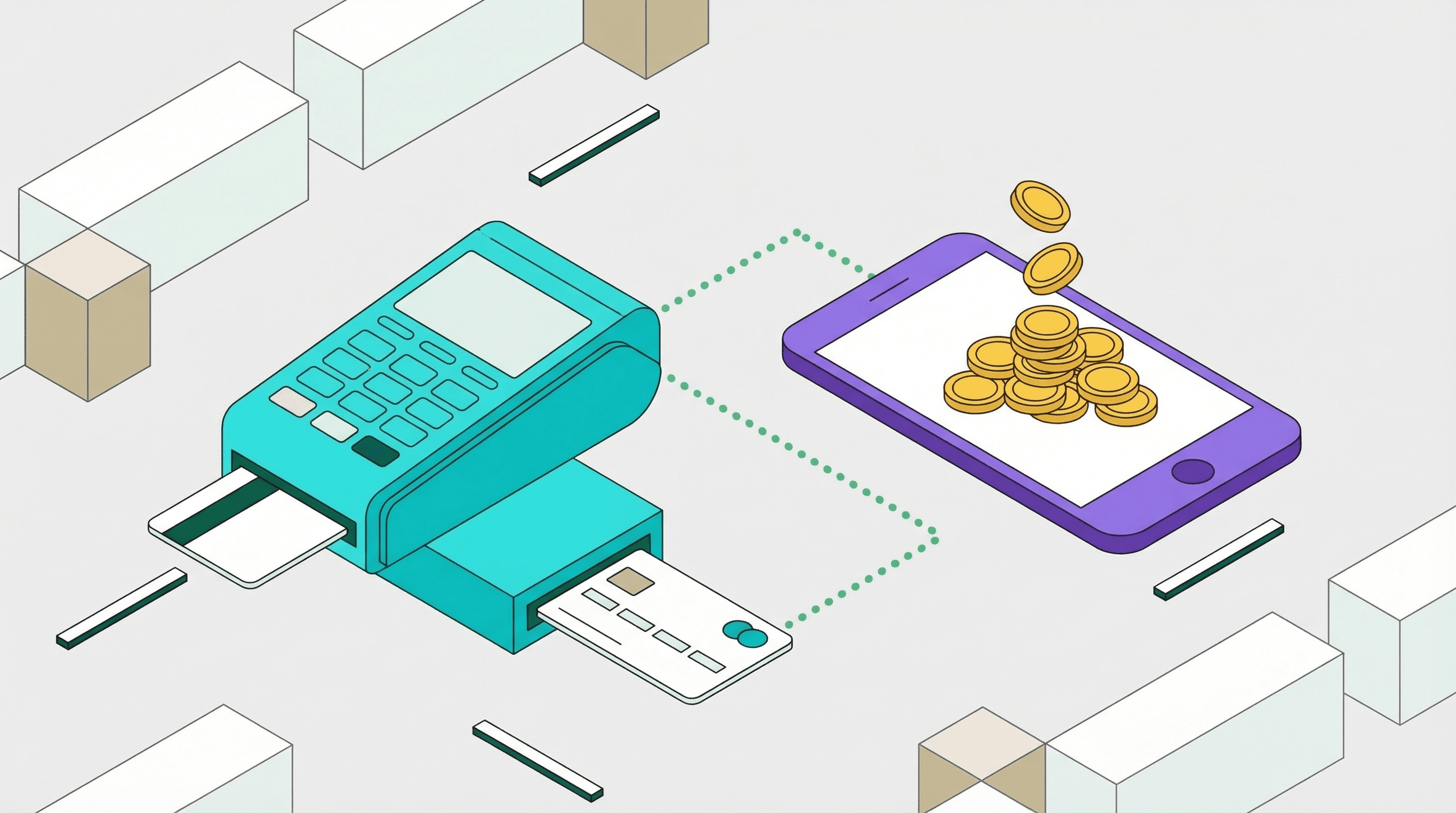
Every time you tap a credit or debit card, a complex financial engine shifts into gear. While consumers rarely notice them, interchange fees are the invisible drivers of the global payment economy.
Interchange fees are paid by the merchant’s bank to the cardholder’s issuing bank on each purchase. According to Stripe, they often make up 70% to 90% of total processing fees, supporting issuer fraud costs, handling, and rewards.
This article explores how interchange functions within the clearing cycle, who earns these fees, and how they fund popular cashback programs. You will also learn how blockchain rails offer a modern alternative to this legacy model. Keep reading to master the economics of modern payments.
Key Takeaways
Interchange fees are a major revenue stream for card issuers, accounting for the majority of the total "swipe fees" that merchants must pay to accept digital payments.
The "rewards paradox" creates a hidden wealth transfer, as merchants often raise retail prices for all customers to cover the costs of the rewards earned by premium credit card users.
Stablecoin and blockchain rails present a structural challenge to this model, offering near-instant settlement and significantly lower fixed costs compared to traditional card networks.
The Fee You Never See When You Tap Your Card
What Happens in Milliseconds at the Point of Sale
Authorization, Clearing, and Settlement in Simple Terms
The transaction lifecycle begins with authorization, where the issuer approves the purchase based on available funds. The clearing stage is the critical phase where interchange fees are calculated and deducted by the issuing bank. Settlement occurs when the actual transfer of funds is completed.
Where Interchange Sits in the Transaction Flow
Interchange is not a separate charge added to the consumer's bill but is deducted during the clearing phase of a transaction lifecycle. This ensures the issuing bank is compensated before the merchant gets their final payout. This flow maintains liquidity and balance of the four-party card model.
Why Interchange Is Invisible to Consumers
Merchant Pricing vs Cardholder Pricing
Interchange fees are not itemized on consumer receipts because they are part of the Merchant Discount Rate, a cost borne by the business. The consumer pays the final retail price while the merchant covers the processing fees as a standard operational expense for accepting digital payments.
How Fees Are Embedded Into Retail Costs
Because interchange can be as high as 3.0%, merchants typically pass these processing costs on to all customers through higher prices. This creates a system where the "hidden" fee is baked into the cost of goods, making it invisible at the point of sale but present in every price tag.
Who Pays Interchange
The Merchant’s Role in Funding Card Acceptance
Merchant Discount Rate Breakdown
The Merchant Discount Rate (MDR) is the total fee a business pays to its "acquirer" or payment processor. Interchange fees represent the largest portion of the MDR, often 70% to 90% of the total cost, with the remainder going to card networks and the payment processor for their services.
Interchange vs Processor and Network Fees
While interchange goes to the card issuer, other entities also take a cut. The card network charges assessment fees, and the payment processor adds a markup for hardware and software services.
Under a "Blended" pricing model, these three distinct costs are bundled into one flat percentage for the merchant.
How Interchange Varies by Card Type and Region
Credit vs Debit Economics
Interchange rates are not uniform and fluctuate based on the perceived risk and cost of the card used. Credit card interchange is significantly higher than debit cards, often ranging from 1.5% to over 3.0%, whereas debit fees are often capped by regulations like the Durbin Amendment in the U.S.
Domestic vs Cross-Border Transactions
When a card is used outside its home country, costs increase significantly due to currency conversion and fraud risks.
Visa U.S.A. international transaction rates can reach 2.00% for Infinite cards, reflecting the added complexity and premium pricing applied to cross-border commerce by major card networks.
Who Collects Interchange
The Issuing Bank’s Central Role
Risk, Underwriting, and Credit Provision
The issuing bank collects interchange to compensate for the financial risks of credit lending. These fees cover operational costs of handling the transaction and the risk of funding cardholder purchases before the customer actually pays their monthly bill, providing a buffer for the bank.
Fraud Management and Compliance Costs
Banks use interchange revenue to build and maintain sophisticated security infrastructure. A portion of every fee is allocated to managing potential fraud risk, allowing the issuing bank to absorb losses from unauthorized transactions and maintain the integrity of the broader payment ecosystem.
The Card Network’s Pricing Influence
Rate Setting and Fee Schedules
Card networks like Visa and Mastercard do not collect the interchange fee themselves, but they hold the power to set the rates. The networks publish complex "Interchange Reimbursement Fee" schedules that dictate exactly how much a merchant must pay based on industry, card type, and data quality.
Competitive Dynamics Among Networks
Networks compete for "share of wallet" by setting attractive interchange rates for banks. Higher interchange rates incentivize banks to issue a specific network's cards, but this power is increasingly checked by global regulators who view these high fees as a burden on the general economy.
How Interchange Funds Cashback Programs
Rewards as a Revenue-Sharing Model
From Merchant Fee to Cardholder Perk
The "rewards paradox" stems from the fact that your "free" cashback is funded by the merchant's fees. Interchange revenue is the primary source used by issuing banks to fund rewards programs, effectively acting as a marketing expense subsidized by the merchant on every transaction.
Economics of Points, Miles, and Cash Rewards
Issuers use high-interchange credit cards to attract high-spend users. This creates a wealth transfer where cash and debit users indirectly subsidize the rewards earned by premium cardholders, as the higher costs of credit acceptance are spread across the prices paid by every consumer in the store.
Sustainability of Reward Programs
Interchange Caps and Regulatory Pressure
Regulators worldwide are increasingly capping these fees to protect merchants and lower consumer prices. In the European Union, interchange is capped at 0.2% for debit and 0.3% for credit, a move that has historically led to reduction or elimination of generous cardholder rewards in those regions.
Premium Cards and High-Spend Users
Despite regulation, premium cards continue to command higher fees to support elite perks. Cards like Visa Infinite or Mastercard World Elite carry higher interchange rates, as networks argue these users bring more value to merchants, justifying the higher cost of acceptance required to fund rewards.
Interchange in a World of Stablecoin Payments
How Blockchain Rails Change Fee Structures
Network Costs vs Card Fees
Blockchain technology introduces a fundamentally different economic model for moving money.
Instead of percentage-based interchange fees, blockchain networks typically use fixed or basis-point fees, which can drastically reduce the cost of acceptance for merchants compared to the 1.5% to 3.0% legacy average.
Real-Time Settlement and Liquidity Impact
Traditional card networks typically settle funds in one to two days, creating a cash-flow lag for businesses.
Blockchain systems offer near-instant, real-time settlement, which significantly improves merchant liquidity by providing immediate access to capital without waiting for the legacy clearing cycle to conclude.
The Future of Rewards Without Interchange
Alternative Incentive Models
As high interchange fees face pressure, new loyalty models are emerging onchain. When payments settle over blockchain rails, the merchant and customer can transfer value directly through the network rather than relying on an issuing bank to move funds and fund rewards.
Merchants can offer token-based incentives or discounts while retaining more of the transaction value.
Merchant-Funded vs Protocol-Funded Rewards
Future rewards may not rely on "swipes" at all. Protocol-level incentives, such as fee rebates or yield-based loyalty programs, allow the payment rail itself to reward users. This shifts the cost away from the merchant's margin and toward a self-sustaining ecosystem built on digital asset liquidity.
The Shift Toward Modern Payment Rails
Interchange fees have served as the foundation of the card industry for decades, powering everything from bank operations to the "free" travel miles in your wallet.
However, the $236B in annual U.S. card “swipe fees” represents a significant friction point for commerce. (CMSPI State of the Industry Report, 2024)
As transparency increases and regulatory caps become more common, the traditional model of high-margin interchange is being challenged by more efficient technologies.
By moving toward faster settlement and more transparent network fees, some payment systems are shifting away from opaque, layered cost structures. Where blockchain rails are used, value transfer can be more directly traceable and easier to automate in software.