USD₮ is the largest stablecoin in the world with 58% dominance. It’s used on several blockchains, and the network you choose determines the speed and cost of transfers and the apps that support USD₮.
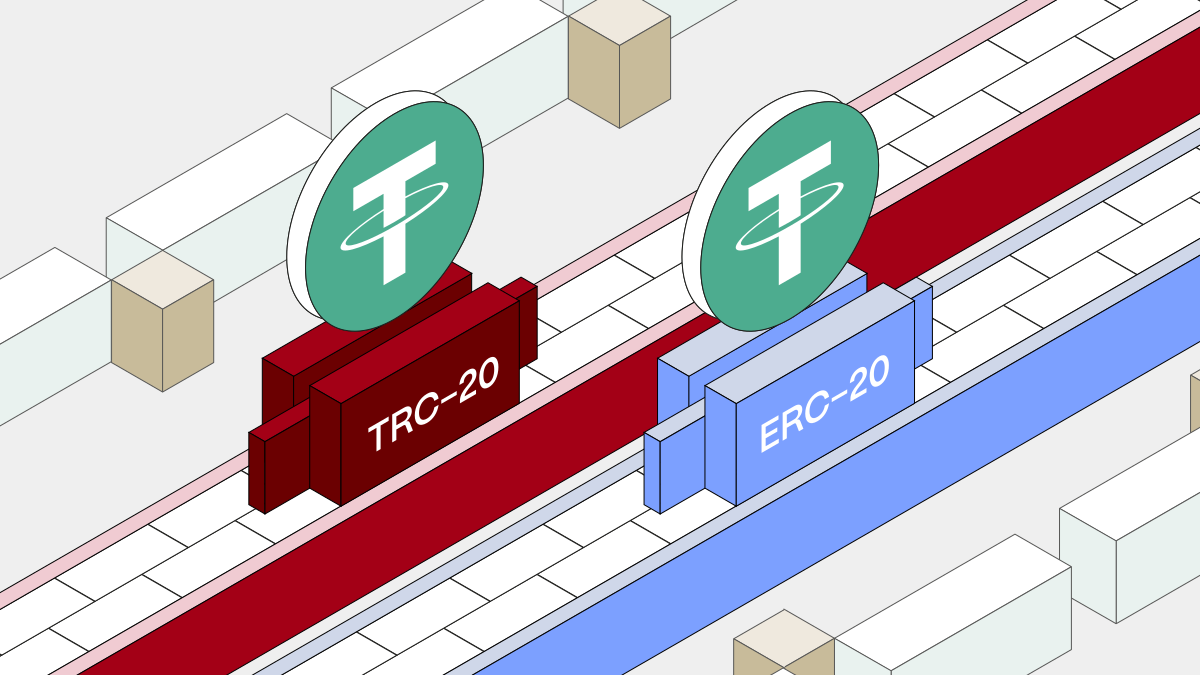
USD₮ token standards are ERC-20 on Ethereum and TRC-20 on TRON. The main differences between TRC-20 and ERC-20 are:
Blockchain design and ecosystem
Transaction speed and confirmation times
Fees and how they are calculated
Network compatibility with apps and bridges
This guide compares ERC-20 vs TRC-20 on fees, speed, security, and support. By the end, you will know when ERC-20 fits best, when TRC-20 shines, and how Plasma is laying a modern path for stablecoin payments at scale.
Key Takeaways
ERC-20 offers deep security, broad DeFi reach, and strong institutional tooling for complex flows.
TRC-20 prioritizes low fees, fast settlement, and wide exchange support for routine transfers.
For payments, picking the right rail improves cost predictability, user experience, and operational reliability.
Understanding Token Standards
What is a Token Standard?
A token standard is a shared rulebook that defines how a token behaves on a blockchain. It specifies the functions that all tokens must provide, like how to transfer tokens, how to approve another account to spend on your behalf, and how apps can read balances.
Because wallets and exchanges can rely on the same interface every time, standards make tokens easier to support and safer to integrate. On Ethereum, that standard is called ERC-20, which has become the template for fungible tokens.
Standards matter for beginners because they reduce surprises. If two tokens both follow the same interface, your wallet knows how to show balances, your exchange knows how to process deposits, and dApps know how to connect.
Without a standard, every new token would require custom code, and basic actions like sending funds would be fragile or inconsistent. With standards, developers build once and reuse across many apps, which is why the ERC-20 and TRC-20 names appear so often.
How ERC-20 and TRC-20 Fit Into the Blockchain Ecosystem
ERC-20 lives on the Ethereum network, which hosts a large and mature ecosystem of wallets, decentralized exchanges, lending markets, custody providers, and developer tools.
That ecosystem makes ERC-20 tokens like USD₮ easy to plug into advanced financial workflows, structured settlement, and programmable payments. As a result, many institutions and app developers default to ERC-20 when they need maximum composability.
TRC-20 lives on the TRON network. TRC-20 mirrors the ERC-20 interface and method names, which lowers the learning curve for developers and makes wallet and exchange integrations straightforward.
For end users, the experience is familiar: you can send, receive, approve spending, and check balances the same way, but with a fee and performance profile that often suits high-frequency, lower-value transfers.
Overview of USD₮ ERC-20
Ethereum Blockchain and the ERC-20 Standard
Ethereum is a smart-contract platform that introduced general-purpose programmability for money. The ERC-20 standard defines the basic functions and events a fungible token must implement.
Because this interface is public and stable, wallets, exchanges, and dApps can interact with any ERC-20 token using the same calls. That consistency is why ERC-20 became the default for many stablecoins and utility tokens.
On Ethereum, every transaction consumes gas, which represents the computational work validators perform. Users pay fees in ETH. Since the EIP-1559 upgrade, each block includes a base fee that is burned and a separate priority fee (a tip) that you can add to encourage faster inclusion.
Wallets estimate fees based on recent blocks, so even if you are new to crypto, you can usually accept the default estimate and get a reliable result.
Key Features and Functionality
Smart Contracts and dApp Compatibility
ERC-20’s power comes from composability. The same token can move through a decentralized exchange, a lending market, and a payment splitter without changing its code.
Because thousands of apps on Ethereum are built to the same standards, developers can stack building blocks and create new products quickly. For users, that means USD₮ on ERC-20 plugs into almost every tool you might want to try, from basic swaps to automated portfolio strategies.
Security and Decentralization
Ethereum’s validator set and its culture of standardization prioritize security and decentralization. The ERC-20 specification is public and widely reviewed. Surrounding documentation, audits, and best-practice libraries help reduce implementation errors.
If you plan to use USD₮ inside complex apps or want the broadest choice of security-minded providers, this emphasis can be a major benefit.
Wallet and Exchange Support
Because ERC-20 is the oldest and most widely adopted fungible token standard, support is near universal across major wallets, exchanges, and custodians.
For many users, this means predictable deposit routes, easy fiat off-ramps, and a large set of bridges and aggregation tools. If you need the widest set of integrations, ERC-20 is often the path of least resistance.
Overview of USD₮ TRC-20
TRON Blockchain and the TRC-20 Standard
TRON implements the TRC-20 standard, which intentionally mirrors ERC-20. The method names and events are familiar, so both developers and integrators can support TRC-20 tokens like USD₮ with minimal friction.
The network is designed to deliver fast confirmations and low costs in typical conditions, which is why many users pick TRC-20 for frequent transfers and exchange flows.
TRON manages network usage through a resource model built on Bandwidth and Energy. Bandwidth corresponds to the size of a transaction in bytes. Energy measures the computation needed to run contract code.
TRX is the native cryptocurrency of the TRON blockchain. Users can stake TRX to obtain resources, or they can pay in TRX when they do not have enough. This model gives apps and users knobs to control costs, and it is one of the reasons TRC-20 transfers are often affordable.
Key Features and Functionality
Transaction Speed and Scalability
TRON aims for quick confirmation in normal conditions. While actual times depend on network load and application settings, the combination of a delegated validator design and the resource system helps keep throughput steady for routine transfers.
That is appealing when you need to move USD₮ between venues without waiting long.
Low Fees and Cost Efficiency
Because simple transfers mainly consume Bandwidth and contract calls consume Energy, fees remain accessible for many use cases. Power users and apps can stake TRX to acquire resources, which lowers marginal costs for repeated transactions.
This design helps keep day-to-day expenses predictable and is one of the reasons TRC-20 is popular for payouts and remittances.
Wallet and Ecosystem Support
TRC-20 enjoys extensive support at centralized exchanges and many retail-friendly wallets. The interface is compatible with ERC-20 concepts, so the onboarding curve is gentle.
For beginners, this means you can learn one mental model for sending and receiving USD₮ and apply it on TRON as well as Ethereum.
Example:
Action | Resource Used | Typical Cost Model |
Sending TRX | Bandwidth | Free if you have enough BP; else burns TRX |
Calling smart contract | Energy | Uses Energy; burns TRX if insufficient |
Storing data | Storage | Costs TRX based on size |
Summary:
Resource | Purpose | How to Get | Cost if Insufficient |
Bandwidth | Transactions | Free daily or freeze TRX | TRX burned |
Energy | Smart contracts | Freeze TRX | TRX burned |
Storage | Data onchain | Pay TRX | Pay TRX |
ERC-20 vs TRC-20: Key Differences
Blockchain Technology and Ecosystem
The biggest difference sits under the hood. Ethereum prioritizes general-purpose programmability, a large independent validator set, and a culture of formal standards that underpin a deep developer ecosystem.
This attracts high-value applications and complex financial workflows that take advantage of composability.
TRON prioritizes throughput and cost efficiency, with a resource model that keeps basic transfers accessible for everyday use. For most beginners, both move USD₮ reliably, but the surrounding ecosystems serve slightly different needs.
Transaction Speed Comparison
Speed depends on how busy the network is, how your wallet sets fees, and how many confirmations your destination requires. On Ethereum, the EIP-1559 fee market helps wallets choose sensible fees, but confirmation time can vary during peak demand because blocks have limited capacity.
On TRON, the delegated design and resource system aim to keep confirmations quick in typical conditions. In practice, both networks are fast enough for most retail transfers, but TRC-20 often feels more immediate for small, frequent sends.
Transaction Fees and Gas Costs
On Ethereum, you pay in ETH for the gas your transaction consumes. The base fee adjusts up or down depending on recent block usage, and you can add a small priority fee to speed inclusion.
This mechanism is transparent and well documented, which is helpful for new users, even if fees rise during busy periods.
On TRON, you either consume Bandwidth and Energy that you already hold through staking, or you pay TRX to cover what you lack. Many users find this approach keeps average costs low for simple transfers.
Network Compatibility and Interoperability
ERC-20 has the longest history in smart-contract finance, which translates into wide compatibility with wallets, custody providers, DeFi protocols, and cross-chain bridges. If your USD₮ flow touches advanced apps, the odds are good that ERC-20 support is already battle-tested.
TRC-20 has strong exchange support and simple wallet flows that are friendly for deposits and withdrawals. If your main action is getting funds on and off venues quickly, TRC-20 usually fits well.
Security and Decentralization
Security comes from more than code. It also comes from how many independent actors maintain the network, how standards are reviewed, and how mature the tooling is. Ethereum emphasizes decentralization and standards-driven development, which is attractive for complex or high-value activity.
TRON emphasizes efficiency and user-visible performance, which is attractive for high-frequency transfers where each cent matters. For beginners, the practical tip is to use trusted wallets, double-check addresses, and keep allowances modest on both networks.
Use Cases and Ideal Scenarios
Choose ERC-20 if you plan to plug USD₮ into a wide range of onchain applications. That includes decentralized exchanges, lending and borrowing, automated strategies, and multi-sig treasury operations. The ERC-20 interface is the bedrock of these tools, and it is supported everywhere you would expect.
Choose TRC-20 if your focus is sending USD₮ to people or venues frequently and at low cost. TRC-20’s resource model helps keep fees down, and its exchange support makes routine deposits and withdrawals straightforward.
Dimension | ERC-20 (Ethereum) | TRC-20 (TRON) |
Ecosystem | Programmable, standards-driven, large validator set; rich dev/composable apps. | Throughput + cost focus; simple, accessible transfers. |
Speed | Consistent but can slow at peaks (block limits, EIP-1559 fees). | Typically quick confirmations for small, frequent sends. |
Fees | Pay gas in ETH; transparent but can spike when busy. | Use Bandwidth/Energy or pay TRX; usually cheaper for basics. |
Compatibility | Widest support across wallets, DeFi, bridges; battle-tested. | Strong exchange support; smooth deposits/withdrawals. |
Security/Decentralization | Highly decentralized; mature standards/tooling for high value. | Efficient design; solid for high-frequency, low-cost moves. |
Best Use | Integrating USD₮ into DeFi, DEXs, lending, treasuries. | Low-cost USD₮ transfers and quick venue on/off-ramps. |
Practical Considerations for Choosing Between ERC-20 and TRC-20
When to Prefer ERC-20
Pick ERC-20 when you want the deepest pool of integrations and the most mature set of developer tools.
If you expect to use USD₮ inside DeFi, to set up scheduled payments controlled by smart contracts, or to maintain an onchain treasury with multiple signers and policies, Ethereum’s ecosystem gives you a long list of ready-made options.
The documentation, standards process, and libraries are extensive, which lowers risk for both developers and users.
An easy way to think about ERC-20 is as the “maximum compatibility” option. If someone builds a new DeFi app, the odds are high it supports ERC-20 on day one. If your USD₮ needs to touch several apps before it reaches its destination, staying on ERC-20 can reduce friction.
When to Prefer TRC-20
Pick TRC-20 when low cost and speed are your top priorities. If you send USD₮ often, if your amounts are small, or if you mostly move funds between exchanges and retail wallets, TRC-20 is often the practical choice.
Because simple transfers mostly consume Bandwidth and not complex computation, you avoid paying for features you are not using. If you run a payout flow or support users in regions where every cent counts, these small savings add up.
A simple mental model is that TRC-20 is designed to feel fast and inexpensive for common actions. You still need to check that your destination supports TRC-20 deposits, but most major venues do.
Cross-Chain Transfers and Conversion Options
Because USD₮ exists on more than one network, you can often switch rails by withdrawing on a different chain from the same exchange account. Many venues support ERC-20 and TRC-20 side by side.
If you need to move funds from an app on Ethereum to a retail wallet that prefers TRON, one path is to deposit to an exchange that supports both chains and withdraw on TRC-20. Always verify the correct deposit address format and network selection before sending.
For up-to-date issuance and chain availability, Tether’s Transparency page publishes current metrics.
If you want to bridge directly between chains without using an exchange, research the bridge’s security model and track record. The ERC-20 and TRC-20 standards focus on token behavior on their native chains, not on how assets move between chains.
Bridges add separate risk. Beginners should start with simple deposit-withdrawal flows before exploring third-party bridging tools.
Plasma Blockchain
Plasma is a blockchain network built for stablecoin and digital dollar payments. Its goal is to make onchain money movement as easy and trusted as sending a text via sub-second finality.
Where ERC-20 and TRC-20 were designed as general-purpose token standards for their respective chains, Plasma starts with the payments problem and optimizes for it directly.
The focus is on high throughput, low and predictable fees, and a regulatory-ready design that helps businesses and institutions move money with confidence.
Think of Plasma as a payments-first rail. It is built to carry stablecoins at scale, so settlement is fast, fees are simple to understand, and the network is tuned for the kinds of transfers people do every day.
If you are evaluating ERC-20 vs TRC-20 from a payments point of view, you may find that Plasma gives you a third option that aligns more closely with how merchants, fintechs, and platforms actually move funds.
Instead of choosing between deep DeFi composability and low-cost retail flows, Plasma aims to provide both speed and certainty.
Plasma does not replace USD₮ on Ethereum or TRON; it complements them by providing a purpose-built path for stablecoin transfers. If your priority is predictable settlement time, transparent costs, and an ecosystem built around compliance and payments, Plasma might be exactly what you’re looking for.
Conclusion
Choosing ERC-20 vs TRC-20 for USD₮ is simpler when you map the rail to the job. If you need maximum compatibility with dApps, advanced treasury tools, and a large ecosystem of DeFi building blocks, ERC-20 on Ethereum is the natural default.
If you need fast, low-cost transfers for deposits, withdrawals, payouts, or remittances, TRC-20 on TRON often delivers a smoother day-to-day experience. Many users rely on both, switching rails as the task changes.
If your focus is payments, you may want something designed for that specific job. Plasma targets sub-second finality to make stablecoin transfers instant, affordable, and predictable, complementing ERC-20 and TRC-20 options and built to move money with the speed and certainty of the internet.