How DeFi Vaults Work: The Infrastructure Abstracting Onchain Yield
Onchain capital management is evolving as institutions and consumers seek secure, automated ways to capture yields without navigating the manual complexities of fragmented liquidity protocols.
DeFi vaults are non-custodial smart contract infrastructures that pool user capital to execute yield-generating strategies across decentralized protocols while abstracting away technical complexity.
In this article, you will learn what vaults are, how they work, and how Veda’s BoringVault architecture provides the foundational rails necessary for institutional and consumer adoption.
Key Takeaways
Modular architecture separates fund custody from strategy logic to minimize the attack surface.
Merkle tree verification enforces programmatic whitelists, ensuring funds only interact with pre-approved protocols.
Vault infrastructure enables "one-click" yield access for retail and institutional users.
The Problem Vaults Are Designed to Solve
Direct DeFi Interaction Is Too Complex for Most Users
Without vaults, generating yield requires users to independently manage collateral, monitor debt ratios, and execute multiple transactions across different platforms, which creates a significant cognitive barrier.
These complexities, including setting slippage or managing private keys across several protocols, can lead to permanent capital loss for non-expert participants who fail to navigate the fragmented landscape correctly.
The Risk of Manual Strategy Execution
User execution is prone to human error and private key exposure, especially when handling high-frequency rebalancing.
Each step, such as moving assets between Aave and Curve, increases the risk of interacting with malicious contracts or being harmed by protocol-level exploits that can impact users interacting with affected pools/contracts.
Without professional infrastructure, users are exposed to "black box" risks and the high gas costs associated with executing complex, multi-step trades.
Capital Efficiency Versus Security Trade-offs
There is an inherent trade-off in DeFi where high capital efficiency often requires complex, risky strategies. To maximize returns, users must interact with multiple protocols frequently, but this increases the attack surface and logic risk of the smart contracts or manual processes being used.
This can result in users resorting to static strategies that are easy to audit but that cannot adapt to changing market conditions.
Advanced architectures aim to bridge this gap by isolating the core fund-holding contract while delegating complex execution to modular, programmatically restricted components.
What Is a DeFi Vault?
The Basic Concept: Pooled Capital with Curated Strategies
A DeFi vault is a smart contract designed to pool capital from multiple users to execute complex yield strategies according to specified parameters.
Instead of managing assets individually, users deposit funds into the vault and receive redeemable vault tokens that act as an onchain receipt representing their proportional ownership of the underlying pooled capital.
The core value of a vault lies in its ability to reduce transaction costs and automate rebalancing while minimizing exposure limits. By pooling assets, a vault can execute large-scale movements that would be too expensive for individual retail users to perform due to high Ethereum or Layer 2 gas fees.
How Vaults Differ from Simple Staking
Unlike simple staking, which involves locking a single asset to earn protocol-defined rewards, Veda vaults can deploy assets across numerous yield-generating DeFi protocols.
While staking is often a static "set and forget" action, vaults interact with lending markets, DEXs, and yield aggregators using a transparent, non-custodial structure to optimize for the best returns.
Yield in a vault is typically reflected in the increasing Price Per Share, rather than direct token distributions. This means that as the vault's strategies generate profit, each share becomes redeemable for a larger amount of the underlying asset over time, providing a streamlined accounting model.
The Evolution from Yield Farming to Vault Infrastructure
Vault design has evolved toward standardization, modularity, and security. This evolution reflects lessons from complexity, opacity, and exploit-driven losses.
Early Vault Models and Their Limitations
First-generation vaults (e.g., early Yearn vaults) focused on comparatively simpler strategy sets and fewer integrated venues than many modern designs.
These early models were limited in scope and could only shift funds between a few established platforms like Aave or Compound without executing more complex maneuvers.
What Second-Generation Vaults Improve
Second-generation vaults introduced multi-strategy capabilities, allowing for dynamic interactions across dozens of protocols simultaneously.
However, these were often monolithic "black boxes" that lacked transparency, making it difficult for auditors to fully vet the complex internal logic and hidden risks.
How Veda's BoringVault Architecture Works
The Philosophy Behind "Boring" Infrastructure
The BoringVault philosophy prioritizes minimizing the attack surface by keeping the core custody contract extremely simple.
By reducing the central vault contract to approximately 100 lines of code, Veda ensures that the primary layer holding funds is non-upgradeable, auditable, and inherently secure.
Core Components of the BoringVault System
BoringVault is a modular system with a vault, a user entry layer, an accounting source of truth, and a strategy manager. The key modules are BoringVault, Teller, Accountant, and Manager.
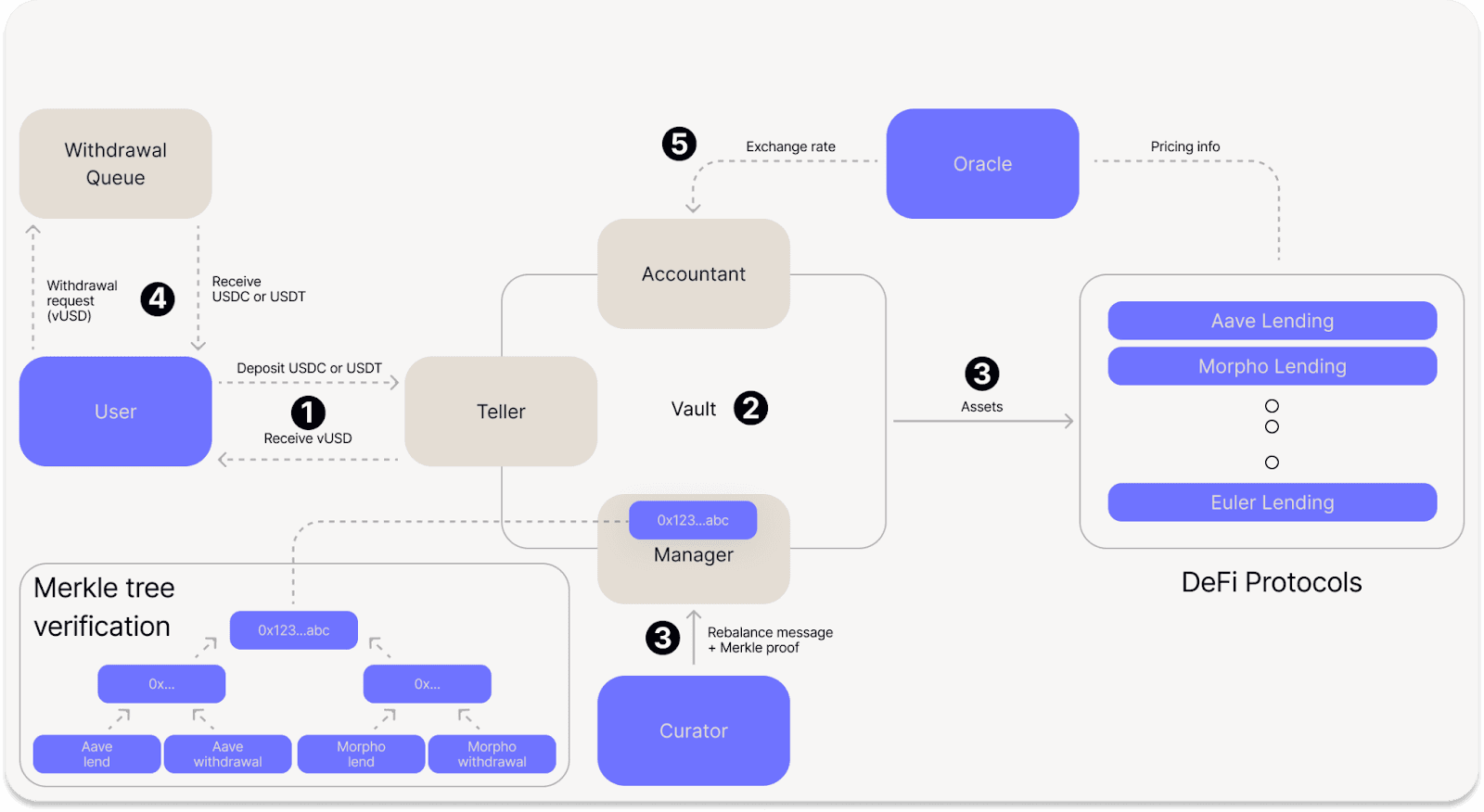
Veda’s modular vault architecture, showing deposits, custody, Merkle-verified strategy execution, withdrawals, and exchange-rate updates.
Smart Contract Architecture
The BoringVault contract holds assets without being bogged down by complex logic.
It delegates specialized tasks, such as rebalancing or user deposits, to discrete, external modules like the Teller, Accountant, and Manager to maintain a clean separation of concerns.
Strategy Management Layer
The strategy management layer is governed by the ManagerWithMerkleVerification contract, which restricts all actions to a pre-approved whitelist.
This programmatic control ensures that even if a strategist's key is compromised, they cannot move funds to unauthorized addresses outside the verified Merkle tree.
Asset Flow and Rebalancing
Asset rebalancing occurs through the Manager, which assigns a merkle root to a strategist address to define the transaction types they can execute on behalf of the vault. Veda may curate and maintain strategy parameters, or these can be managed by 3rd party curators. The private keys remain owned by the end-users via a non-custodial smart contract framework.
This ensures that every move, whether supplying to Aave or providing liquidity to Uniswap, matches a specific, pre-authorized leaf in the strategy's security tree.
How Deposits and Withdrawals Are Processed
Users interact with the Teller contract, which serves as the professional entry point for all deposits. The Teller mints shares at a rate provided by the minter, while the Accountant sets exchange rates subject to a minimum update delay.
Withdrawals are managed through the BoringQueue, a system that implements a time-delayed, solver-based process.
This withdrawal queue introduces a configurable maturity delay and uses third-party solvers to fulfill redemptions only after maturity, which helps mitigate timing-based MEV/arbitrage by separating the withdrawal request from its execution.
Yield Generation and Distribution Mechanics
Yield is accrued by increasing the value of vault shares rather than through direct payouts.
The Accountant contract acts as the source of truth, calculating the exchange rate using offchain computation with onchain safeguards like bound limits and rate limits to prevent extreme, malicious price jumps.
Merkle Tree Security: How Veda Restricts Vault Actions
What Merkle Trees Are and Why They Matter
Merkle trees are used to enforce granular permissions by whitelisting every allowed vault action.
The Data Structure Explained
A Merkle tree is a cryptographic data structure where every "leaf" represents a specific transaction. This includes the target address, function selector, and arguments, allowing the system to collapse a massive whitelist into a single cryptographic hash known as the Merkle root.
Cryptographic Verification Without Full Disclosure
Merkle trees allow for efficient onchain verification by providing a "proof" that a specific action exists within the root. This means the vault can enforce a complex whitelist of thousands of allowed actions without storing the entire list onchain, saving gas while enforcing policy constraints efficiently onchain.
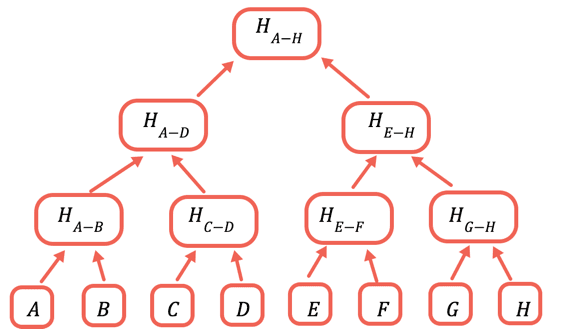
Merkle tree diagram showing leaves and hashed parent nodes up to a single Merkle root.
How Veda Uses Merkle Trees for Permissioned Actions
Veda’s manager with Merkle verification makes strategy policy enforceable at execution time. The strategist must supply the Merkle proof for each action, and the contract verifies it onchain.
Whitelisting Allowed Protocols and Strategies
Veda encodes every approved protocol interaction as a leaf in the vault's Merkle tree. If a strategist wants to supply USDC to Aave, the Manager contract must verify that the exact Aave pool address and "supply" function are contained within the audited, pre-approved strategy root.
Preventing Unauthorized Contract Interactions
This mechanism acts as a programmatic guard, designed to restrict fund movements to authorized, audited protocols.
By whitelisting the Target Address, the system prevents unauthorized transfers to incorrect or malicious contracts, even under adversarial conditions where signers might be compromised.
The Security Model: Protection Against Exploits
The Merkle-based model protects against "rug-pulls" and strategy drift by making the rules immutable. Because the Manager contract verifies every proof onchain, the Merkle verification design is intended to make it infeasible to divert funds to a non-whitelisted address unless that address was included in the original audit.
How This Differs from Traditional Multi-Sig Approaches
Multi-sig security relies on human signers, making it vulnerable to social engineering or collusion.
In contrast, Merkle-based permissioning is fully automated and programmatic, allowing for high-frequency rebalancing that is far more efficient than waiting for a quorum of humans to manually review and sign transactions.
Why Vault Architecture Matters for Institutions and Consumer Products
Meeting Institutional Custody and Compliance Requirements
Institutions need auditable controls, transparent trails, and strong operational security before deploying capital onchain. Vault infrastructure is designed to provide these properties without requiring each institution to build bespoke systems.
Audit Trails and Transparency
Institutions require fully auditable transaction trails to satisfy regulatory and compliance frameworks.
Veda’s architecture provides an immutable onchain record where every rebalancing action is verifiable against the Merkle whitelist, supporting transparency into how institutional capital is being deployed.
Risk Management at the Infrastructure Level
Modular vault layers provide the non-custodial risk management that institutions demand.
By isolating assets in a "boring" contract and enforcing policy controls through code rather than human trust, the system creates the safety and predictability required for large-scale capital deployment onchain.
Enabling Consumer Apps to Offer Yield Without Complexity
Fintech apps and neobanks can use Veda as an "embedded finance" layer to offer one-click yield to users. Platforms like Binance and Kraken use this infrastructure to abstract away the long manual process of yield farming, allowing retail customers to interact with yield-generating protocols.
Capital Efficiency for Stablecoin Treasury Management
Vaults allow corporate treasuries to optimize stablecoin yields with institutional-grade security.
By automating the rotation of assets between lending markets and pools like Curve or Convex, treasuries can enhance capital efficiency while adhering to strict, programmatically enforced risk parameters and whitelists.
Veda's Role in the Broader DeFi Ecosystem
Integration with Other DeFi Protocols
Veda recently achieved a milestone by getting eBTC, a vault token, listed as the first-ever vault collateral on Aave.
This creates deep composability, allowing users to borrow against their yield-bearing vault shares, effectively turning passive yield positions into active, useful collateral for further DeFi strategies.
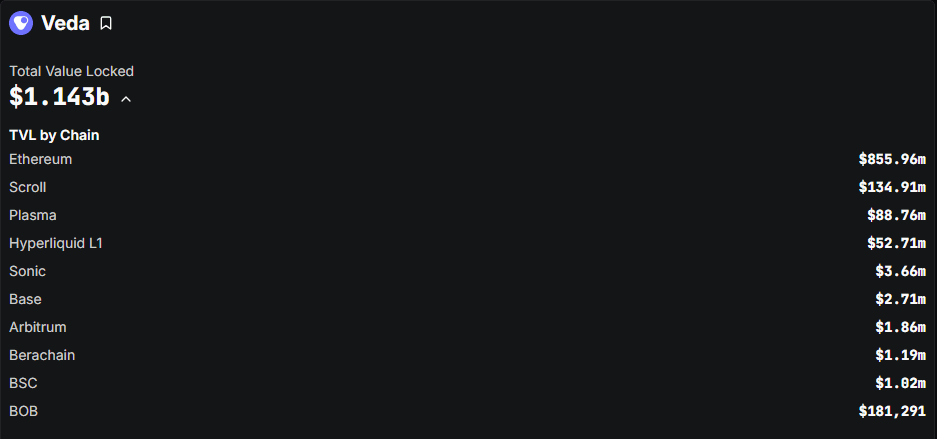
Veda vault usage by chain, based on DefiLlama TVL data (pulled Feb 16, 2026).
How Veda Vaults Connect to Liquidity Sources
The architecture connects to premier liquidity sources including Aave, Pendle, and Uniswap V3.
These integrations allow vaults to source lending yield or earn trading fees through concentrated liquidity positions, ensuring that assets are always deployed where they can generate the most optimized returns.
The Infrastructure Layer Supporting Multiple Use Cases
Veda is positioned as infrastructure that makes existing yield sources accessible, composable, and embedded.
Corporate Treasury Yield
Veda enables companies to earn onchain yield on stablecoin reserves with minimal operational overhead.
The Merkle-tree whitelist gives boards the confidence that treasury funds cannot be moved outside of pre-approved protocols, satisfying internal governance requirements while capturing decentralized market returns.
Embedded Finance Applications
By powering Kraken DeFi Earn, Veda functions as the backend engine for consumer finance. These applications turn complex yield generation into a native feature, attracting users who lack the technical skill to interact directly with raw DeFi protocols.
Institutional Asset Management
Asset managers can use BoringVaults to create bespoke yield products for high-net-worth clients.
This modular setup allows for granular control over which protocols are utilized, providing a transparent and secure "wrap" around decentralized strategies that fits within traditional financial reporting systems.
What Vault Infrastructure Means for the Future of Finance
Bringing Traditional Finance Risk Models Onchain
The establishment of reliable, "boring" infrastructure is the prerequisite for the convergence of TradFi and DeFi.
By providing the audit trails and policy controls that professional firms expect, Veda allows traditional risk models to be applied to the high-yield opportunities found in the onchain economy.
The Convergence of TradFi and DeFi Yield Products
As real-world assets (RWAs) are tokenized, they will require the same secure custody and automated management found in advanced vault architectures.
This convergence is driven by the need for a unified, transparent reporting layer that can handle both crypto-native yields and traditional financial instruments.
Why Boring Infrastructure Enables Exciting Applications
Standardizing on modular, secure vault layers allows developers to focus on building new financial products.
As yield becomes an abstracted, native feature of every digital wallet, the "vaultization" of DeFi will remove the final barriers to entry, enabling a more inclusive and efficient global financial system.
Disclaimer
This article is for educational and informational purposes only. It does not constitute, and should not be construed as, investment advice, financial advice, legal advice, tax advice, a solicitation, an offer, or a recommendation to buy, sell, or hold any digital asset or financial instrument. DeFi protocols involve substantial risks, including but not limited to smart contract vulnerabilities, regulatory uncertainty, market volatility, and potential loss of deposited assets. Past performance of any protocol or strategy is not indicative of future results. DeFi products and services may not be available or lawful in all jurisdictions. Readers should conduct their own due diligence and consult qualified professionals before making any decisions.