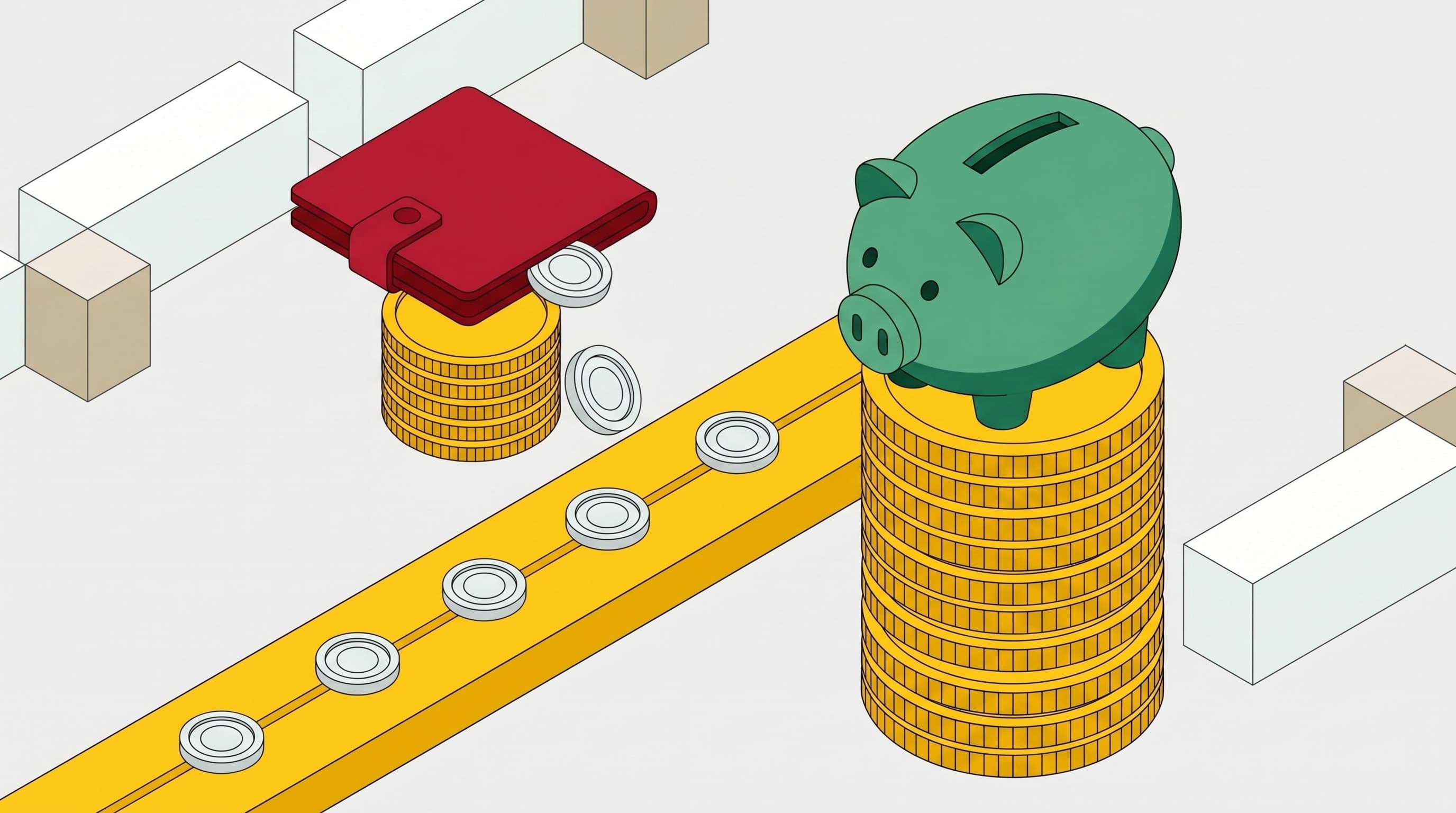
Earning interest is the primary incentive for keeping money in a savings account. It allows your capital to grow over time as a reward for providing the bank with your liquidity.
Savings account interest is calculated using the principal balance, the interest rate, and the frequency of compounding; this is typically standardized through the Annual Percentage Yield (APY) to show true annual growth.
In this guide, you will learn the differences between simple and compound interest, how to use APY for comparisons, and practical tips to boost your earnings. Read on to master your money.
Key Takeaways
Compound interest allows your money to grow faster by earning returns on your previous earnings.
The APY is the standardized metric used to compare different savings products fairly.
Understanding compounding frequency is essential for accurately projecting how much your savings will grow over time.
Understanding Savings Account Interest
What a Savings Account Is and How It Works
When you place funds into a savings account, you are effectively entering into a symbiotic relationship with your bank.
Deposits and How Banks Hold Your Money
Banks act as custodians for your wealth. They keep enough liquidity to meet withdrawals, but deposits are not just stored in a vault; they help fund the bank’s assets and operations. This is what forms the foundation of the bank's operational balance sheet.
How Banks Use Deposits to Generate Loans
Financial institutions use the collective pool of customer deposits to fund loans for other consumers and businesses. By aggregating small amounts from many savers, the bank creates a large capital pool to issue mortgages, auto loans, and business credit.
Why Savers Are Paid Interest
Interest is the payment the bank makes to you for the right to use your deposited funds to facilitate its lending operations. Because the bank earns a higher rate from borrowers than what it pays to you, it can afford to share a portion of that profit as a reward for your liquidity.
Key Concepts Behind Savings Account Growth
Principal, Interest Rate, and Time
Growth depends on the principal (the initial money you deposit), the stated interest rate, and the duration the money remains in the account. Generally, banks employ a daily balance method, applying a daily periodic rate to the account balance each day to calculate interest.
What APY Means and Why It Matters
Annual Percentage Yield (APY) is the annualized yield that reflects compounding and helps estimate one-year earnings under the account’s stated assumptions. It is the most accurate tool for comparing different high-yield accounts.
Simple vs Compound Interest Overview
While simple interest is calculated only on your starting principal, compound interest grows exponentially. This happens because the interest you earn is added back to your balance, allowing you to earn interest on your interest over time, significantly boosting your long-term wealth.
How Savings Account Interest Is Calculated
The Core Formula for Simple Interest
Simple interest is the most basic way to determine how much your money will earn. It assumes you only earn money on your initial deposit, without adding any previous earnings back into the total balance.
Principal × Rate × Time Explained
The formula for simple interest is I = P * r * t. In this equation, the Principal (P) is the amount you start with, the Rate (r) is your annual interest rate as a decimal, and Time (t) represents how many years the money stays in the account.
Example Calculation of Simple Interest
If you place $5,000 in a savings account with a 3% simple interest rate for two years, the math is straightforward: $5,000 * 0.03 * 2. At the end of that period, you will have earned exactly $300 in interest, making your total balance $5,300.
The Compound Interest Formula Explained
P(1 + r/n)^(nt) Breakdown
The technical formula for compound interest is A = P(1 + r/n)^(n*t). Unlike simple interest, this calculation accounts for how your balance grows increasingly larger over each compounding period. Your earnings are regularly added to your principal to build a new, higher base for the next round.
Meaning of Each Variable in the Formula
To use this formula, you need to identify four specific figures:
P (Principal): Your original deposit amount.
r (Rate): The nominal annual interest rate.
n (Compounding periods): How many times interest is added per year.
t (Total years): The length of time you save.
How Compounding Frequency Changes Results
The value of n is critical. If a bank compounds daily (n=365) rather than monthly (n=12), you earn interest on a slightly larger balance every single day. Over time, more frequent compounding leads to higher total returns even if the annual interest rate stays the same.
Using APY to Estimate Real Earnings
Because compounding frequencies vary between banks, looking at the interest rate alone can be confusing. To solve this, financial institutions use the APY.
How APY Reflects Compounding
APY captures both the interest rate and the frequency of compounding in a single percentage. If you deposit $100 in a savings account, APY helps estimate one-year growth under the account’s stated assumptions.
Why APY is Used for Comparing Accounts
APY provides a standardized apples-to-apples metric for savers. Whether one bank compounds daily and another monthly, comparing their APYs allows you to see which account will actually put more money in your pocket by the end of the year.
Simple Interest vs Compound Interest
How Simple Interest Works
Simple interest is calculated exclusively on your initial deposit, meaning the principal amount remains static throughout the life of the account or loan. Since the interest you earn is not reinvested into the base, the amount of money earned each period does not increase.
Interest Based Only on Initial Deposit
In this model, you never earn a return on previous interest earned. If you deposit $1,000 at a 5% simple annual rate, you will earn $50 every year, regardless of how long you hold the account. Your earnings do not grow because the calculation ignores the accumulated value.
When Simple Interest Is Typically Used
In the banking environment for 2024 to 2026, simple interest is not typically used for savings accounts. Instead, it is most commonly found in debt products like auto loans, personal loans, or bridge financing, where the borrower pays interest based only on the original principal.
How Compound Interest Works
Compound interest is the driver behind modern wealth building because it uses a growth model that includes your previous earnings. Unlike simple interest, compound interest is widely used in savings products because it helps balances build more efficiently over time.
Earning Interest on Interest
As interest is added to your principal, the base for the next calculation grows larger. This means you earn interest on your interest, causing your balance to accelerate even if you do not add extra funds. This process turns even small deposits into significant sums over several decades.
Daily, Monthly, Quarterly, and Annual Compounding
Banks use various cycles to add interest back to your account. Daily compounding provides the fastest growth, as it updates your balance every 24 hours. Other accounts may use monthly, quarterly, or annual cycles, which calculate and add your earnings less frequently.
Key Differences Between Simple and Compound Interest
Understanding the mechanics of these two models is vital for long-term planning. While they may look similar in the first few months, the gap between linear and exponential growth widens significantly over the years.
Long-Term Impact on Savings Growth
Compounding creates larger balances over time because each interest payment increases the base for the next one. The gap widens the longer the money stays invested.
For example, with simple interest, the formula is I = P × r × t. A $10,000 deposit at 5% for 10 years earns $5,000, for a total of $15,000. With daily compounding, A = P(1 + r/n)^(nt), the same deposit grows to about $16,486.65.
Why Compound Interest Is More Common in Savings Accounts
Savings accounts are designed to accrue interest over time, and compounding is a practical way to calculate that growth because earned interest is added back to the balance.
Once that happens, future interest is calculated on a larger amount, which reflects how most savings products are structured and disclosed through APY.
How Banks Apply Interest to Savings Accounts
How Interest Is Calculated Daily
Banks usually calculate savings interest using your daily ending balance and a daily periodic rate derived from the account’s annual rate. Each day’s accrued interest is added to a running total, then credited to the account on the bank’s scheduled payout date, often monthly.
Daily Periodic Rate Explained
To understand how your money grows, you must look at the daily periodic rate. Banks calculate this by dividing your annual interest rate by 365 days as mentioned above. This tiny fraction is applied to your precise balance at the end of every single day.
How Account Balances Affect Daily Accrual
Because interest accrues daily, your specific daily balance matters. Even if you withdraw money mid-month, you still earn interest for the exact days those funds were present in the account. This ensures you are rewarded for every 24-hour period your money is held.
When Interest Is Paid Into Your Account
Savings interest may accrue daily, but banks usually post it to your account on a monthly schedule. Once credited, that interest becomes part of your balance, so future interest can be calculated on a slightly larger amount.
Monthly Crediting Cycles
While accruals happen daily, the actual payment usually follows a monthly schedule. Most high-yield savings accounts sum up the total daily interest earned over a month and credit it to your principal balance on your statement closing date.
Differences Between Savings Accounts and Other Deposit Accounts
Savings accounts offer high flexibility compared to other options. For example, a Certificate of Deposit (CD) may only credit interest at maturity, whereas savings accounts provide monthly liquidity.
Factors That Affect Savings Account Interest Earnings
Interest Rates Across Banks
Where you choose to store your money has a massive impact on your wealth building. There is a wide gap between different types of financial institutions.
Traditional brick-and-mortar banks often offer lower rates because they must pay for physical branches and large staff teams.
Online Banks vs Traditional Banks
Online institutions have lower overhead and typically pass these savings to customers via higher APY. The national average rate for savings accounts was hovering around 0.39% according to FDIC data in March 2026.
By contrast, top high-yield savings rates in early 2026 often cluster between 3.3% and 5.0% APY. Choosing an online-first platform often means your money works much harder for you with less operational friction.
Market Conditions and Rate Changes
Most savings accounts offer variable interest rates, meaning they can change at any time. These rates are heavily influenced by Federal Reserve policies. When the central bank adjusts the federal funds rate, commercial banks usually follow suit by raising or lowering the APY on your account.
Fees and Account Conditions
Monthly Maintenance Fees
Monthly maintenance fees can quickly erase the interest earned, especially on smaller account balances. For example, a $10 monthly fee totals $120 per year. If your account only earns $50 in interest, you are actually losing money over time.
Minimum Balance Requirements
Some accounts require a minimum balance to earn the premium APY or waive fees. If your balance dips below this threshold, your interest rate might drop to a lower tier, or you may be hit with a penalty fee that wipes out your monthly gains.
Withdrawal Limits and Restrictions
While savings accounts are for storing money, frequent access can be costly. Many banks still apply monthly transfer limits. If you exceed these activity limits, you may face excessive withdrawal fees, which can be as high as $15 per transaction, depending on the institution.
How to Maximize Savings Account Interest
Choosing the Right Type of Account
Finding the right vehicle for your liquid cash is the first step toward better returns. Not all savings products are built the same; the gap between a standard bank account and a specialized one can result in losing out on passive income.
High-Yield Savings Accounts vs Standard Accounts
A High-Yield Savings Account (HYSA) should be the primary choice for liquid cash and emergency funds. While traditional banks often offer nominal interest rates, some top HYSAs in 2026 are reaching APY levels of 5.0%.
These higher rates are often found at online only banks or through promotional offers that may require specific conditions, such as setting up a direct deposit or maintaining a certain balance cap.
A strong HYSA can help reduce inflation drag, but it does not guarantee preservation of purchasing power.
Comparing APY and Compounding Frequency
When comparing two savings accounts, APY is usually the better benchmark because it already reflects how often interest compounds over a year.
Compounding frequency matters most when two accounts have the same nominal interest rate but different calculation methods.
Smart Saving Strategies
Regular Deposits Over Time
Automating monthly transfers ensures your principal base continues to grow without requiring constant manual effort. By treating your savings like a recurring bill, you benefit from a larger balance for the bank to calculate interest against, which accelerates the compounding effect over time.
Separating Savings Into Goals
Many modern banks allow you to organize funds into buckets or sub-accounts. This strategy helps you track progress for specific short-term goals, such as a vacation or a car down payment.
It provides visual motivation and prevents you from accidentally spending money reserved for specific needs.
Avoiding Unnecessary Withdrawals
Keeping funds in the account allows compounding to stay active on the largest possible balance. Every time you withdraw, you reduce the base amount that earns interest.
By minimizing transfers out of your HYSA, you ensure your interest is calculated on its maximum potential every day.
Conclusion
Understanding how your interest is calculated empowers you to move your money where it works hardest. By prioritizing accounts with high APYs and daily compounding while avoiding monthly fees, you ensure your savings grow reliably.
Whether you are building an emergency fund or saving for a specific goal, the math of compounding is your greatest ally.
While high-yield accounts provide a secure foundation, relying solely on savings for long-term wealth building carries inflation risk. For goals like retirement, many users find balance by combining high-yield savings for liquidity with diversified investments.
For readers interested in digital-dollar alternatives, Plasma One is a product built around saving, spending, sending, and earning in a single app. It ties into our topic here since it offers a different way to manage liquid balances while still keeping funds accessible for everyday use.